
China AI Bubble Bursts: $480 Billion Gone, So Why Is Bitcoin Not Crashing?

0
0

A number has been doing the rounds on social media: a trillion-plus yuan “wiped out from China’s stock market today.” The viral version is wrong. The real version is worse, and it took four months instead of one afternoon.
China’s STAR50 index, the Shanghai board that tracks the country’s AI and semiconductor leaders, has fallen roughly 40% from its July peak, erasing about $480 billion in market value. The blue-chip CSI 300 has slipped into a bear market, down about 20% from its June high, and on Tuesday it hit a 14-month low as tech selling deepened yet again. Reuters put it plainly this week: in China, the AI bubble has already burst.
So what actually happened, and why is crypto barely blinking?
What Caused the China AI Stock Crash?
The uncomfortable answer is that nobody can point to a single trigger. There was no fraud, no scandal, no surprise rate hike. There was simply too much money chasing too few profits.
A few ingredients combined:
- Valuations with no floor. Even after a 40% fall, the STAR50 still trades at roughly 100 times past earnings. The Nasdaq 100, for comparison, trades at around 30 times. That tells you how far the index had run, and how far it can still fall before anyone calls it cheap.
- A market that was all AI. According to Goldman Sachs, AI-linked stocks made up 42% of China’s total market capitalisation and 57% of daily turnover at the peak. When one sector is more than half of all trading, there is no diversification. If AI sneezes, the whole market catches the flu.
- Retail-driven mania. China’s A-share market is dominated by small investors, and a large chunk of the rally was built on enthusiasm for anything wearing an AI label, regardless of revenue. One Beijing fund manager described it as a market that turned into a “speculative crazy bull” before the bubble popped.
- Geopolitics and export curbs. Fears that the US or allied countries could ban Chinese equipment in data centres, plus widening US restrictions on tech investment, removed one of the sector’s biggest growth stories.
- Beijing pulling the punch bowl. On October 9, Chinese regulators issued guidelines explicitly aimed at preventing investment bubbles in “new productive forces,” a category that includes AI. Markets took the hint.
- Tax bills and tired buyers. Traders also cited end-of-period tax liabilities and a simple lack of fresh capital after the summer surge.
The irony is thick. The Chinese government spent years nudging households to move savings into equities. The result was a boom it then had to talk down, and a bust that is now punishing exactly the retail investors it wanted to attract.
Is the AI Bubble Bursting in the US Too?
Not yet, and the gap matters. While Chinese AI stocks were collapsing, the Nasdaq saw a drawdown of only around 6% from its record high three weeks ago.
The difference is what the money was buying. US AI spending is mostly infrastructure: chips, data centres, power contracts, cloud capacity. You can argue about whether it will pay off, but there is real capex and real revenue underneath. A big share of China’s rally was priced on narrative alone.
That said, the two markets are not sealed off from each other. This week brings earnings from Microsoft, Alphabet and Amazon, and the market is reading them as a referendum on the AI trade. If US hyperscalers signal any slowdown in AI spending, the question “is America next?” gets a lot louder.
How Did Bitcoin and Crypto React to the China Crash?
Here is the part that should interest crypto investors most: Bitcoin basically ignored it.
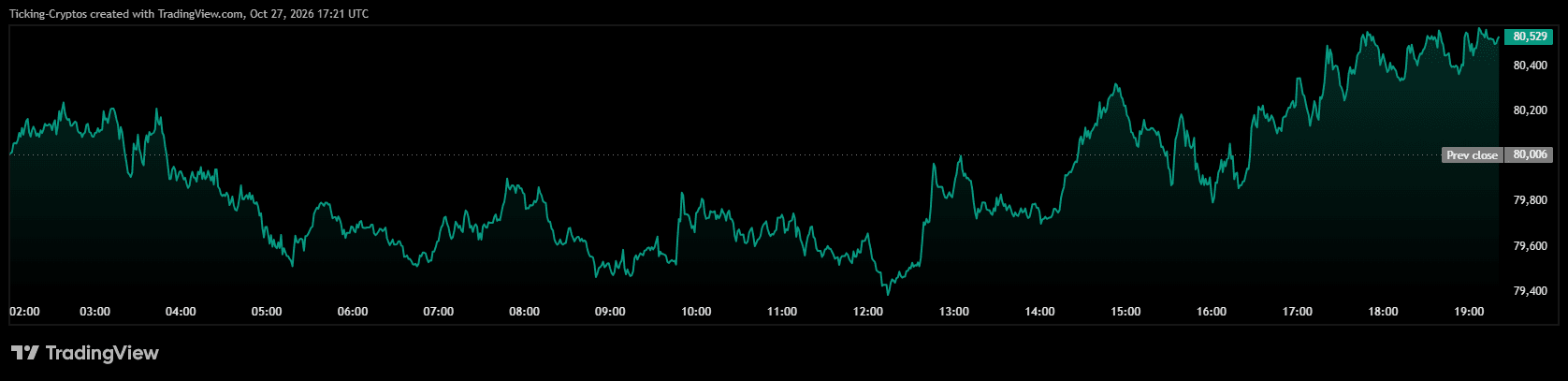
While Shanghai closed 1.3% lower on Tuesday, $Bitcoin spent the day hovering just below $80,000, down well under 1% over 24 hours. Ethereum held around $2,300, Solana sat near $100 and XRP actually gained about 2%. You can check live levels on our crypto prices page.
Bitcoin’s weakness in October has its own, entirely separate causes:
- The Fed. Markets price roughly a 90% chance the Federal Reserve holds rates at its October 28 meeting, but the small chance of a hike, driven by oil above $110 and sticky inflation, has traders sitting on their hands.
- ETF outflows. US spot Bitcoin ETFs recorded about $635 million in net outflows on October 22, the kind of institutional selling that caps any rally.
- Treasury buyers going quiet. Strategy paused its purchases, removing a reliable bid from the market.
- A dead “Uptober”. Bitcoin is on track to close October in the red, down more than 4% on the month and still around 37% below its all-time high near $126,000.
None of that has anything to do with Chinese semiconductor stocks. For once, crypto is trading on crypto-specific and US macro factors, not on a risk-off wave coming out of Asia.
What Does the China AI Bubble Mean for Crypto?
Three takeaways:
1. Correlation is not destiny. The lazy assumption is that Bitcoin is a leveraged tech stock and sells off whenever risk assets wobble. This week disproves it. A $480 billion wipeout in the world’s second-largest equity market produced no measurable contagion in crypto. Bitcoin’s correlation with the Nasdaq is real, but its correlation with Chinese A-shares is close to zero, and capital controls mean Chinese retail money cannot easily rotate between the two anyway.
2. The AI narrative is now a two-way street. For 18 months, “AI boom” meant bullish for every risk asset, including AI-themed tokens. China just demonstrated what the other side of that trade looks like. If US earnings this week disappoint, AI crypto tokens, which trade almost purely on narrative, would be the first casualties. Watch our charts page for sector flows.
3. Bitcoin’s “digital gold” case gets a quiet data point. The Chinese playbook is familiar: a government engineers a bull market, then regulates it back down. Bitcoin is one of the few assets outside that loop. Nothing explosive happened to the price this week, but nothing happened is sometimes the point. In a week where an entire national AI sector lost a fifth of its value, Bitcoin moved less than 1%.
Can Bitcoin Hold $79,000 This Week?
For now, Bitcoin needs to hold support near $79,000 and reclaim $81,000 to show any strength. A clean break below $79,000 opens the door to $78,000 and then $75,000, with the Fed decision on Wednesday the obvious catalyst either way.
The China crash is a warning about what happens when a market becomes one single trade. Crypto has been there before, more than once. The lesson from Shanghai is not that AI is dead. It is that paying 100 times earnings for a story eventually stops working, no matter what country, or what asset class, you are in.
0
0

 Manage all your crypto, NFT and DeFi from one place
Securely connect the portfolio you’re using to start.
 Where will Bitcoin trade next?
Live Polymarket and Kalshi odds on Bitcoin price targets, compared side by side.
See Bitcoin price odds


