
Dogecoin: 22,538 transfers a day, barely a seventh of Litecoin

0
0

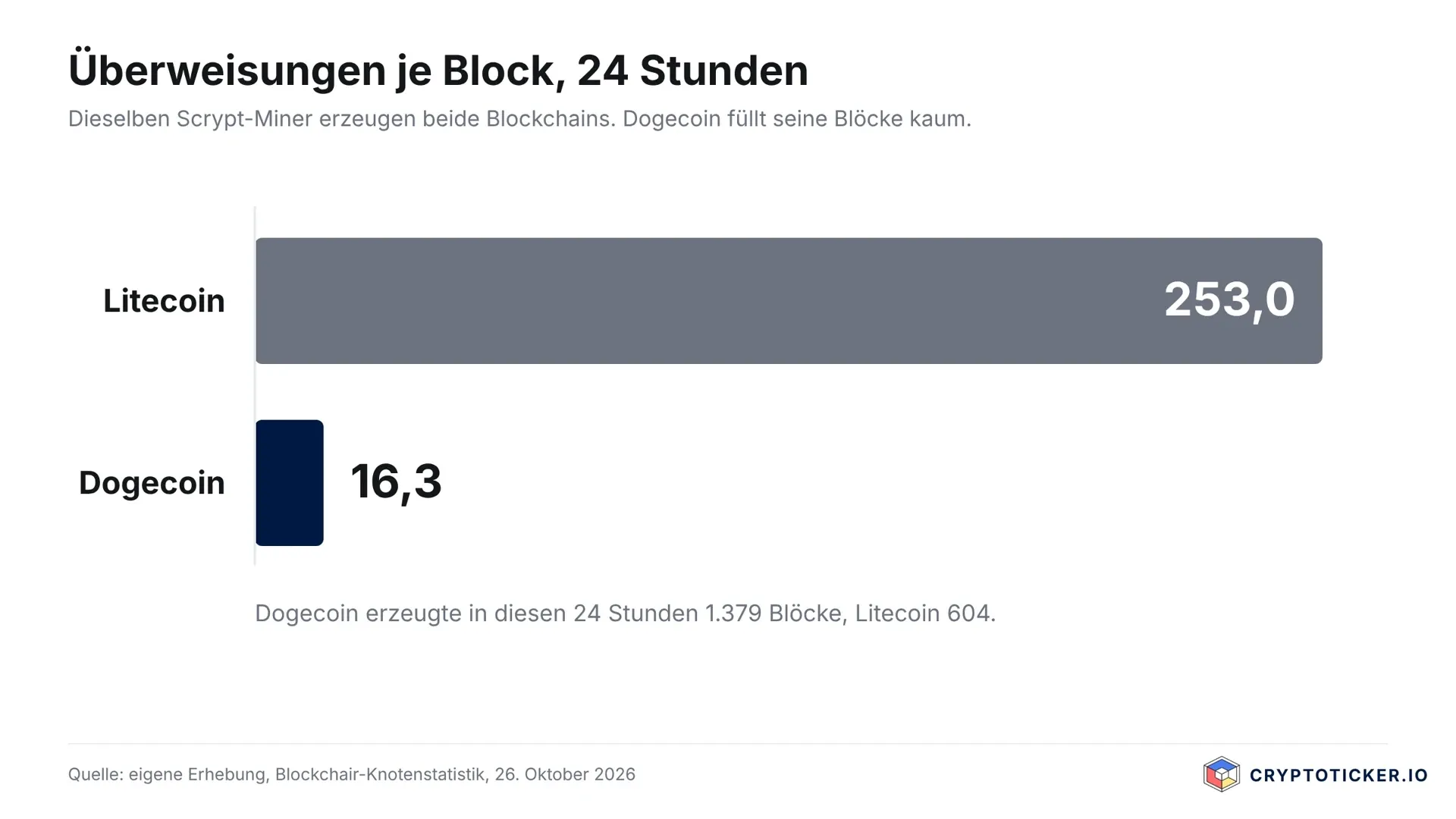
What is on the record: between Sunday and Monday midday, the Dogecoin network wrote 1,379 blocks and settled 22,538 transfers in them, according to the node statistics from Blockchair, queried around midday on October 26. That works out at 16.3 transfers per block. Litecoin, whose blocks are produced by the same machines, came to 253 per block over the same period. Our own assessment follows further down: for holders, an empty network is good news first of all, because it makes moving into self-custody cheap.
Dogecoin traded at $0.0771 on Monday midday, 0.9 percent above the previous day and 21.0 percent below where it stood 30 days ago (CoinGecko, October 26). The price is the quietest number of the day. What happens inside the network is more interesting, because that is where the cost of a transfer and the time it takes are decided.
22,538 transfers in 24 hours: how full Dogecoin blocks really are
A Dogecoin block holds one megabyte. The transfers sitting in the queue at the time averaged around 470 bytes (42 entries across 19,699 bytes). Scale that up and roughly 2,000 transfers fit into one block. Sixteen arrived.
That calculation is an estimate from two measured values, not a figure published by the network. The order of magnitude holds even with generous rounding, though: the blocks are filled to well under one percent. Dogecoin has no capacity problem, it has the opposite.
For the technology that means two things. First, there is no fee competition, because nobody is bidding for space. Second, the security of the network therefore rests almost entirely on the block reward and barely on the fees users pay.
1,379 blocks instead of 1,440: the network is behind its one-minute pace
Dogecoin targets one block per minute. Over a full day that would be 1,440 of them. The count was 1,379, so 61 fewer. That is 4.2 percent behind pace.
That is less dramatic than it sounds, and still not irrelevant. Dogecoin has adjusted its difficulty after every single block since 2014, not every two weeks like Bitcoin. That procedure is called DigiShield and was introduced after the network had repeatedly been flooded by miners and then left dry. With an adjustment after every block, a shortfall of 61 blocks can only arise if computing power has fallen away over the course of the day.
Difficulty stood at 53,965,265 at the time of the query. The last block had been written at 10:41 UTC, a few minutes before the measurement. The network is running, it is just running a little slower than its own timetable.
Merged mining since 2014: why the same scrypt miners secure both blockchains
Merged mining, called Auxiliary Proof of Work or AuxPoW in the protocol, means a miner computes once and may submit the result to two blockchains, as long as both use the same hashing procedure. Dogecoin and Litecoin both use scrypt and have been coupled this way since September 2014.
The advantage for Dogecoin is obvious. It does not have to sustain a mining industry of its own but gets Litecoin's computing power as a by-catch, so to speak. The disadvantage is the same sentence read from the other side: if scrypt hashing power withdraws, Dogecoin loses its protection along with it, without having done anything wrong itself.
That is exactly why the Litecoin figure in this measurement is more than a footnote. Both blockchains were served by the same machines in the same 24 hours. Litecoin produced 604 blocks holding 152,835 transfers, Dogecoin 1,379 blocks holding 22,538. Dogecoin therefore produces well over twice as many blocks and moves barely a seventh of the transfers in them.
Median fee of $0.0054: what a Dogecoin transfer costs today
The median fee for a Dogecoin transfer over these 24 hours was $0.0054, a little over half a cent. The average was higher at $0.0269, because individual large transactions pull the figure up. The median is the more honest number for you, because it describes what an ordinary transfer cost.
For context: an Ethereum transfer costs a multiple of that depending on load, and even Bitcoin sits at several cents in quiet phases. Half a cent at Dogecoin is not a special offer but the consequence of empty blocks. As long as nobody bids for space, the minimum fee stays the normal case.
A mempool with 42 entries: the queue is practically empty
The mempool is a network's waiting area. Transfers sit there once sent but not yet confirmed in a block. At the time of the query it held 42 entries totalling 19,699 bytes.
42 entries against a block capacity of around 2,000 means what you send now goes into the next block. With a target interval of one minute, that works out in practice to a confirmation within one to two minutes, with further confirmations every minute after that. The 486 reachable nodes distribute the transfer across the network while that happens.
The exchange fee beats the network fee many times over
Here is the point where most investors lose money without noticing. The network fee of half a cent goes to the miners. What your exchange charges for a withdrawal is entirely separate from that and set by the exchange itself.
Fixed withdrawal fees in DOGE are common in the market, they differ markedly between providers and they do not move automatically when the network gets cheaper. A fixed fee of a few DOGE amounts to no more than cents at a price of $0.0771, yet it still sits many times above what the network itself charges. Other providers ask for considerably more.
Anyone moving coins therefore compares their provider's terms, not the state of the network. Which exchanges set which withdrawal fees and where minimum amounts apply is shown in our overview of crypto exchanges.
How to check your exchange's withdrawal fee
The route is the same at almost every provider. In your account you open the withdrawal page, select DOGE and the Dogecoin network, and before entering an amount you read off two figures: the fixed withdrawal fee and the minimum withdrawal amount. Both are stated there in DOGE, not in euros.
Then convert the fee into a percentage of your withdrawal amount. On small amounts a fixed fee eats a double-digit percentage, on larger ones it barely registers. That is exactly why moving in one go is worth more than moving in five tranches.
Make sure, too, that you really select the Dogecoin network. Some exchanges also offer DOGE as a token on other blockchains. A withdrawal sent there does not land in your Dogecoin wallet.
Holding period and transfer: moving to your own wallet is not a sale
For investors in Germany, the tax part is the second piece of important news. When you move coins from an exchange to a wallet of your own, the beneficial owner does not change. Such a transfer is therefore not a disposal, and the holding period on your position keeps running.
What you must not lose in the process is the evidence. You still have to be able to document the acquisition date and acquisition cost for each position, and after a transfer that data no longer sits with your exchange automatically. Export your transaction history before you withdraw, and keep it together with the transaction ID of the transfer.
What the holding period in Germany currently looks like and what is politically in motion around it is something we track on our page on the crypto holding period. Individual tax questions belong in the hands of a tax adviser; this text does not replace one.
Where the coins belong after the withdrawal
A wallet of your own means you hold the private key and nobody else. With a hardware wallet that key sits on a device that never speaks to the internet; the signature for a transfer is created on the device itself. With a software wallet it sits on your computer or phone, which is more convenient and more exposed.
Which device supports which coins, how recovery works and what the models cost is in our hardware wallet overview. More important than the choice of device is that you secure the recovery words away from the device and test receiving with a small amount before you send the whole position. At a network fee of half a cent, that test run costs you practically nothing.
Our assessment: an empty network is no flaw, but no argument either
From the newsroom's point of view, the low utilisation is not an alarm signal. Dogecoin was never built as a settlement layer for large payment volumes, and a network that serves its users for fractions of a cent does exactly what it was meant to do. The measured values support that: a median fee of $0.0054, a mempool with 42 entries, confirmation every minute.
Against it stands the fact that no price argument follows from this situation. The 22,538 transfers of a day contribute only cents to the network through fees; operation rests on the block reward and therefore on the computing power Litecoin attracts. Holding Dogecoin means also holding a bet on the scrypt miners, and no network statistic on a quiet Monday shows that dependency. The 21.0 percent price decline over 30 days has nothing to do with how full the blocks are.
What can be derived from the figures is a question of cost, not of direction: if you were planning to pull holdings off an exchange anyway, network conditions for that are currently favourable. That is a statement about fees and waiting time, not about the price.
What has come in since the weekend
On October 25 we reported on the end of the trademark agreement with House of Doge, with $400,000 still outstanding. The price has moved in a narrow band since then: Monday's low was $0.0760 and the high $0.0776, a span of 2.1 percent. The $0.0750 level, where Dogecoin had marked its lowest point in 65 days as of our report on October 24, has not been tested again since.
What is new is the look inside the network itself. Where the trademark question is a dispute over licences, block count, mempool and fee say something about operations, and those ran on through the weekend without incident.
Dogecoin transfers: the network fee is not the expensive part
Three steps if you want to use the situation:
- Read the fixed withdrawal fee and the minimum amount for DOGE in your exchange account and convert them into a percentage of your amount. The provider comparison for that is under crypto exchanges at a glance.
- Export your transaction history with acquisition data beforehand, so that the holding period remains documented.
- Test the receiving address with a small amount before you transfer the position. Which device suits you is in the hardware wallet overview.
The price and market data in this article come from CoinGecko, the network figures from Blockchair's node statistics.
(As of October 26, 2026. This article is not investment advice. Prices and fee structures change; check the terms with the provider before you buy.)
0
0


 Manage all your crypto, NFT and DeFi from one place
Securely connect the portfolio you’re using to start.


