
Bitcoin price at $83,200: outperforms the market as Solana sheds 11.9 percent

0
0

Bitcoin stood at roughly $83,200 at midday on Tuesday, or $83,212.80 and €74,361.20 to be exact, according to Kraken data. That is a gain of 1.8 percent on Monday's close of $81,737.20. The striking part is not the number itself but its surroundings: Bitcoin is, at this moment, the only one of the eight largest coins trading higher over 24 hours.
Ethereum is down 1.3 percent over the same period, XRP 2.2 percent, Solana 3.6 percent, Dogecoin 2.6 percent, Shiba Inu 4.5 percent and Polkadot 7.2 percent (CoinGecko, as of October 13, midday). Over seven days the gap is wider still. That spread is the real reason for this article, and for private investors in Germany it carries a very specific tax consequence, set out further below.
Where the Bitcoin price stands at midday on Tuesday
The night was restless. Bitcoin fell as low as $80,951.20, marking the low of the day, recovered to $84,053.10 and settled just above $83,000 by midday. The distance between the daily low and the daily high is $3,101.90, or 3.8 percent. For a Tuesday without a major scheduled event, that is a wide range.
In euro terms BTC stands at €74,361.20, with a daily high of €75,146 and a low of €72,568.40. The price is 34 percent below its all-time high of $126,080. Trading volume on Kraken over the past 24 hours came to 2,409 BTC across 166,327 individual trades, with a volume-weighted average price of $82,667.32. The current price therefore sits above the daily average, which means buyers in the second half of the day paid above the mean.
Seven days compared: 2.8 percent versus 11.9 percent
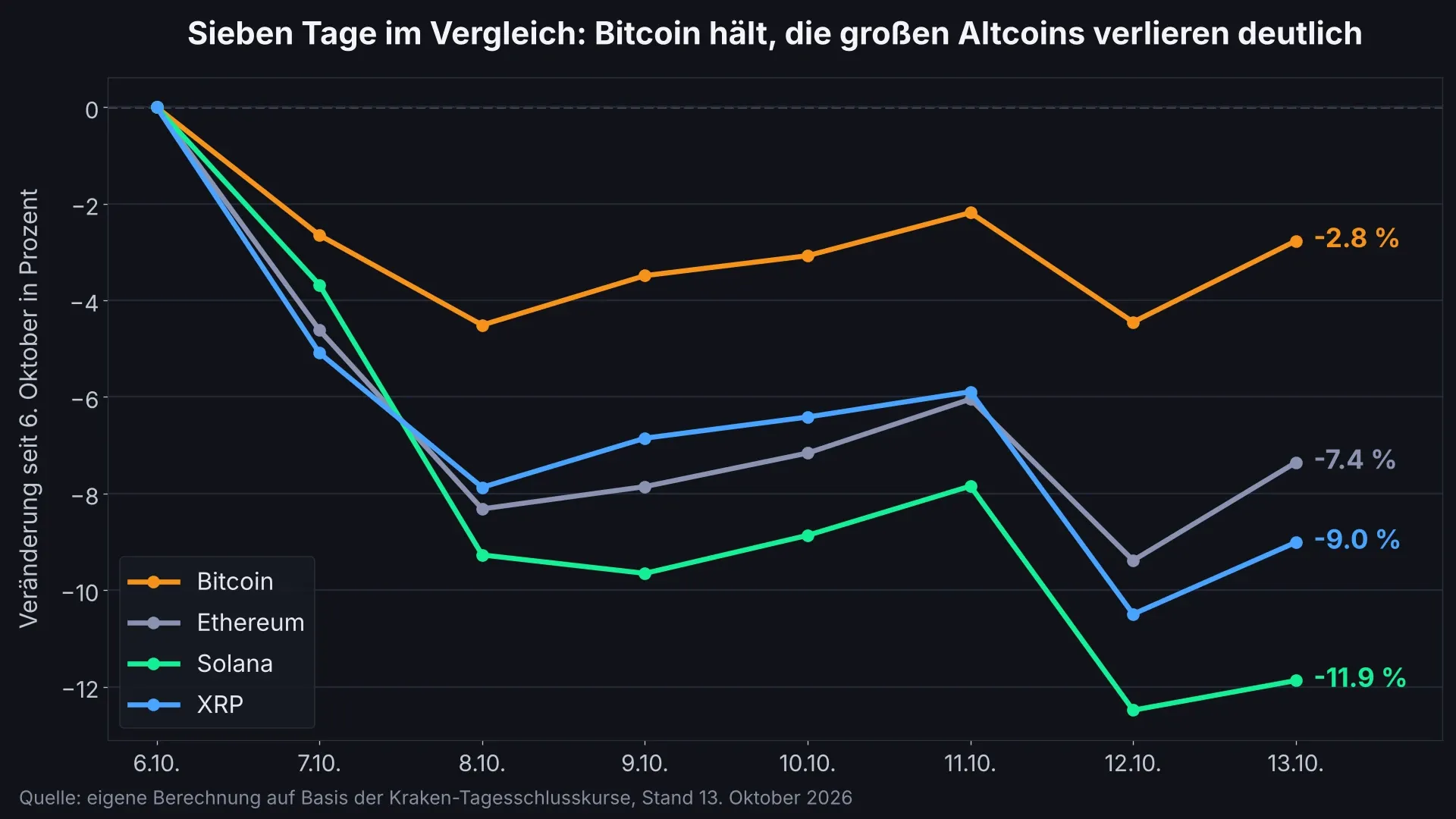
For the weekly view we indexed Kraken's daily closing prices since October 6 to a common starting point. The result: Bitcoin is 2.8 percent below its October 6 level, Ethereum 7.4 percent, XRP 9.0 percent and Solana 11.9 percent. All four curves broke down together on October 7 and 8, but Bitcoin found its footing at a markedly higher level.
The gap between Bitcoin and Solana is therefore 9.1 percentage points over seven days. Anyone holding €10,000 of Solana on October 6 has around €8,810 today; the same amount in Bitcoin is worth around €9,720. That is no longer noise, it is a difference that shows up immediately in a portfolio overview.
The mechanism behind Bitcoin's relative strength
In market analysis, relative strength simply means that an asset loses less than the rest during a downward phase. The pattern rarely arises from good news about a single coin. Almost always it comes from the structure of the buyer base.
For Bitcoin, a substantial part of that base has consisted of regulated fund products since the ETFs were approved. Their inflows and outflows move in daily steps and follow allocation decisions, not minute charts. Altcoins, by contrast, depend far more on leveraged trading on derivatives venues. When the market falls, positions there are liquidated by force, and every forced liquidation produces a sale that triggers the next. That is how two hours can deliver a loss that takes Bitcoin two days.
Then there is the direction of the money. US spot Bitcoin ETFs recorded a net outflow of around $485 million on October 7, according to consistent reports, and outflows over the week added up to roughly $681 million. Bitcoin is still holding up better than the rest. Above all, that says one thing: the altcoins are currently missing the buyer who is still there for Bitcoin even in a week of outflows.
What has changed since yesterday's article
Yesterday the question in this slot was whether Bitcoin would hold the $82,500 level (as set out in our Bitcoin forecast of October 12). The answer one day on: the level held, but only narrowly and not without interruption. The price fell overnight to $80,951.20, which is $1,548.80 below that level, and worked its way back from there.
A brief undercut followed by a quick return is read differently in the market than a close below. The October 12 daily close came in at $81,737.10, also below $82,500. Two touches from beneath in two days weaken a level rather than confirm it. For the coming days, $82,500 is therefore no longer support but a zone the price has only just reclaimed.
The levels that count now, and why
On the downside there is the daily low at $80,951.20. It is the point where buyers stepped in overnight, and at the same time the round $81,000 area that already held on October 8 (daily low back then: $80,328.60). Two lows in that neighbourhood within five days make it the first dependable support zone.
On the upside there is the daily high at $84,053.10. Above it sits the October 11 close at $83,675.60, which has already been passed, and beyond that the October 12 high at $84,250. The zone between $84,050 and $84,250 is therefore the next test. If it gives way, the October 4 and 5 level of $86,500 to $86,900 comes into view.
Wednesday's inflation print and the Fed on October 28
On Wednesday, October 14, the US Department of Labor publishes the consumer price index for September at 8:30 a.m. Eastern Time. It is the last inflation reading before the meeting of the Federal Open Market Committee, which according to the Federal Reserve's calendar takes place on October 27 and 28. The Federal Reserve Bank of Cleveland's nowcast most recently stood at around 3.6 percent headline inflation year on year and about 2.4 percent for the core rate.
In practical terms for you: the 3.8 percent range Bitcoin has already covered today can repeat itself within half an hour on Wednesday afternoon. Anyone holding an order close to the current price should know it can be triggered in that half hour without anything fundamental having changed in the underlying picture.
Switching into Bitcoin: what the holding period costs in Germany
This is where the most expensive mistake is being made right now. The reflex on seeing the chart above is: out of Solana, into Bitcoin. For tax purposes in Germany that swap is not a reallocation but two things at once, namely a sale of the altcoin and a purchase of Bitcoin.
Private disposals are governed by section 23 of the German Income Tax Act. For crypto assets held privately the rule is: if more than twelve months pass between acquisition and disposal, the gain is tax free. Below that it is taxed at your personal income tax rate, provided the gains from all private disposals in the calendar year together reach the exemption limit of €1,000. An exemption limit is not an allowance: at a gain of €1,001 the full amount is taxable, not just the one euro above the line.
For the swap that means two things at the same time. First: if you have held your Solana for more than a year, the sale is tax free, and that is the good part. Second: the Bitcoin you receive in exchange counts as acquired on that day. For those coins the twelve-month clock starts at zero. Anyone who already holds Bitcoin from 2024 and buys more now ends up with two positions on two different clocks. Which of them is sold first next time is determined by the first in, first out principle, which the German tax authorities apply separately for each wallet.

Loss offsetting: what altcoin losses are worth on your tax return
The flip side is the more interesting one for many. Anyone who sells Solana, XRP or Shiba Inu at a loss inside the twelve-month window can put that loss to use. Only against gains of the same kind, however, meaning other private disposals in the same year. Offsetting against employment income or against interest on a savings account is ruled out.
If a loss remains at the end of the year, it is not forfeited. It can be carried back to the previous year or carried forward into later years, again only against private disposals. The form matters here: the loss has to be declared in the Anlage SO schedule of the tax return, otherwise the tax office does not formally assess it, and a loss that has not been assessed is not available the following year.
In concrete terms for the current case: Shiba Inu is down 0.8 percent over 30 days and 12.7 percent over seven days, Dogecoin 12.5 percent over seven days. Positions dating from the summer are therefore partly in the red and still inside the window. Anyone intending to sell there anyway would sensibly first look at which realised gains have already accumulated this year. A portfolio tracker with a tax function works out that comparison position by position, holding periods included.
Buying route and custody under MiCA
Anyone who does buy Bitcoin in this situation has a clearer legal position than two years ago, thanks to the European regulation on markets in crypto assets. Providers targeting retail clients in the EU need authorisation as a crypto-asset service provider, granted and supervised in Germany by BaFin. Authorisation says nothing about the price, but a great deal about custody, complaint procedures and what happens to your coins if the provider becomes insolvent.
On the buying route itself, three items decide the actual cost: the trading fee, the distance between the buy and sell price, and the fee for withdrawing to a wallet of your own. The second of those appears in no fee table, yet in thin trading it quickly costs more than the fee itself. Which providers are authorised in Germany and how their terms look side by side is set out in our crypto exchange comparison.
For custody the old principle is unchanged: coins on an exchange are a claim against that exchange, coins on your own hardware wallet belong to you directly. Anyone planning to hold larger amounts for months in order to reach the twelve-month mark has the quieter route on a wallet of their own, but then has to document the acquisition dates themselves.
Our assessment of the relative strength
In the view of this newsroom, Bitcoin's relative strength is currently dependable, but it is not a buy signal. Three documented points support it: Bitcoin is down 2.8 percent over the week against 7.4 to 11.9 percent for the three large altcoins, it holds a gain of 8.6 percent over 30 days while Shiba Inu loses 0.8 percent over the same period, and it is today the only large coin up over 24 hours.
Against it, just as clearly: the strength is relative, not absolute. Bitcoin stands 34 percent below its all-time high and has lost ground over seven days as well, only less. Around $681 million flowed out of the ETFs in one week. A phase in which Bitcoin falls less than the rest has regularly been, in market history, a phase in which investors reduce risk, rather than the start of a new advance. What follows from that is an observation and not a recommendation: the gap between BTC and the altcoins is currently a statement about risk appetite in the market, not about the quality of individual projects.
Bitcoin at $83,200: Wednesday sets the next level
The picture at midday on Tuesday can be summed up in three steps, all of which come before Wednesday's inflation print.
- Keep the zone between $80,951 and $84,053 in view. Everything so far has played out inside that daily range. A daily close above or below it is the first real piece of information; everything in between is movement without a message.
- Look up the holding period for each position before swapping. Twelve months decide tax exemption under section 23 of the Income Tax Act, and a swap into Bitcoin resets the clock to zero for the new coins. A tax tool with a portfolio overview delivers that comparison position by position.
- Calculate the total cost of the buying route, not just the fee. Trading fee, price spread and withdrawal costs together make up the price you actually pay. The authorised providers and their terms are listed in the exchange comparison.
(As of October 13, 2026. This article is not investment advice. Prices and fee structures change; check the terms with the provider before you buy. Crypto assets are highly volatile and a total loss of the capital employed is possible. This text is no substitute for tax advice.)
0
0


 Manage all your crypto, NFT and DeFi from one place
Securely connect the portfolio you’re using to start.
 Where will Bitcoin trade next?
Live Polymarket and Kalshi odds on Bitcoin price targets, compared side by side.
See Bitcoin price odds


