
Solana ETF in Hong Kong at 0.6 percent: what changes for European investors

0
0

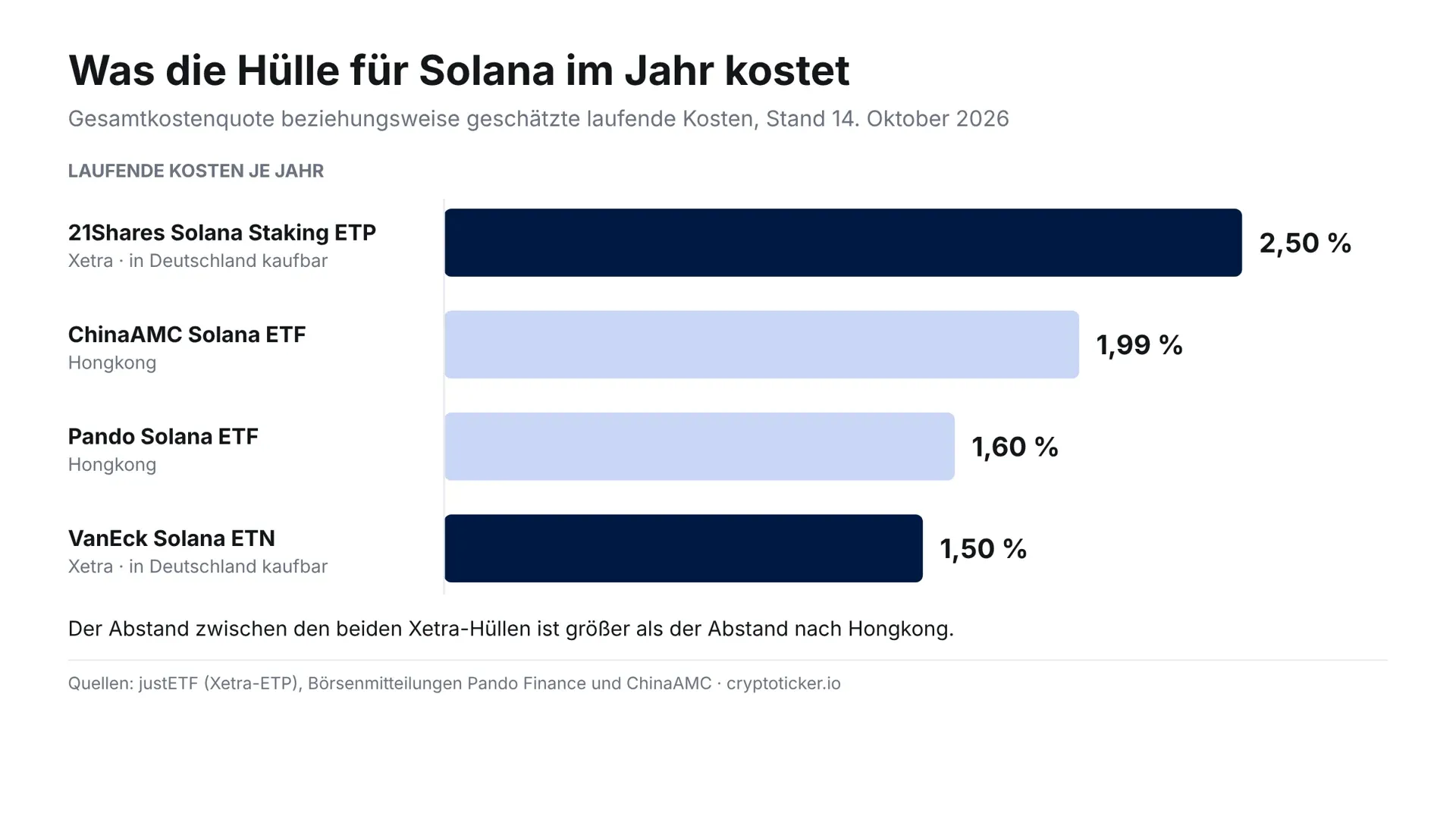
Hong Kong saw the launch of its second spot ETF on Solana on October 13, issued by Pando Finance under the ticker 02831. The management fee is 0.6 percent a year. You cannot buy this product from Europe. The number still matters, because it shows the range in which the cost of a Solana wrapper now sits. On Xetra the spread runs from 1.50 to 2.50 percent a year, and over ten years that gap costs more than any single day's move.
Pando lists Hong Kong's second Solana spot ETF
The fund was introduced on the Hong Kong Stock Exchange after a subscription period running from October 6 to 12. That makes it the city's second spot ETF on Solana after the ChinaAMC product, and Pando Finance's third exchange-traded product on a single cryptocurrency, following Bitcoin and Ethereum.
The construction is deliberately plain. The fund may hold up to 100 percent of its net asset value in SOL, but uses no derivatives and no leverage. It also runs no staking, forgoing the network rewards a Solana position can otherwise earn. The reference is the CME CF Solana Dollar Reference Rate at the Asia-Pacific close. HashKey Exchange handles trading of the coins, HashKey Custody Services the custody, and BOCI-Prudential Trustee acts as trustee.
A spot ETF is an exchange-traded fund that actually buys and holds the cryptocurrency rather than tracking its price through futures. The share price therefore follows the coin price directly, less the running costs.
0.6 percent management and 1.6 percent running costs are two different numbers
The management fee is only part of the bill. Pando puts estimated total running costs at 1.6 percent a year. The gap to the 0.6 percent comes from custody, trusteeship, audit and trading-related costs, which the fund also pays out of its assets. At ChinaAMC, a 0.99 percent management fee sits next to an estimated 1.99 percent in total costs.
Comparing two products therefore means taking the total expense ratio, not the management fee. The first number leads every press release; the second decides the return. In Europe this figure is called the total expense ratio, or TER, and it covers every cost taken from the product on an ongoing basis.
Why the Hong Kong fund is not an option here
An ETF authorised in Hong Kong may not be distributed to retail investors in the European Union. German brokers therefore do not carry such products. The same applies to the US spot ETFs on Solana: those funds do not meet European distribution rules, and a German brokerage account will not even display them.
The European route runs instead through exchange-traded notes, called ETPs or ETNs depending on the issuer. Legally these are not funds but collateralised bearer notes, backed by real coins held at a custodian. In practice you buy them like a share through an ordinary brokerage account. Which products those are, and what matters about the collateral, is set out in the overview of crypto ETFs in Germany.
Solana ETPs on Xetra: 1.50 percent against 2.50 percent
Two large Solana products sit side by side on Xetra, separated by a full percentage point a year. The 21Shares Solana Staking ETP (ISIN CH1114873776, ticker ASOL) costs 2.50 percent a year and holds around 588 million euros. The VanEck Solana ETN (ISIN DE000A3GSUD3, ticker VS0L) costs 1.50 percent and holds around 76 million euros.
The split is striking: the more expensive product holds roughly eight times the money. Part of that has a sound basis, because the 21Shares product runs staking and passes some of the network rewards to investors, which can offset at least part of the higher fee. What counts is therefore what remains after the fee and after the reward, and that number sits in the factsheet, not in the marketing.
21Shares has also launched a cheaper Solana product, the Core Staking ETP (ISIN CH1385084384). At launch the issuer quoted a total expense ratio of 0.35 percent. Because fee models change and comparison sites have recently carried differing figures, check the current rate in the issuer's factsheet before you buy.
How the fee shrinks a Solana holding
With a physically backed product the fee is not debited from your account. The manager takes it out of the deposited holdings. Each share therefore stands behind slightly fewer coins with every year that passes. The price of the note does not fall as a result, but the claim on SOL shrinks, and it does so quietly.
In numbers: at 2.50 percent a year, 77.6 percent of the original coin quantity remains after ten years; at 1.50 percent it is 86.0 percent. The difference is 8.3 percentage points. On an investment of 10,000 euros with an unchanged price, that comes to around 834 euros, the cost of the wrapper alone. In the first year the gap is still modest at 250 against 150 euros, but in every following year it works on an already smaller holding.
This model calculation assumes an unchanged price and leaves staking rewards aside. It does not show what an investor earns, but what the wrapper consumes regardless of the price direction.

The capital gains holding period under Section 23 EStG applies only outside the wrapper
This is where the cost question turns. Holding SOL directly in your own wallet or at an exchange brings Section 23 of the German Income Tax Act into play. Sell after more than one year and the gain is tax-free, whatever its size. Within the year, an exemption limit of 1,000 euros applies to all private disposals together. The German Federal Ministry of Finance confirmed this line in its circular of March 6, 2025.
An exemption limit means all or nothing. One euro above it and the entire gain becomes taxable, not just the excess. The period is counted to the day: buy on March 15 and the earliest tax-free sale is March 16 of the following year.
With an ETP or ETN this treatment is not assured. Whether the one-year period applies there is widely held to depend on whether the note carries a claim to delivery of the actual coins. Without that claim, taxation as investment income under Section 20 EStG is the likely outcome, meaning 25 percent withholding tax plus the solidarity surcharge, even after ten years. A definitive ruling covering every product variant is still missing. Settle the point before you buy, in the securities prospectus and, if in doubt, with a tax adviser, because it usually weighs more than a percentage point of fees.
Staking income and the 256-euro exemption limit
Holding Solana directly allows the coins to be staked for network rewards. For tax purposes those rewards are other income under Section 22 No. 3 EStG, taxable at the personal rate in the year they arrive. A separate exemption limit of 256 euros applies, independent of the 1,000 euros under Section 23.
Two points are regularly confused. First, staking does not extend the holding period of the coins involved. The ten-year period once discussed is off the table; the 2025 ministry circular expressly keeps to one year. Second, the rewards received start their own one-year clock from the day they arrive, so they are fresh coins with a fresh clock. Anyone collecting rewards regularly needs a clean record of each inflow, and that is what crypto tax software and portfolio trackers are for. How staking offers differ is shown in the overview of staking platforms.
What the outflows from the US funds say about demand
The Hong Kong opening falls in a week when institutional money was pulled elsewhere. The US spot ETFs on Solana saw net outflows of 24.8 million dollars in the week of October 5 to 9, the first negative week after 14 weeks of inflows. Bitwise's BSOL fund accounted for the largest share at around 21 million dollars. We set out those figures in detail on October 11.
The picture has not turned since. October 12 added a further 0.7 million dollars in outflows, taking the run to six consecutive trading days. For context, the US spot ETFs on Bitcoin and Ethereum together saw around 1.22 billion dollars leave over the same period. That points to a broad retreat from crypto funds rather than a Solana-specific problem.
At midday on Wednesday SOL trades at around 106.62 dollars, or 95.24 euros, 0.6 percent below the previous day and 63.6 percent below its record of 293.31 dollars (data from CoinGecko). The price here is the occasion, not the news. The news is that the supply of wrappers is growing while demand for them is easing.
Our assessment: the wrapper is a cost question, not the price question
From the newsroom's perspective, the most interesting number of the week is not the 0.6 from Hong Kong but the split on Xetra. That around 588 million euros sits in the product charging 2.50 percent and around 76 million in the one charging 1.50 percent can only partly be explained by staking rewards. Much suggests that name recognition and first listing weigh more heavily than the cost ratio.
There is a serious objection on the other side: a staking product with a higher fee can end up ahead of a cheaper one without staking once rewards are counted. Whether that holds can only be read from the net result reported in each factsheet, not from the fee alone. The 1.50 to 2.50 percent spread is documented, the difference in fund size is documented, and the ten-year calculation is documented. What is not documented is that the more expensive wrapper earns its premium. We are assessing the situation and making no buy or sell recommendation.
Solana ETP fees: 1.50 versus 2.50 percent adds up over a decade
- Check your product's factsheet for the total expense ratio rather than the management fee. Which wrappers are tradable in Germany is set out in the overview of crypto ETFs in Germany.
- Check the prospectus for whether your ETP carries a claim to delivery of the coins. That determines whether the one-year period is reachable at all. Recording each purchase and each inflow is handled by crypto tax software and portfolio trackers.
- Price up the direct purchase: holding SOL yourself for more than a year means no annual fee and, under Section 23 EStG, no tax on the gain. For a trading venue, see the overview of crypto exchanges.
(As of October 14, 2026. This article is not investment advice. Prices and fee structures change; check the terms with the provider before you buy.)
0
0

 Manage all your crypto, NFT and DeFi from one place
Securely connect the portfolio you’re using to start.


