
Is WLFI Dead? What the 50% Crash Means for Holders in 2027

0
0

Is WLFI Dead? What the Crash Reveals About Its Future
WLFI lost more than half its value in about four hours on 28 November 2026. The market report cited below recorded a low of $0.0158. Many holders are asking whether WLFI is dead and should first check unlocks, treasury sales, and liquidity, and not the price alone. The sell-off followed a sale of roughly $20 million in Ether-related assets by a World Liberty-linked strategic reserve wallet, plus forced liquidations of leveraged longs.
Glossary
Liquidation: a forced position close when margin runs out.
Governance token: a token used to vote, not to own the company.
Cliff: a period before vested tokens begin to unlock.
Peg: the target value, here $1, for a stablecoin.
What happened to WLFI on November 28, 2026?
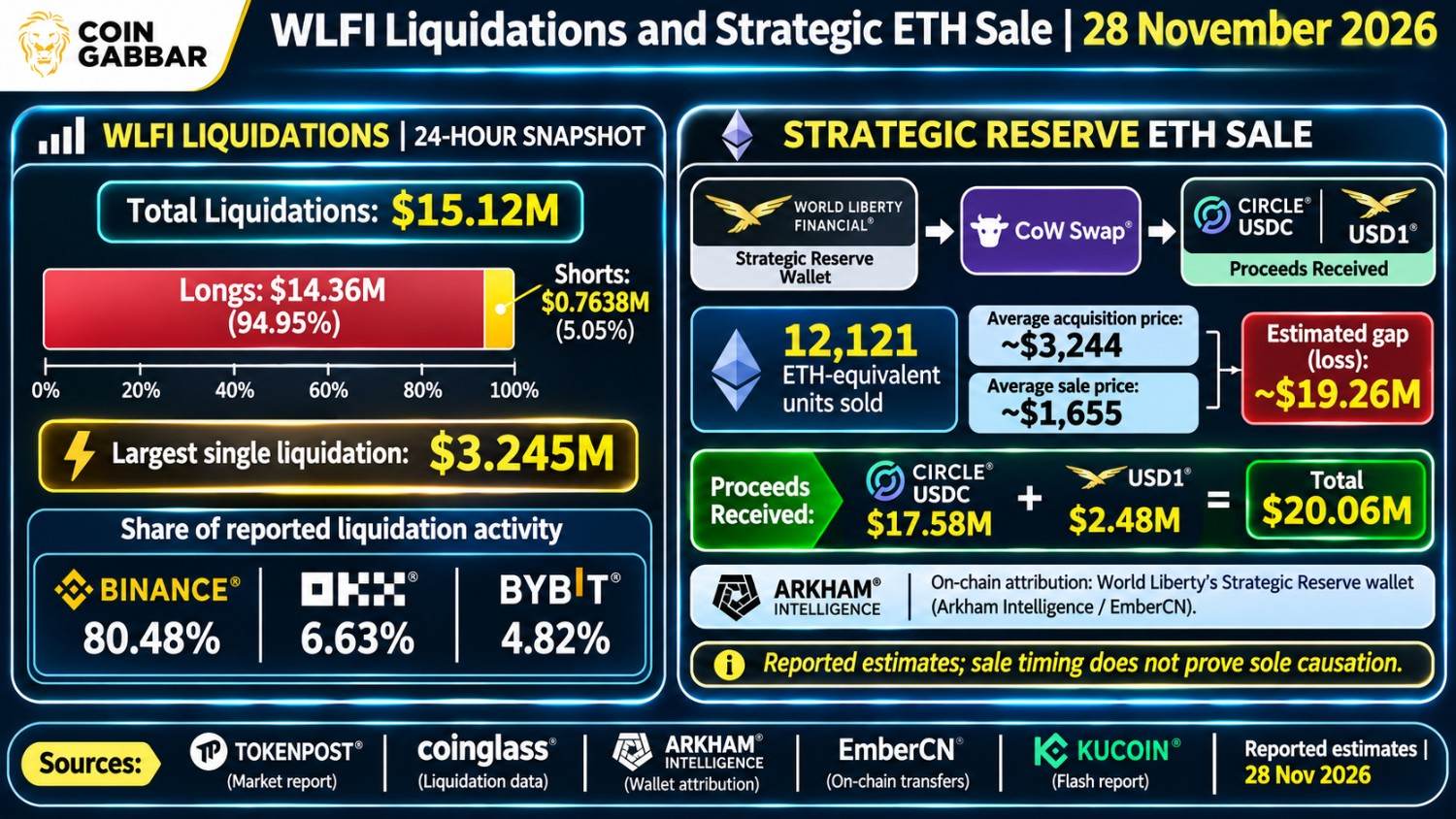
A wallet labelled World Liberty's Strategic Reserve by Arkham Intelligence sold about 10,600 WETH and about 1,378 mETH on 27 November 2026. That equals about 12,121 ETH-equivalent units. The wallet received about $17.58 million in USDC and $2.48 million in USD1, or roughly $20.06 million in total (28 November 2026).
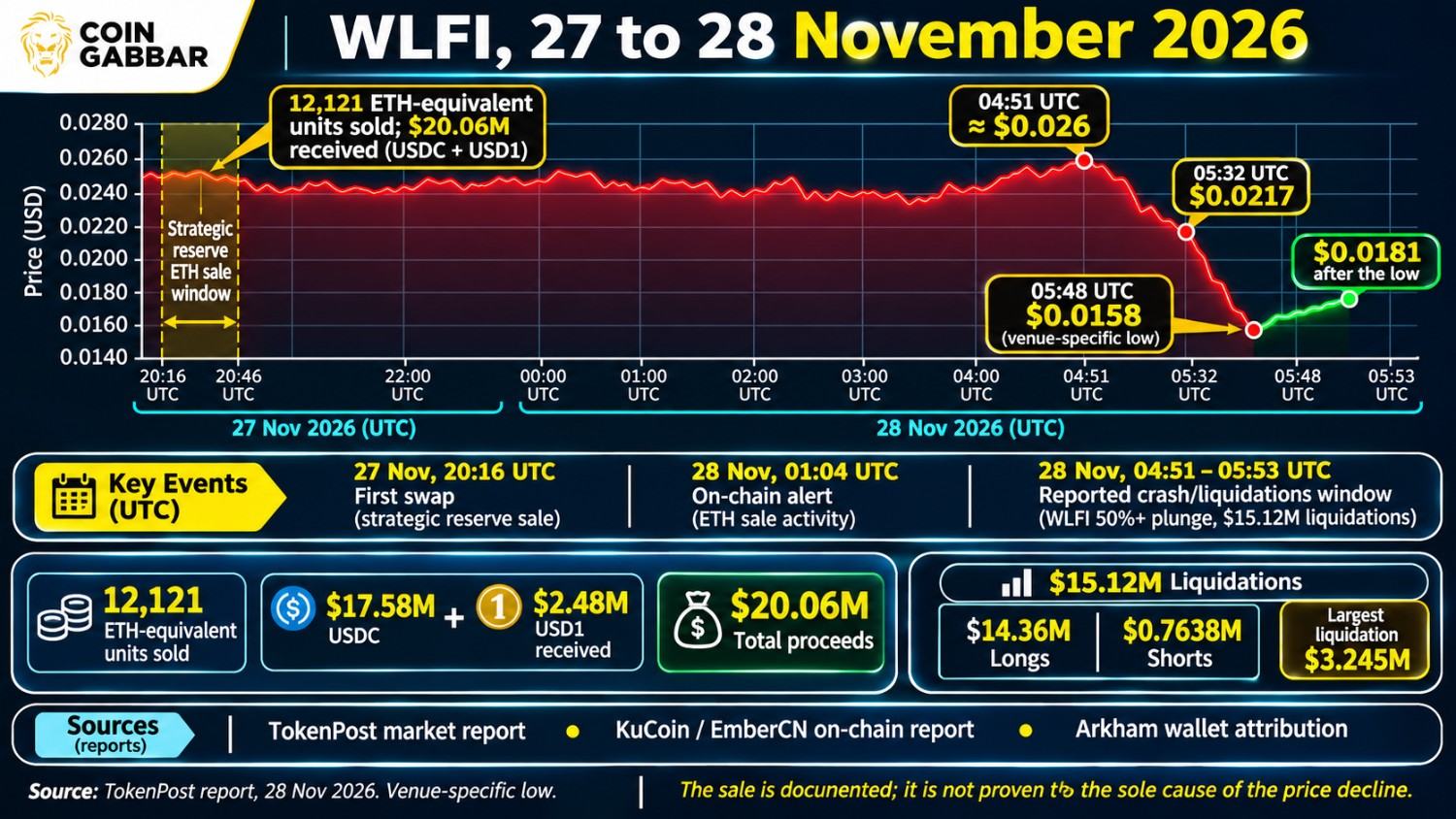
The reported average purchase price was about $3,244 per unit, and the average sale price was near $1,655. CoinGabbar's calculation gives a gap of $1,589 per unit, or about 49%. Multiplied by 12,121 units, that is about $19.26 million. The inputs are reported estimates, so the result is not an audited loss for World Liberty Financial.
Time (EST) | UTC | Event |
27 Nov, 3:16 PM | 27 Nov, 20:16 | First swap in the reported sale window |
27 Nov, 11:51 PM | 28 Nov, 04:51 | WLFI near $0.026, down about 37% |
28 Nov, 12:48 AM | 28 Nov, 05:48 | Reported low of $0.0158, then $0.0181 |
28 Nov, 12:53 AM | 28 Nov, 05:53 | The liquidation snapshot shows $15.12 million. |
Source: TokenPost market report and on-chain records, 28 November 2026. The $0.0158 low is an exchange-specific observation, not a confirmed closing price. CoinMarketCap's 24-hour range showed $0.01718 to $0.0415.
Liquidations amplified the fall. Total liquidations in the 24-hour snapshot reached $15.12 million, of which $14.36 million were longs, and the largest single order was $3.245 million. A forced close adds selling pressure, as how crypto liquidation works explains. Liquidations can speed a crash up without starting it.
What is WLFI used for, and who holds the supply?
WLFI is a governance token. According to World Liberty's documentation, holders vote on protocol upgrades, partnerships, and treasury proposals. The token does not give ownership in the company or a claim on profits. Staking carries a 180-day lock, does not add voting power, and pays rewards in USD1 from a shared pool that can change or end.
The initial supply was 100 billion tokens. Arkham groups about 66.914 billion WLFI under 54 addresses attributed to the World Liberty entity. This is an attribution estimate, not proof that one person owns the tokens.
Allocation | Share | Tokens |
Token sale | 33.893% | 33.893 billion |
Community growth | 32.6% | 32.6 billion |
Co-founders | 30% | 30 billion |
Team and advisors | 3.507% | 3.507 billion |
Source: World Liberty Financial tokenomics page, accessed 28 November 2026.
CoinMarketCap showed a circulating supply of about 31.66 billion and about 152,660 holders on 28 November 2026. The project's own page shows a current total supply near 96.743 billion, so initial, current, circulating, and maximum supply must be read as separate figures.
USD1 is a dollar stablecoin tied to the same ecosystem. BitGo is named as its issuer in World Liberty's FAQ, and World Liberty owns the brand. For how stablecoin redemption works in general, see the stablecoin redemption gap.
Is WLFI dead or just oversold?
WLFI was about $0.0196 on CoinMarketCap on Nov. 28, 2026, down about 52.8% in 24 hours and about 95.7% off its $0.46 all-time high on Sept. 1, 2025, ~12:00 UTC. That’s a major crash in the market.
The project looked active in the materials reviewed. The governance site, staking, USD1, and lending activity all remained online. The strategic reserve wallet also moved funds, sending about $16.59 million in USDC and $2.5 million in USD1 to the lending protocol Dolomite. So is WLFI dead as a project? The evidence says no. Is the token healthy? That is a separate question.
Liquidity is a key concern. CoinMarketCap recorded about $550.74 million in 24-hour volume against a $619.53 million market capitalization, a turnover near 89%. High turnover shows heavy trading, but it does not prove order books were deep enough to absorb large orders. This article treats thin liquidity as a possible amplifier, not a confirmed cause.
On USD 1, one report put it near $0.94 on Binance, while later readings showed $0.9995 and about $1.00. The $0.94 print is a venue-specific price gap. It does not establish missing reserves.
What could move WLFI in 2027?
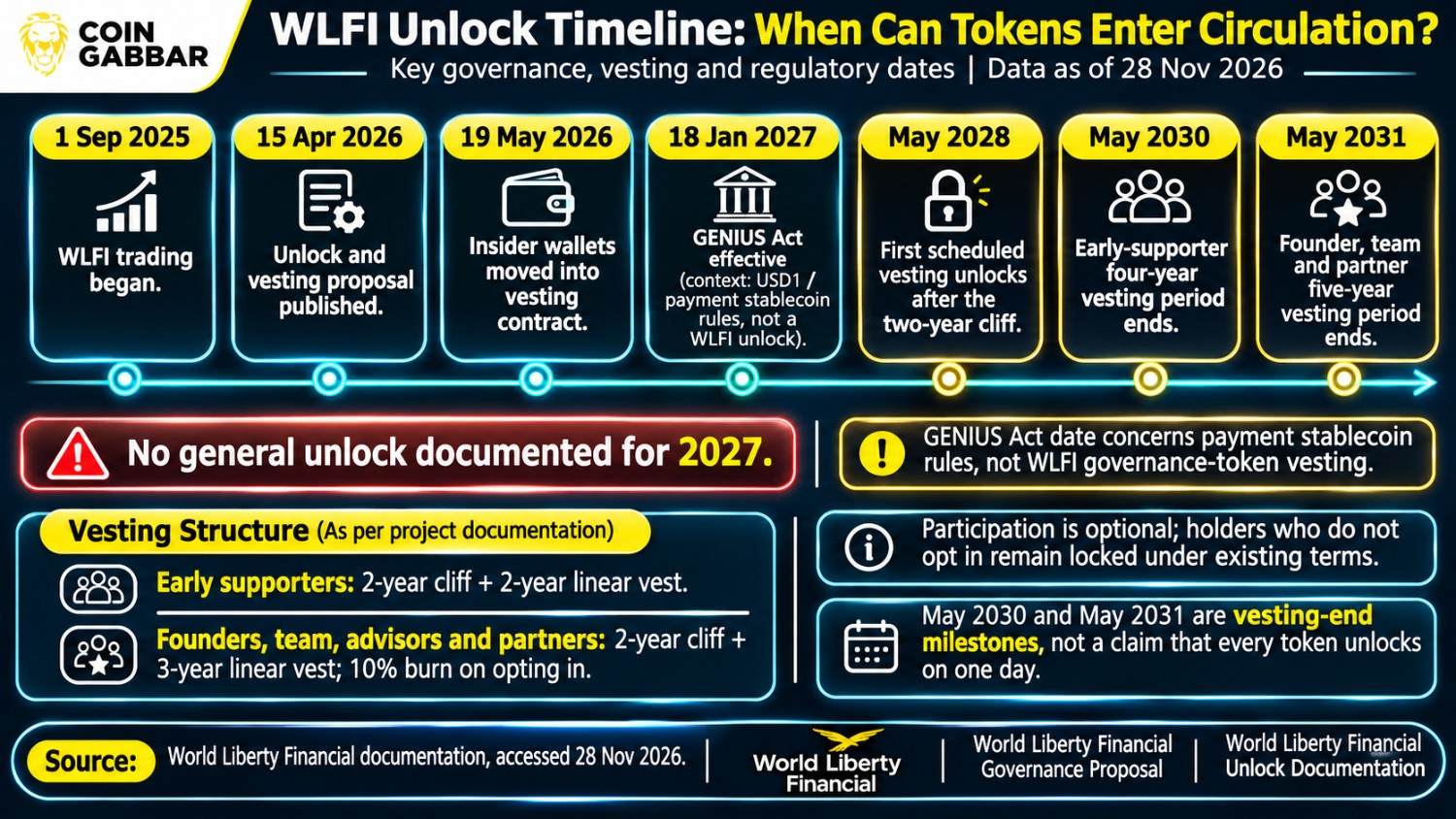
The documented vesting plans do not show a large general unlock in 2027. Under the April 2026 proposal, about 17.04 billion early-supporter tokens follow a two-year cliff and two years of linear vesting. About 45.24 billion founder, team, and partner tokens can opt into a plan with a 10% burn, a two-year cliff, and a three-year vest. The first scheduled unlocks fall in May 2028. The 2027 concern is therefore supply overhang and treasury decisions, not an automatic unlock date.
Buybacks are a possible positive. On 6 November 2026, the project discussed more token buybacks funded by fees from USD1-related reserves. That was not a guaranteed purchase schedule, and announced plans differ from completed purchases or burns.
The GENIUS Act takes effect on 18 January 2027. The OCC issued its final implementing rule on 21 October 2026. The law covers payment of stablecoins such as USD1, not governance tokens such as WLFI.
World Liberty's April 2026 governance proposal discussed a World Liberty Trust Company that would apply to issue USD1 itself. That is a plan. Nothing in the sources reviewed shows an approval.
Signals worth tracking:
USD1 circulation, whether it holds $1 on several venues, and how easily holders can redeem it.
Treasury transfers that can be traced on-chain, plus buybacks that show up as real purchases.
How many holders vote and how much lending activity the protocol records.
Whether order books stay deep on more than one exchange.
What are the risks of buying WLFI after the crash?
Volatility is the first risk. A 50% fall in hours can repeat. Concentration is the second: large attributed wallets hold most of the supply, and one address labelled Strategic Reserve (01:04 UTC) held about 12.639 billion WLFI on 28 November 2026.
Political and legal exposure also apply. A complaint filed on 21 April 2026 in the US District Court for the Northern District of California (case 3:26-cv-03360) alleges about four billion WLFI tokens were improperly frozen. These are allegations by the plaintiff, not court findings.
Sizing and exits matter more than price targets. The guide on avoiding liquidation risk covers leverage limits.
Expert Opinion
Supporters point to USD1 growth, the buyback plan, and a governance process that is still running. Skeptics point to insider supply, a handful of large wallets and a thin market. Neither side wins on one green candle. A rebound on a single exchange pair proves little. A convincing recovery would need steady prices across venues, a USD1 that holds its peg, buybacks that can be verified, and treasury transfers that outsiders can follow.
Conclusion: what the crash means for holders
The 28 November 2026 crash, 04:51 UTC – 05:53 UTC, combined a documented ETH sale, forced liquidations, and a venue-specific USD1 dip. The causes are not fully proven. So is WLFI dead? The evidence reviewed does not support that label, and it does not support a guaranteed recovery either. Holders should watch treasury disclosures, USD1 data, and the May 2028 unlock window.
Key Takeaways
WLFI fell over 50% in about four hours on 28 November 2026, based on one exchange-specific report.
A strategic reserve wallet sold ETH-related assets. The sale is documented, but it is not proven to be the only cause.
USD1 traded near $0.94 on one venue, while other sources showed about $1.00.
The documented vesting schedules point to May 2028, not 2027, for the first large unlocks.
Is WLFI dead? The sources reviewed show an active project and a collapsed price.
Disclaimer: This article is educational and not financial advice. Crypto prices, supply, and legal facts change quickly. This page does not predict WLFI's price.
0
0


 Manage all your crypto, NFT and DeFi from one place
Securely connect the portfolio you’re using to start.


