
Phantom Integrates Kalshi Prediction Markets for US Users

0
0
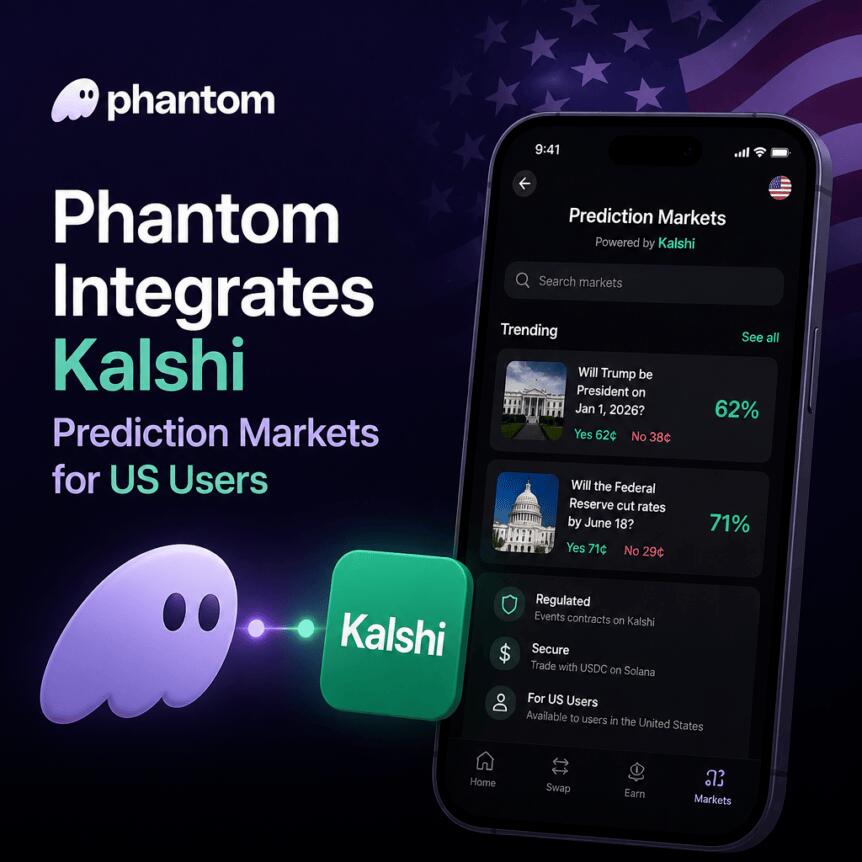
Phantom is rolling out prediction markets to eligible US users directly inside its wallet app, using an integration with Kalshi. The move brings CFTC-regulated event contracts—ranging from short-term Bitcoin price markets to sports and other real-world events—into a familiar trading interface for crypto users.
In a Wednesday announcement, Phantom said the new functionality appears under a dedicated “Predict” tab. Availability varies by US state and by market category, and Phantom Cash balances can be used to fund trades denominated in the CASH stablecoin. Kalshi, meanwhile, handles customer verification, account management, and trade execution, while Phantom provides in-app access.
Key takeaways
- Phantom’s “Predict” tab integrates Kalshi so eligible US users can trade CFTC-regulated event contracts within the wallet.
- Event contracts include short-term Bitcoin price markets that settle on a 15-minute schedule.
- Funding is routed through Phantom Cash, denominated in the CASH stablecoin, with Kalshi running verification and execution.
- The launch follows a March CFTC no-action letter that allowed Phantom to connect users to regulated markets without registering as an introducing broker, subject to conditions.
- Kalshi’s growth continues despite ongoing US legal challenges involving federal derivatives rules and state gambling laws.
What Phantom’s prediction market integration adds for US users
For traders, the most practical change is where they can place bets. Phantom has positioned prediction markets as an in-app experience that resembles a token swap workflow, but with event contracts instead of tokens.
Once users qualify, the Predict tab provides live market data, sports scores, and market discussions. Phantom’s announcement emphasizes that users can view information about markets before placing trades, suggesting the app is designed to support both research and execution without leaving the wallet environment.
The integration also specifies operational details: trades are tied to CFTC-regulated event contracts, and settlement timing for at least some Bitcoin-linked markets is every 15 minutes. That cadence matters for traders who rely on short time windows rather than longer-dated outcomes.
The compliance framework: why the CFTC no-action letter matters
Phantom’s ability to connect users to regulated event contracts does not come from an open-ended license—it builds on a regulatory “no-action” pathway previously granted by the US Commodity Futures Trading Commission.
Earlier coverage from Cointelegraph noted that in March the CFTC granted Phantom no-action relief, allowing the wallet provider to route users to regulated markets without registering as an introducing broker, provided certain conditions are met. By referencing that relief, Phantom’s latest launch effectively signals that its prediction-market offering is intended to stay aligned with the structure the CFTC outlined.
For users, the practical implication is that the integration is designed around the assumption of CFTC oversight of the underlying event contracts. For investors and builders, it also reinforces a broader industry point: in the US, access to “prediction market” functionality often depends on how products are structured and how intermediaries position themselves with regulators.
Kalshi’s legal fight is still intensifying
Phantom’s announcement lands while Kalshi remains at the center of a widening dispute over what governs event-contract trading in the United States. According to Cointelegraph, on Monday the CFTC sued Utah after the state challenged Kalshi’s event contracts under its gambling laws.
The core tension in these cases is the relationship between federal derivatives regulation and state gambling rules. Even as that uncertainty persists in court, participation in Kalshi’s markets has continued to expand.
That momentum is reflected in data compiled by DeFi Rate. DeFi Rate reported that Kalshi recorded $10.8 billion in crypto contract volume over the 30 days ending Oct. 27, representing a 19.6% increase compared with the prior period. The figures underline an asymmetry that is common in crypto-adjacent regulatory battles: legal outcomes may be slow, but market demand can increase while the framework is still being tested.
For traders considering alternatives to traditional exchanges or sportsbooks, this ongoing growth suggests that many participants are willing to use these venues now—even as courts continue to determine the legal boundaries.
How “in-wallet” market access could reshape the user experience
Prediction markets historically have leaned on dedicated platforms. By contrast, Phantom is making event trading feel like another capability inside a crypto wallet—complete with contextual information (like sports scores) and an execution flow designed to reduce friction.
That approach may influence adoption in two ways. First, it lowers the barrier for casual crypto users who already manage balances in a single app and may not want to create and manage accounts elsewhere. Second, it turns prediction markets into a “just-in-time” activity: users can research and trade without switching tools, which can matter for shorter settlement cycles such as 15-minute Bitcoin price markets.
However, the launch also signals that access is not uniform. Phantom’s rollout is subject to eligibility requirements and varies by state and category of market. That means wallet-based access does not eliminate regulatory differences across jurisdictions; it simply changes how quickly eligible users can reach regulated products.
What to watch next
Phantom’s prediction-market rollout is a concrete example of regulated event trading integrating deeper into mainstream crypto tooling, but the broader US legal questions around event contracts are still in play. Traders and developers should watch how the CFTC’s ongoing actions against state-level challenges evolve—and whether court outcomes change which markets become broadly available or how wallet providers structure similar integrations.
This article was originally published as Phantom Integrates Kalshi Prediction Markets for US Users on Crypto Breaking News – your trusted source for crypto news, Bitcoin news, and blockchain updates.
0
0

 Manage all your crypto, NFT and DeFi from one place
Securely connect the portfolio you’re using to start.
 Where will Bitcoin trade next?
Live Polymarket and Kalshi odds on Bitcoin price targets, compared side by side.
See Bitcoin price odds


