
Dogecoin price at its August low: why DOGE is falling twice as hard as bitcoin

0
0
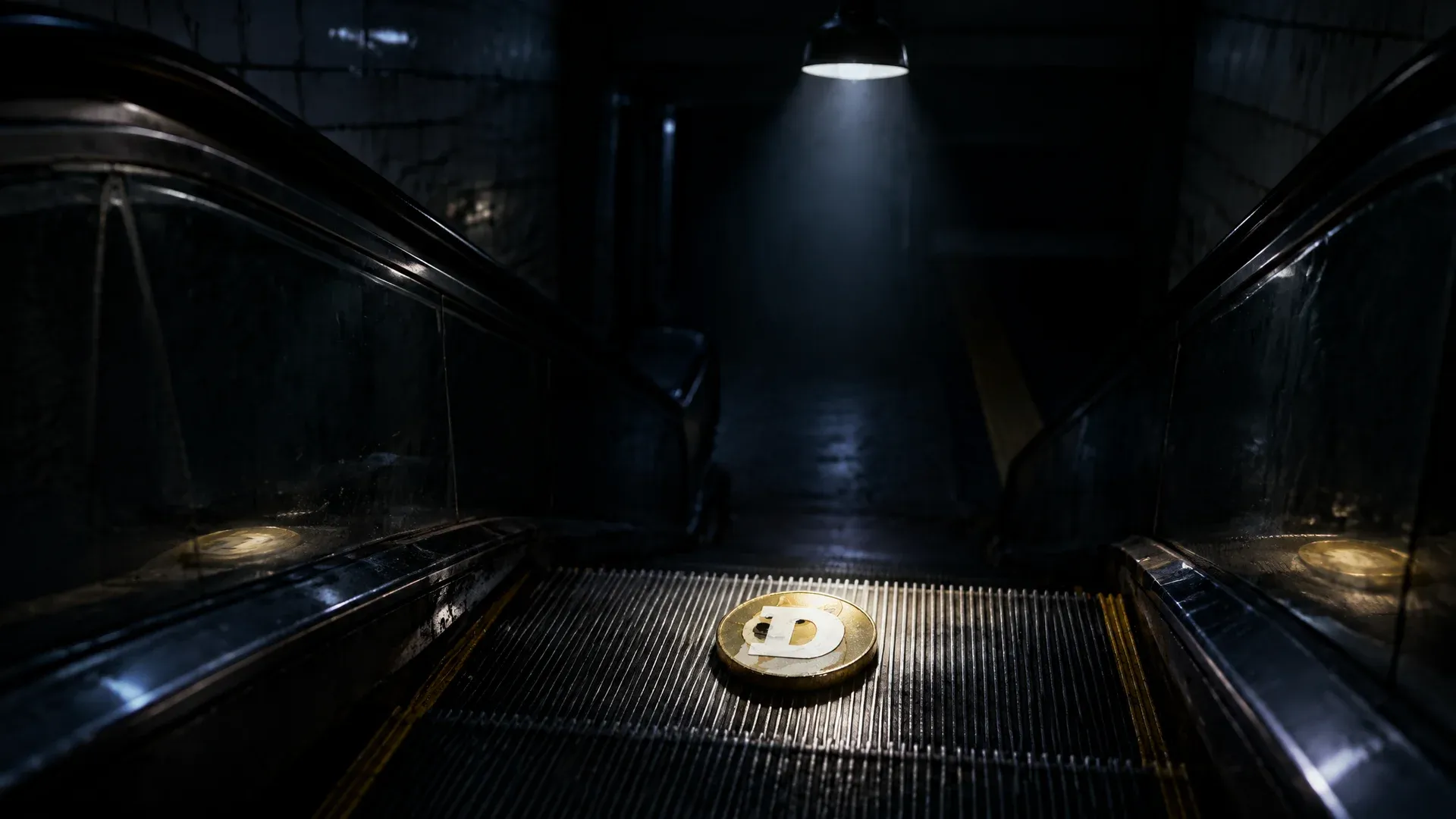
Dogecoin is falling because bitcoin is falling, and roughly twice as hard. On Monday evening, November 9, 2026, Dogecoin (DOGE) traded at about $0.0700, or €0.0625, according to CoinGecko. During the day the price slid as low as $0.0679, reaching the low last seen in early August 2026. Besides bitcoin's weakness, the price is weighed down by a derivatives market positioned one-sidedly for a rebound, a lack of support from the corporate side and a fearful mood across the market.
What is documented: price, daily range, account ratio and futures volume come from public market data published by CoinGecko and OKX, as of Monday evening. Our view of what this means for the coming days follows further down in a separate section.
Dogecoin price on Monday evening: $0.0700 after an intraday low of $0.0679
In the 24 hours to the evening, DOGE moved between $0.0679 and $0.0714. The net result is a loss of 1.7 percent, 5.9 percent over seven days and 17.9 percent over 30 days. On October 10 Dogecoin still closed at $0.0853, on November 2 at $0.0755. A year earlier, on November 10, 2025, the daily close stood at $0.179. Anyone who bought then is now sitting on a loss of a good 60 percent.
Market capitalisation is just under $11 billion, which puts Dogecoin in 13th place among the largest cryptocurrencies. Trading volume across all exchanges tracked by CoinGecko was around $700 million, almost three times the level of a quiet Sunday, when it came to just over $244 million. Both moving averages sit well above the price: the 50-day average of closing prices at $0.0848 and the 200-day average at $0.0856. A moving average is the mean of the closing prices over the stated number of days; when the price is below it, the trend points down.
Bitcoin below $75,000: DOGE loses twice as much in 30 days
The main reason for the decline does not lie with Dogecoin itself. Bitcoin traded at $74,800 on Monday evening, 1.5 percent lower than the day before and 9.0 percent lower than 30 days ago. At midday bitcoin slipped below Strategy's average cost basis of $75,451, a level many traders watch as a psychological support.
Over the same 30 days Dogecoin lost 17.9 percent, almost exactly double. This pattern is typical of memecoins. They have no earnings of their own, no fee income for holders and no staking yield to keep buyers on board in weak phases. Their price depends on the risk appetite of the whole market, and the market gauges that appetite first by bitcoin. When bitcoin falls, investors pull money out of the most speculative assets first.

DOGE against bitcoin: from 96 to 93 satoshi in five days
How much of the weakness is home-made shows in the price of Dogecoin measured in bitcoin. A satoshi is one hundred-millionth of a bitcoin, the network's smallest unit. On November 4 one DOGE still cost 96 satoshi; on Monday evening it was 93 satoshi, according to CoinGecko. So Dogecoin has also lost a good 3 percent against bitcoin in five days.
The discount is smaller than the loss in dollars, but it shows the direction: at the moment there is no reason drawing buyers specifically to Dogecoin rather than bitcoin. In recovery phases the relationship usually reverses, and DOGE then rises faster than bitcoin. As long as the satoshi figure keeps falling, that signal is missing.
Long accounts on OKX: the ratio stands at 4.9 to 1
The second reason lies in the derivatives market. On the OKX exchange, according to its public trading statistics, there were 4.93 accounts holding a long position for every account with a short position on Monday. A long position profits when the price rises, a short position when it falls. On October 20 the ratio was still 3.19 to 1. Since then the price has dropped by roughly a fifth, and the number of accounts betting on a recovery has gone up.
The picture across several exchanges was similar at the weekend. According to an analysis by TokenPost, 73.4 percent of the accounts tracked held a long position in DOGE on Saturday evening, November 7, even though the funding rate was slightly negative at minus 0.0013 percent per eight hours. The funding rate is a balancing payment between the long and short sides of perpetual contracts; when it is negative, long holders pay the short side. Many accounts on one side and the capital on the other: that suggests mainly smaller traders are betting on rising prices, while larger positions are hedging or wagering on further losses.
A crowded long side is no floor. Each of these positions has a pain threshold at which it is closed by a stop order or a forced liquidation. The exchange then sells the contract, and that sale pushes the price down further until the next cluster of positions is reached.
Trading volume triples: contracts changed hands at the August low
Volume shows how violent Monday was in the derivatives market. For DOGE contracts on OKX, the exchange reported trading volume of $224 million for Monday up to the evening, against $76 million for the whole of Sunday. Open interest, the sum of all positions not yet closed, fell over the same period from $119.7 million to $111.3 million. So positions were closed when the price hit the August low, but not on a large scale: around 93 percent of the contract value is still open.
The funding rate on OKX stood at plus 0.0051 percent at the 5 p.m. German time settlement, close to zero. A strong skew in favour of the short side, of the kind that often builds up before a short-squeeze rally, is therefore not visible.
House of Doge and 21Shares: the corporate tailwind is gone
The third reason is the backdrop. House of Doge, the listed corporate arm around the Dogecoin Foundation, has lost its exclusive licence. According to a filing with the US Securities and Exchange Commission dated October 23, reported by the news site Coinpaper on October 26, the exclusivity ended with effect from October 19. House of Doge owes the foundation $400,000, payable in cash or in shares once sufficient funds are available, and must remove the Dogecoin brand from its company names by December 31, 2026.
Shortly afterwards the ETF provider 21Shares ended its cooperation with House of Doge on its Dogecoin product TDOG. Neither announcement did much to the price itself. Both, however, take off the table a story that had attracted buyers in the spring: that a listed company would carry Dogecoin into wide use as a means of payment.
Fear index at 29: the wider market stays under cover
The Crypto Fear and Greed Index from data provider Alternative.me stood at 29 points on Monday and 28 on Sunday. The index combines price volatility, volume, social media sentiment and bitcoin's share of the total market into a value between 0 and 100. Readings below 25 count as extreme fear there, and the range above that up to the middle of the scale as fear. For a memecoin whose price lives on buyers' mood, that is a difficult environment: in such phases new money tends to flow into bitcoin or stays parked in stablecoins.
What changed since Sunday: the $0.0690 level held only on a closing basis
On Sunday evening Dogecoin cost $0.0712. Our article on the buyers of November 2025 named $0.0760 as resistance at the time and $0.0690 as the next support, because the lowest daily close of the year had been recorded there in August. Two things have happened since. DOGE has broken down out of the $0.0706 to $0.0720 range in which it swung on Sunday. And the $0.0690 level was briefly breached on Monday, with the intraday low at $0.0679. A daily close below it has yet to happen, though: the lowest close of the year remains $0.0690, from August 7.
The same question therefore arises once more, one step lower. Support is no longer a single number but a zone between $0.0679 and $0.0690.

Dogecoin price levels: $0.0679 below, $0.0760 above
On the downside, the zone from $0.0679 to $0.0690 is the first level, and it has already held twice: in early August the price turned higher there, and on Monday it has held again so far. If DOGE closes below it, that would be the lowest daily close of 2026, and the data for the past twelve months would show no lower area where buyers have stepped in before.
On the upside, the first hurdle is $0.0714, Monday's intraday high. Above that comes $0.0760, the level we named as resistance on Sunday; DOGE last closed just below it on November 2. Only a close above that value would show that last week's downward push is over. The 50-day average at $0.0848 is a good 21 percent away.
Stop-loss on Dogecoin: how the order works below $0.0679
If you hold DOGE and plan to sell should the August low break, you should know the difference between two order types. A stop-loss order becomes a market order as soon as the price reaches the stop level and then sells at the next available price. In a fast market that can be well below the level. A stop-limit order also sets a minimum price; it never sells below it, but may not be executed at all if the price rushes through.
At a level where many traders place their stops, a brief slip-through is common: the accumulated sell orders trigger at the same time, the price drops below the level for a few minutes and then returns. If you put your stop just under $0.0679, you are standing right in that crowd. A stop placed a little away from the round or obvious number reduces the risk of being sold out in such a spike. Also check whether your exchange offers stop orders for DOGE at all; some beginner apps only know buying and selling at market price.
Anyone trading with leverage also has a liquidation price at which the exchange forcibly closes the position. The higher the leverage, the closer it sits to the entry. With a price that swings 5 percent in a day, as it did on Monday, even tenfold leverage is a bet that the August low holds.
Buying Dogecoin under MiCA: a licensed EU exchange rather than a leverage platform
For investors in Germany weighing a purchase at this price, the route you buy through matters more than the timing. Since the transition period for the EU's Markets in Crypto-Assets Regulation (MiCA) ended, providers that sell or hold crypto assets in Germany need authorisation as a crypto-asset service provider in the EU. Whether a platform has it can be checked in the public register of the European Securities and Markets Authority, ESMA. Which providers are authorised and what they charge in fees, we compare among the regulated crypto exchanges.
A purchase on the spot market, meaning buying the coins directly without credit, cannot be liquidated. The price can fall, but the position is not forcibly closed. Anyone who switches instead to platforms with perpetual contracts and leverage often trades with providers outside EU supervision. Fees differ too, and on small amounts they weigh more heavily than a few tenths of a cent on the price. Our crypto exchange comparison gives an overview.
For buyers who have held DOGE for some time, the tax angle from Sunday's article still applies under German rules: losses from sales within one year of purchase can be offset against other private capital gains from disposals, after that no longer. If you want to document your purchases properly, you will find suitable tools in our comparison of crypto tax tools.
Dogecoin from the newsroom's view: no turnaround without bitcoin
Our assessment: there is currently no trigger of its own for a Dogecoin recovery. The evidence is set out above. DOGE is losing twice as much as bitcoin over 30 days, its ratio to bitcoin keeps falling to 93 satoshi, the fear index stands at 29, and the corporate side is producing departures rather than new partners. On top of that, the derivatives market, with almost five long accounts per short account, sits on the side that would be forced to sell if the zone around $0.0679 breaks. In our view it follows that the direction of DOGE in the coming days will be decided by bitcoin, not by Dogecoin itself.
Against this: the zone around $0.0680 already held in August, after which the price climbed to above $0.093 by the end of that month, a good third higher, and the funding rate is no longer negative. There is no certainty in either direction. Memecoins can also fall far below earlier lows, and a total loss is possible with Dogecoin as with any cryptocurrency.
Dogecoin at the August low: a close below $0.0690 would be a first for 2026
- Decide what you will do on a daily close below $0.0690, and choose the order type deliberately. Where you can place stop and limit orders for DOGE is shown in the exchange comparison.
- Before buying, check whether your platform holds a MiCA licence. Authorised providers are listed among the regulated crypto exchanges.
- Record the purchase date and price of every position so that you can offset losses within the one-year period. The crypto tax tools help with this.
(As of November 9, 2026. This article is not investment advice. Prices and fee structures change; check the terms with the provider before you buy.)
0
0


 Manage all your crypto, NFT and DeFi from one place
Securely connect the portfolio you’re using to start.
 Where will Bitcoin trade next?
Live Polymarket and Kalshi odds on Bitcoin price targets, compared side by side.
See Bitcoin price odds


