
Gold vs bitcoin: one bitcoin now buys only about 18 ounces of gold

0
0
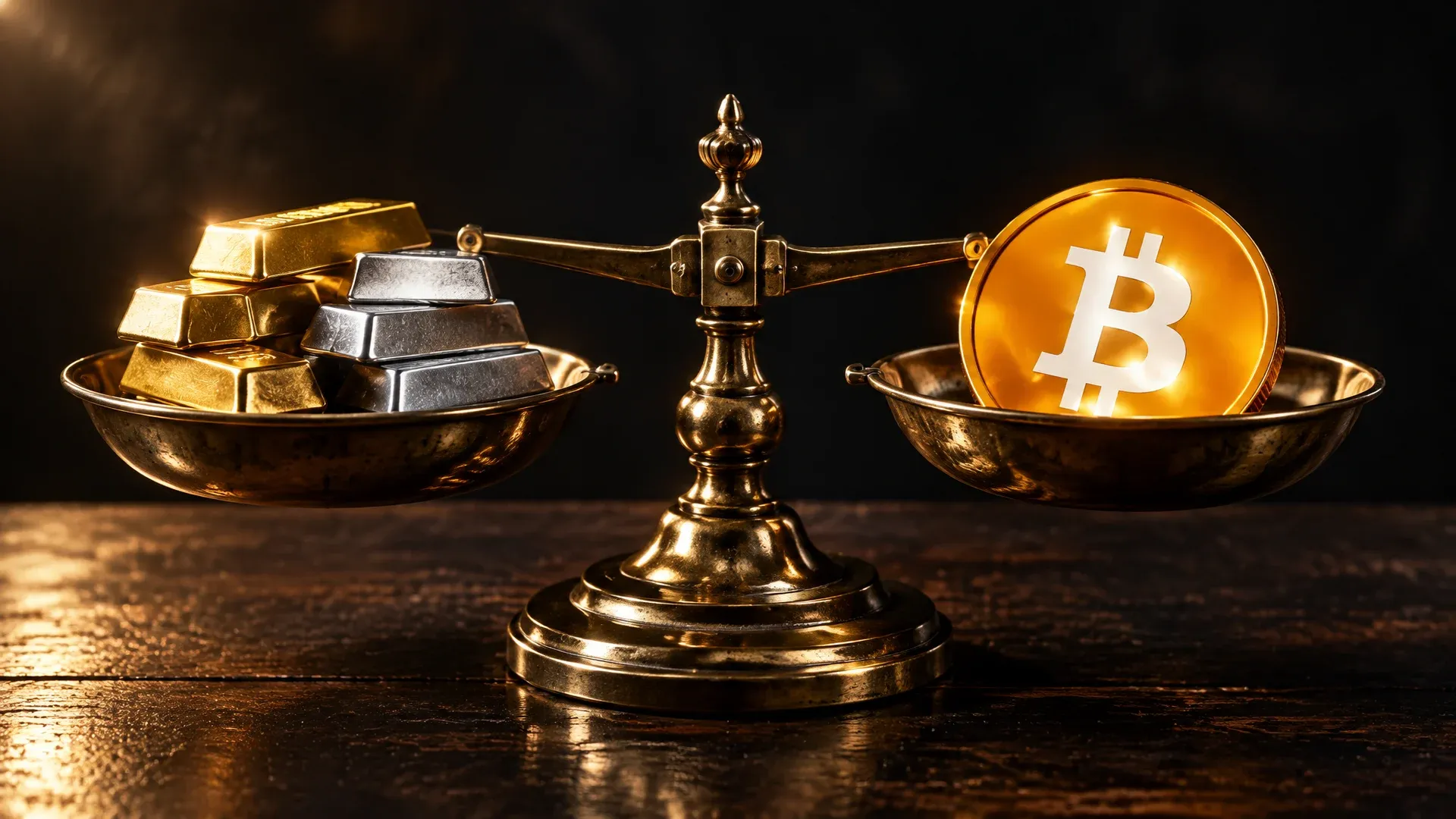
Gold and bitcoin are both seen as a hedge against currency debasement, yet the balance of power between them has more than halved within a year. On Thursday, November 12, one bitcoin cost about $71,300 and a troy ounce of gold $3,885. One bitcoin was therefore worth 18.4 ounces of gold. In December 2024 the figure was almost 40 ounces. By Friday afternoon it had slipped further to around 17.7 ounces, because bitcoin fell more sharply than the metal.
The short answer to the question of what the precious metals rally means for crypto investors: the rally is over, and it did not lift bitcoin with it. Gold is 27 percent below its record of January 29, silver as much as 57 percent below its high of January 26. Bitcoin stands 43 percent below its record close of October 6, 2025. What is new is something else: since the summer, gold, silver and bitcoin have fallen on the same day strikingly often. If you hold bitcoin and precious metals as counterweights in your portfolio, you should know these numbers.
For this article we analysed the daily closing prices of gold and silver futures on the Comex exchange in New York and the dollar price of bitcoin since 2021. All percentages refer to the dollar. In euro terms the picture looks similar, because on Thursday the euro stood at $1.11, almost exactly where it was at the start of 2024. Converted, an ounce of gold cost about 3,500 euros and one bitcoin about 64,300 euros.
Bitcoin-to-gold ratio: how many ounces of gold one bitcoin is worth
The bitcoin-to-gold ratio divides the bitcoin price by the price of gold per ounce. The measure strips out the dollar and shows which of the two assets is gaining relative to the other. When it rises, bitcoin is gaining on gold. When it falls, gold is ahead.
From the FTX low to a record and back again
At the end of November 2022, after the collapse of the FTX exchange, one bitcoin bought just over 9 ounces of gold. The ratio then turned sharply higher. On December 17, 2024 it peaked at 39.9 ounces, with bitcoin trading at around $106,000 and gold at $2,660. Since then the trend has been mostly downward: 36 ounces at the start of 2025, just under 21 ounces at the start of 2026 and a low of 12.4 ounces on February 23, 2026. At that point gold was still above $5,200, while bitcoin had dropped to just under $65,000.
| Date | Bitcoin in dollars | Gold per ounce in dollars | Ounces of gold per bitcoin |
|---|---|---|---|
| November 21, 2022 | about 15,800 | about 1,740 | 9.1 |
| December 17, 2024 | 106,141 | 2,662 | 39.9 |
| January 29, 2026 (gold record) | 84,562 | 5,318 | 15.9 |
| February 23, 2026 | 64,617 | 5,226 | 12.4 |
| November 12, 2026 | 71,343 | 3,885 | 18.4 |
Since February the ratio has recovered by almost half. Most of that came from the gold price, which has dropped by around 26 percent since February 23, while bitcoin gained about 10 percent over the same period. The ratio is not a buy signal. It only shows in which direction the two assets have moved relative to each other.
Performance since 2024: silver leads, bitcoin posts the smallest gain
If you had put equal amounts into gold, silver and bitcoin on January 2, 2024, all three positions would be in profit on November 12, 2026. The ranking still surprises many crypto investors.
| Period to November 12, 2026 | Gold | Silver | Bitcoin |
|---|---|---|---|
| since January 2, 2024 | plus 87.4 percent | plus 110.6 percent | plus 58.7 percent |
| since January 2, 2025 | plus 45.6 percent | plus 68.7 percent | minus 26.4 percent |
| since January 2, 2026 | minus 10.3 percent | minus 29.2 percent | minus 20.7 percent |
| twelve months (since November 12, 2025) | minus 7.8 percent | minus 6.3 percent | minus 29.8 percent |
Over almost three years, silver has clearly beaten bitcoin, and so has gold. Bitcoin was only ahead for a while: at the end of 2024 the cryptocurrency stood at more than twice its level at the start of that year, while gold had gained about a quarter. The gap only opened in 2025 and 2026, when bitcoin slid from its record of almost $124,800 just as the precious metals began their big rally.
Precious metals rally in 2025 and 2026: a surge until January, then the slump
The precious metals rally came in two phases. In 2025 gold climbed from about $2,670 to more than $4,300, silver from just under $30 to more than $70. January 2026 brought the final sprint: silver closed at $115 on January 26, gold at $5,318 on January 29. Both were records.
Since then prices have been falling, and silver much faster. On November 12 silver closed at just under $50, 57 percent below its high. Gold lost 27 percent over the same period. What lies behind the fall in gold and why gold lost its reputation as a safe haven in this phase is explained in our article on the falling gold price from October 31.
For bitcoin investors one number from this phase is instructive: silver, the classic crisis metal, has lost more since January than bitcoin has since its record. An asset's reputation does not protect it from a deep setback when prices have risen steeply beforehand.

Gold and bitcoin correlation: why both are suddenly falling together
Correlation measures how closely two prices move in step. A value of 1 means they move in perfect lockstep, 0 means there is no relationship, and minus 1 means they move in exactly opposite directions. We compared the daily price changes of bitcoin and gold for each year.
- 2024: correlation 0.07, practically no relationship
- 2025: correlation 0.09, also barely measurable
- 2026 to November 12: correlation 0.25
- last 90 trading days: correlation 0.50
The trend between bitcoin and silver is similar, with a value of 0.53 over the last 90 trading days. Gold and silver themselves have moved closely together for years, most recently at 0.86.
Ten days of losses in both since January
A simple count shows it more clearly than any statistic. On how many trading days did gold and bitcoin each lose more than 2 percent? In 2023 there was not a single one, in 2024 and 2025 two each. In 2026 there have already been ten up to November 12, including October 22 and most recently Thursday itself, when gold fell 2.9 percent and bitcoin 3.5 percent.
This only establishes that they move together, not why. One plausible explanation: when investors need liquidity in several markets at the same time, they sell whatever can be sold, and that includes gold as well as bitcoin. For portfolio planning, the consequence is what counts. A mixed portfolio of bitcoin and precious metals provided less of a cushion in weak phases in 2026 than in the two years before.
Volatility in 2026: silver at 69 percent, bitcoin at 44 percent
Volatility describes how strongly a price fluctuates around its average, annualised. Bitcoin has traditionally led the field here. In 2024 that still held true: at about 56 percent, bitcoin fluctuated almost twice as much as silver at 31 percent and almost four times as much as gold at 15 percent.
In 2026 the picture has flipped. Up to November 12, silver shows volatility of around 69 percent, bitcoin 44 percent and gold 29 percent. Gold can no longer be considered a calm counterweight either: its volatility has almost doubled compared with 2024.
For investors who avoid bitcoin because of its swings and turn to silver instead, that is an important finding. How much an asset swings depends heavily on the market phase. A metal that climbs from $70 to $115 within a few weeks can fall just as quickly.
Gold-to-silver ratio: 78 ounces of silver for one ounce of gold
The gold-to-silver ratio tells you how many ounces of silver you get for one ounce of gold. It is the oldest yardstick among the precious metals and works on the same principle as the bitcoin-to-gold ratio. In April 2025 it stood above 105, because silver initially lagged behind the gold rally. On January 26, 2026, the day of the silver record, it had shrunk to 44. On November 12 it was back at almost 78.
The ratio shows how far silver overshot during the rally. Within little more than nine months the ratio more than halved and then almost doubled again. Investors are used to swings like that from bitcoin, but many do not expect them from precious metals.
Bitcoin as digital gold: what the 2026 numbers say about the safe haven
The digital gold label rests on one thing the two have in common: both assets are scarce, the supply of bitcoin is capped at 21 million units, and neither pays interest. Even so, bitcoin has not proven itself as crisis protection over the past three years. In phases when gold rose, bitcoin often went its own way, and since the summer of 2026 bitcoin has tended to fall alongside the precious metals rather than offset their losses.
Market capitalisation, the total value of all units, is also far apart. On November 12 the entire bitcoin supply was worth about $1.4 trillion. The World Gold Council estimates above-ground gold stocks at more than 200,000 tonnes, which at the current price is worth well over $20 trillion. Anyone who buys bitcoin because of its resemblance to gold is therefore also buying into a narrative that the price data has so far only partly supported.
How gains on gold and bitcoin are taxed depends on the country you live in; our comparison of crypto tax software helps you keep track of purchases and holding periods.
Ways to buy: bars, gold ETCs, bitcoin ETNs or a crypto exchange
You can buy gold and silver as bars and coins from a bullion dealer or a bank, as an exchange-traded security, or as a tokenised version on a blockchain. With bitcoin, you can choose between buying directly on a crypto exchange and securities that track the price.
- Physical precious metal: you own the metal itself, but you have to store and insure it. The spread between the buying and selling price is high for small denominations.
- Gold-backed exchange-traded securities: products that give you a claim to delivery of the gold are treated differently for tax purposes from products that only pay out cash. Check how the product is structured before you buy.
- Bitcoin directly: through a crypto exchange you own real bitcoin, which you can also transfer to your own wallet. Look for a licence under the EU's MiCA regulation and pay attention to fees. Our comparison of crypto exchanges gives you an overview.
- Bitcoin ETNs and ETFs: exchange-traded products track the price and can be held in an ordinary brokerage account. Which ones are tradable in Germany is covered in our guide to crypto ETFs in Germany. The tax treatment depends on how the product is structured and has not been conclusively settled in every case.
Tokenised gold combines both worlds: a token on a blockchain represents a share in gold held in a vault. In the EU, such a provider has needed a licence since the transition periods ended. What matters here is shown in our article on tokenised gold in the EU.
Bitcoin and precious metals allocation: what the numbers mean for your split
Three years of price data lead to three sober conclusions. First, none of the three assets came out on top every year: bitcoin won in 2024, silver in 2025, and so far in 2026 gold has lost the least. Second, the volatility of all three assets has risen in 2026, most of all for silver. Third, precious metals currently work only to a limited extent as a counterweight to bitcoin, because their prices fall together more often.
No particular allocation follows from this, but a test question for your portfolio does: how far would it fall if bitcoin and gold dropped on the same day, as they did on November 12? If you have a clear answer and can live with the losses, you can hold bitcoin and precious metals side by side. A savings plan also spreads your entry over many prices instead of betting everything on one moment.
Gold and bitcoin: at 18 ounces, your portfolio weighting decides
- Choose how to buy: decide whether you want to own bitcoin directly or prefer a security in your brokerage account. You will find providers with a MiCA licence in our comparison of providers for buying bitcoin.
- Spread your entry: with annual swings of more than 40 percent, the right moment is almost impossible to pick. A bitcoin savings plan buys at fixed intervals and smooths out your average price.
- Record your purchases: note the date and price of every purchase of bitcoin and precious metals so that you can document your holding periods. Crypto tax tools and portfolio trackers help with this.
(As of November 13, 2026. This article is not investment advice. Prices and fee structures change; check the terms with the provider before you buy.)
0
0

 Manage all your crypto, NFT and DeFi from one place
Securely connect the portfolio you’re using to start.
 Where will Bitcoin trade next?
Live Polymarket and Kalshi odds on Bitcoin price targets, compared side by side.
See Bitcoin price odds


