
Coinbase stock in the crypto crash: lowest close since February 2024

0
0

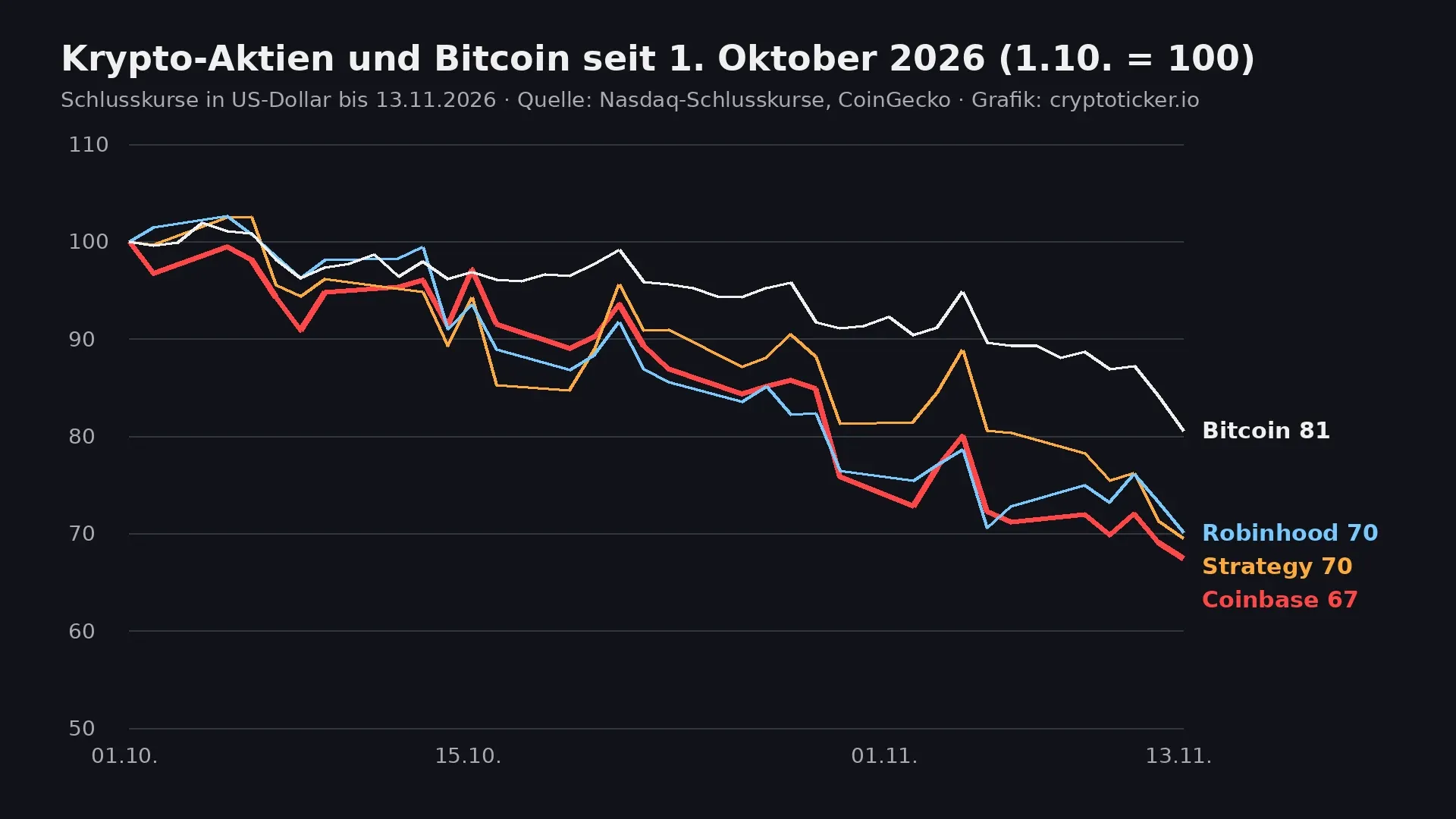
Coinbase stock has taken the full force of the crypto crash of the past few days. On Friday, November 13, 2026, the shares closed at $127.65 on Nasdaq. The last time the closing price was this low was February 2024. During the session the stock even slipped to $125.38, its lowest level of the past twelve months. Coinbase has thus lost 46 percent of its value since the start of the year and almost 33 percent since October 1.
The heart of the story, however, is not the price alone. Coinbase makes its money mainly from trading fees, and that revenue had already collapsed in the third quarter, before the November slump even began. On top of that comes a second effect many investors overlook: Coinbase itself holds almost 18,000 Bitcoin, and at the current price their value is below what the company paid. Here you will find what that means for the next quarterly results, where the stock stands on the chart and how to assess the move with or without leverage.
Coinbase stock at $127.65: where the price stands after the weekly close
A look at the closing prices shows how steep the way down has been. On November 14, 2025, Coinbase still traded at $284.00, the highest close of the past twelve months. The record close of $419.78 on July 18, 2025, lies further back still. Measured against that, the stock has lost 55 percent in a year and is almost 70 percent below its high.
The latest leg down came in early November. On November 4, Coinbase closed at $151.50, and a day later at $136.82. That was a drop of 9.7 percent in a single trading day, two days after the US midterm elections. Since then the decline has continued in smaller steps: $136.27 on November 11, $130.67 on November 12 and finally $127.65 at the weekly close.
Important for investors in Europe: the stock trades on Nasdaq in dollars. If you hold it via a European trading venue in euros, you also carry the currency risk between the euro and the dollar. Stock trading pauses at the weekend, while the crypto market runs around the clock. What Bitcoin does until Monday therefore often already shapes Coinbase's opening price on November 16 at 3:30 pm Central European Time.
Crypto stocks versus Bitcoin: why Coinbase, Strategy and Robinhood fall harder
Coinbase is not alone in its losses. Shares of Strategy, the largest Bitcoin holder among listed companies, closed at $111.62 on November 13, 30.5 percent below their level on October 1. Robinhood lost 30.0 percent over the same period to $77.86. Bitcoin itself fell about 20 percent in those six weeks. The shares of crypto companies have therefore fallen much harder than the cryptocurrency their business depends on.
The reason is an effect analysts call operating leverage. It means that a company's costs barely change when revenue fluctuates. When crypto prices fall, retail investors trade less and fee income drops disproportionately, while salaries, data centres and marketing keep running. Profit therefore shrinks faster than the market. In an upswing the same effect works in reverse, which is what makes the stock so strong in rallies.
If you follow Strategy stock, you see a different mechanism: there, market value depends almost entirely on the Bitcoin holdings. How far the Bitcoin price has now dropped below Strategy's cost basis is covered in our analysis of Strategy stock. Coinbase, by contrast, is first and foremost a trading platform, and its figures show where the pressure is coming from.
Q3 2026 earnings: Coinbase transaction revenue slumps 44 percent
On October 29, 2026, Coinbase filed its third-quarter report with the US Securities and Exchange Commission. The figures in the quarterly report (Form 10-Q) are clear: transaction revenue, meaning fees from trading on the platform, fell year on year from $1.046 billion to $590 million. That is a decline of 43.6 percent. The drop was even larger among retail customers, where revenue fell from $844 million to $450 million, a slump of 46.6 percent.
Total revenue fell from $1.869 billion to $1.216 billion, down 35 percent. The subscriptions and services business, which includes interest income from the USDC stablecoin, held up somewhat better. At $307 million, stablecoin revenue was only 5.4 percent below the prior year. A stablecoin is a cryptocurrency whose value is pegged to a currency such as the US dollar and backed by reserves.
At first glance the quarter still looked good, because Coinbase reported net income of $718.7 million after $432.6 million in the prior-year quarter. A look at the income statement, however, shows that $715.0 million of that came from gains on the company's own crypto holdings. Without these valuation gains, little of the quarterly result would have been left. Many investors see exactly this item as a risk for the fourth quarter.
Coinbase's Bitcoin holdings: 17,954 BTC below their cost basis
As of September 30, 2026, Coinbase held 17,954 Bitcoin as its own investment, according to its quarterly report. The acquisition cost was $1.259 billion, or an average of about $70,120 per Bitcoin. At quarter-end the holdings were valued at $1.501 billion, equivalent to about $83,590 per Bitcoin. In addition there were 152,649 Ether with an acquisition cost of $346 million, an average of about $2,270 per coin, and a book value of $410 million.
At 6:54 pm on November 15, 2026, one Bitcoin cost $64,506 (58,519 euros) and one Ether $1,811. At these prices, Coinbase's Bitcoin holdings would be worth about $1.159 billion. That is roughly $342 million less than on September 30 and about $100 million less than Coinbase paid for the coins. The Ether holdings are about $134 million short of their quarter-end value. Together that makes a valuation gap of almost $476 million. cryptoticker.io compiled this analysis itself on November 15, 2026, based on the two holdings items in the quarterly report and the prices at the time stated.
Whether this amount actually shows up as a loss in the fourth-quarter figures depends on the price on December 31 and on whether Coinbase has bought or sold coins since. But the calculation shows how the leverage reverses: in the third quarter the company's own crypto holdings rescued the result, in the fourth they could weigh on it, while trading fees are under pressure at the same time.

What triggered the crypto crash: Fed rate expectations and ETF outflows weigh
There are several reasons why the crypto market has been under so much pressure since early November. In the futures market, traders now see a rate hike by the US Federal Reserve in December as almost certain. According to the CME FedWatch tool, the probability of a 0.25 percentage point move stood at 88.5 percent on November 14, as Bitcoin.com reports. Higher rates make safe investments more attractive and pull capital out of speculative assets such as cryptocurrencies and growth stocks.
On top of that come outflows from US spot Bitcoin ETFs. According to Farside Investors data analysed by the Coinpaper portal, investors pulled a net of about $1.07 billion out of these funds between November 9 and 13. When the Bitcoin price fell below $64,000 on the evening of November 14, leveraged positions worth $691 million were forcibly closed within an hour, according to TokenPost, about 97 percent of them bets on rising prices. How such chain reactions unfold is explained in our article on the long squeeze in the crypto market.
Sentiment is correspondingly poor. The Alternative.me Fear and Greed Index, which measures market sentiment on a scale of 0 to 100, stood at 10 points on November 15, in the zone of extreme fear. You will find an overview of the whole crypto crash covering Bitcoin, Ethereum, XRP and Solana in our market analysis. Why cryptocurrencies fall almost simultaneously in such phases is explained in our background piece on why Bitcoin is falling.
Will Coinbase stock fall below $100? The levels that matter
We do not give a price forecast, but past closing prices show where the stock has reacted recently. On the downside, the first level is the intraday low of November 13 at $125.38. Below that comes the close of February 7, 2024, at $122.07, the last time Coinbase closed lower than today. In early February 2024, the lowest close of those weeks was $117.30.
Coinbase last fell below the round $100 mark on November 17, 2023, when the stock closed at $99.05. From the current price that would be a further fall of just over 22 percent. In the current situation that is not an impossible scenario, but nor is it an inevitable one. What matters is whether Bitcoin stabilises above its recent lows. If the crypto market keeps falling, operating leverage suggests the stock will fall disproportionately with it.
On the upside, the first hurdle is the November 11 close of $136.27. The next important level is the November 4 close of $151.50, the price before the slump after the midterm elections. Only above that level would the downward push of the past two weeks be reversed.
Trading Coinbase stock: long, short and leverage via CFDs explained
If you bet on a recovery, you go long, profiting from rising prices. If you expect prices to keep falling, you go short and make money when the price drops. With the stock itself, only the upside is possible. For both directions, retail investors in Europe mostly use CFDs. A CFD (contract for difference) lets you bet on the price change of an underlying asset without owning it. You will find the basics in our article on long and short.
Leverage multiplies gains and losses alike. An example: you put up 1,000 euros of margin with 5x leverage and so move a position worth 5,000 euros. If Coinbase stock rises 10 percent, you gain 500 euros, or 50 percent of your stake. If it falls 10 percent, you lose the same 500 euros. With 10x leverage, a 10 percent price change already moves the position by 100 percent of your stake, in either direction. With 100x leverage, as some platforms outside the EU offer, a move of about one percent is enough to lose your entire margin. This point is called liquidation: the position is forcibly closed because the posted margin is used up.
In the EU, fixed caps apply to retail clients; they were introduced by the European securities regulator ESMA and are enforced in Germany by BaFin. For CFDs on single stocks the maximum leverage is 5, for CFDs on cryptocurrencies it is 2. Negative balance protection also applies, so you cannot lose more than the capital you deposited. You will find a comparison of regulated providers with terms for stock and crypto CFDs among our best crypto brokers. If you would rather trade cryptocurrencies directly instead of the stock, look for authorisation under the European MiCA regulation, which our overview of regulated crypto exchanges shows for each provider.
Two tools limit the risk. A stop-loss is an order that closes your position automatically once the price reaches a level you set. For a long on Coinbase, it could sit just below the intraday low of $125.38. Bear in mind, though, that a stock can open with a price gap after the weekend, in which case your stop-loss is executed at the next available price. The second tool is position size: many traders risk only a small, fixed share of their capital per trade, so that a misjudgement does not ruin the account.
Risk warning: CFDs are complex instruments and come with a high risk of losing money rapidly due to leverage. A large share of retail investor accounts lose money when trading CFDs; each provider must state the exact share on its website. Consider whether you understand how CFDs work and whether you can afford to take the high risk of losing your money.
Coinbase in the crypto crash: without a Bitcoin recovery there is no floor
Coinbase stock currently reflects two burdens at once. Trading fees, the core business, had already collapsed by 44 percent in the third quarter. The company's own Bitcoin holdings, which rescued the quarterly result, are below cost at the current price. Both depend on the crypto market, which is currently driven by rate worries and ETF outflows. To assess the situation, you can proceed as follows:
- Check the situation: Watch whether Bitcoin stays above its recent lows until the US market opens on Monday.
- Choose your trading route: Decide whether you want to buy the stock or trade it in both directions via CFDs, and compare providers among the crypto brokers.
- Limit your risk: Set your stop-loss and position size before you enter. If you trade cryptocurrencies directly, you will find MiCA-licensed providers among the regulated crypto exchanges.
(As of November 15, 2026. This article is not investment advice. Prices and fee structures change; check the terms with the provider before you buy.)
0
0

 Manage all your crypto, NFT and DeFi from one place
Securely connect the portfolio you’re using to start.
 Where will Bitcoin trade next?
Live Polymarket and Kalshi odds on Bitcoin price targets, compared side by side.
See Bitcoin price odds


