
Mono Protocol Explained: How Chain Abstraction Simplifies Web3

0
0
Mono Protocol Explained: Why Is This Crypto Project Getting Attention?
Mono Protocol wants to make Web3 feel like using one app on one chain. Users get a single account and a single balance, even when their money sits on many blockchains. That means no hunting for bridges, no buying extra gas tokens, and no constant network switching.
This idea is called chain abstraction, which simply hides the messy multi-chain steps behind one screen. Interest in this crypto project is rising because its token sale is live and the roadmap points to a token launch.
That keeps crypto news and crypto price searches busy. This guide explains the features, token use, supply split, roadmap, and risks, based on the project’s own pages checked on October 19, 2026.
How Does Mono Protocol Simplify Cross-Chain Activity?
Moving money across chains is a hassle today. A user with USDC on one network who wants ETH on another has to bridge funds, pay gas in a different token, and wait for confirmations. Every step costs time and adds a chance of error.
Mono Protocol tries a simpler route. The user states the goal, like swapping USDC for ETH on another chain, and the system does the rest. It picks the chains to spend from, decides if bridging is needed, chooses a solver or bundler, and settles the trade. The project says the user pays once, and fees across networks are worked out automatically.
What Are the Main Features of Mono Protocol?
The product page lists six modules, and each one fixes a specific pain point in multi-chain use.
Liquidity Locks: give instant execution without waiting for the source chain to finalize.
Mono Balances: merge token holdings across networks into one number and handle smart routing and gas.
Chain abstracted swap: one screen for cross-chain and cross-asset trades.
Account Architecture: works with embedded signers, so users never deal with gas directly.
Fees and Monetization: Let app builders set their own per-transaction fees.
Full Token Support: covers many assets.
Together, these modules aim to make a multi-chain app feel like a single-chain one. The project also claims up to 40% faster execution than traditional routes. That number comes from the project itself and was not tested independently.
What Is the MONO Token Used For?
MONO is the native token, and the project lists three jobs for it.
Fees: It pays for universal gas, plus quoting, routing, and resource lock fees.
Staking: Network operators such as bundlers, messaging nodes, and the orchestrator stake MONO to secure the network and share in protocol fees.
Execution bonds: Solvers and routers lock MONO as a deposit that can be lost if an instant trade fails.
According to the roadmap, staking and bonds start with the token launch phase. So these roles are plans for now, not live features.
How Is MONO Tokenomics Structured?
The initial supply is 141,252,439 MONO. Here’s the split the project has published.
Allocation | Share | Purpose |
Presale | 50% | Public token sale |
Liquidity | 10% | Market liquidity |
Marketing | 10% | Promotion and growth |
Team | 5% | Team allocation |
Treasury and Governance | 5% | Reserves and voting |
Strategic Reserve | 5% | Long-term reserve |
Ecosystem Incentives | 5% | Builder support |
User Rewards | 5% | Participation rewards |
Private Round | 5% | Early private investors |
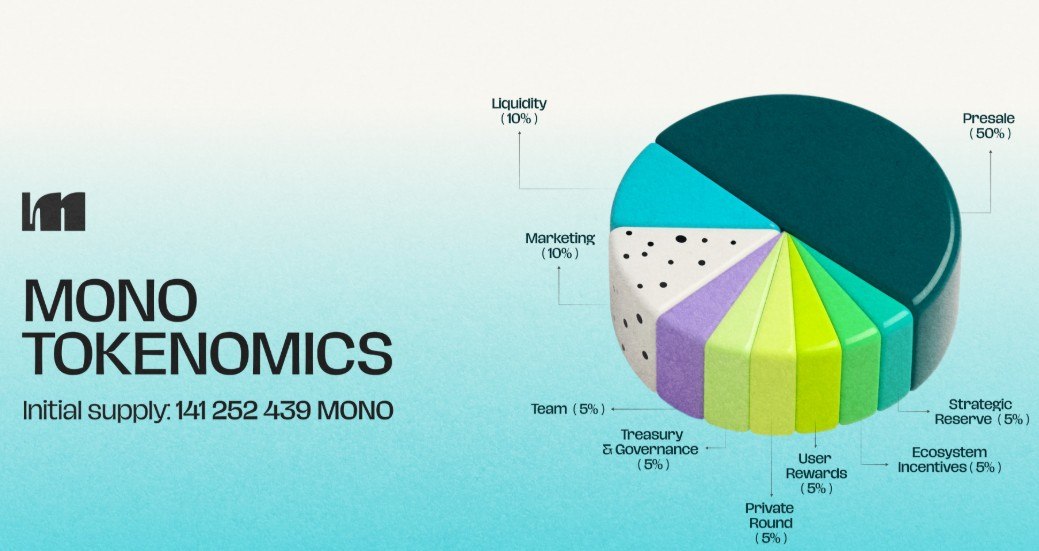
Half the supply goes to the presale. That’s a big public share, but it also means sale buyers could hold most of the circulating tokens at launch, so vesting (the schedule that decides when tokens unlock) matters.
The project says tokens unlock in phases and can be claimed after the token generation event. But a full vesting schedule wasn’t found in the pages reviewed.
Market cap and fully diluted valuation (FDV, the value of all tokens at one price) only mean something after a listing sets a real price. And a presale price isn’t a future crypto price.
What Does the Mono Protocol Presale Show Right Now?
The official presale page showed stage 45 live at $0.1200 per MONO, with about $11.82M raised against a $12M stage target and 4,478 investors. The planned launch price is $0.50.
The project cites a potential return of about 317%. That’s a projection, not a confirmed result. A 200% welcome promo and a Rewards Hub, where quests add extra presale tokens, are also advertised. These work a bit like a crypto airdrop bonus, though no formal airdrop has been confirmed.
What Does the Mono Protocol Roadmap Say, Step by Step?
Q4 2025, marketing and presale launch: website v1, docs v0, a litepaper, presale contracts and audits, KYC controls where needed, and a JavaScript SDK alpha. The site marked this phase as ongoing.
Q1 2026, performance: faster throughput, parallel routing, Bug Bounty v2, and a unified SDK with a partner sandbox.
Q2 2026, expansion: full Solana support, two or three more chains, Unified Balance v2 for non-EVM networks, and a second grants wave.
Q3 2026, token launch: the end of the crypto presale, a crypto listing on centralized and decentralized exchanges, staking, execution bonds, and the Universal Gas Module.
Q4 2026, full product: Mono Protocol v1.0, an enterprise layer, MEV-Shield v2, and a cross-chain payments module.
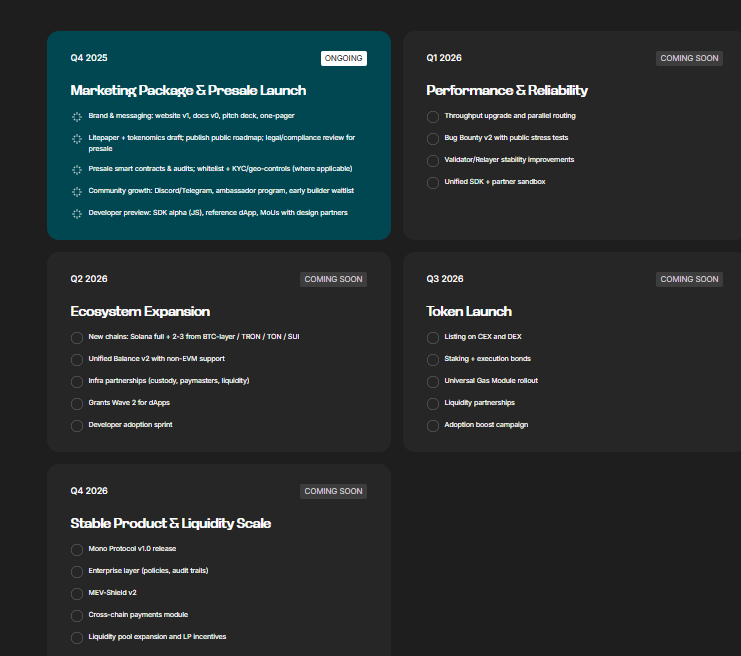
The site still showed the 2026 phases as coming soon.
What Risks Should Readers Consider?
Timing: the Q3 2026 launch target has passed with no confirmed listing date. The project only says news will come once all presale stages end.
Execution: chain abstraction needs solvers, bundlers, and routing to work well across many networks.
Valuation: $0.50 is a target, not a market price, and a half-supply presale can bring selling pressure after unlocks.
Safety: an audit badge doesn’t guarantee safety, and unclear vesting and regulation add more doubt.
What Does the Data Say About Mono Protocol?
The stronger signal is the product idea. One balance across chains solves a real usability problem. The weaker signal is delivery, since the roadmap still shows upcoming phases while the calendar has moved on.
The numbers worth watching are the vesting schedule, circulating supply at launch, and real network usage, because demand for MONO depends on actual transactions. Readers should also confirm the contract address and audit scope on official channels.
Conclusion
Mono Protocol is a chain abstraction project built around unified balances, liquidity locks, and a token that covers fees, staking, and bonds.
The use case is clear, and the allocation table is open. Vesting, listing timing, and real usage are still unanswered, so every figure deserves independent checking.
Disclaimer
This article is for information only and is not financial, investment, or legal advice. Crypto assets and presales carry a high risk of loss, and project figures may change. Readers should research independently and consult a licensed adviser before any decision.
0
0

 Manage all your crypto, NFT and DeFi from one place
Securely connect the portfolio you’re using to start.


