
Aave lenders face a thin withdrawal cushion if the $4B USDC cap fills

0
0

LlamaRisk on Friday raised the USDC borrow limit on Aave’s main Ethereum market to $4 billion from $2.7 billion.
If borrowers hit that cap at current deposits, it would put the reserve at 94.8% utilization, putting lenders in a tough spot for withdrawals.
LlamaRisk puts a fully drawn reserve at 94.8% utilization
The change went live at 11:15 UTC, minutes after LlamaRisk posted it in Aave’s governance forum. USDC loans touched 98.5% of the previous cap, and reserve utilization was 63.1%.
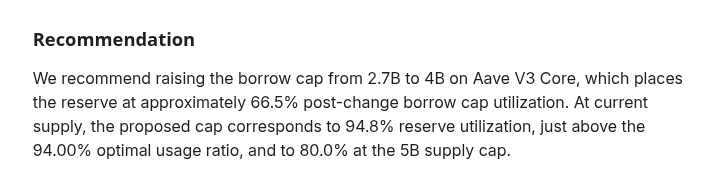
The new ceiling takes borrow-cap utilization to ~66.5%. At current supply, a fully drawn cap entails a reserve utilization of 94.8%, just above the optimal utilization ratio of 94% for the market.
If deposits reach the $5 billion supply cap, LlamaRisk reckoned utilization would be 80%.
Aave’s own data indicated about 4.17 billion USDC supplied and 3.11 billion borrowed Saturday. Borrowing to the cap at that supply would leave around 167 million USDC for withdrawals, down from around 1.06 billion currently.
Reserve utilization stood at 95.8%, above the 94% mark, when LlamaRisk on Nov. 18 cut the borrow cap to $2.7 billion from $2.95 billion.
Deposits reached 99.6% of the old limit a day later, when it raised the USDC supply cap from $3.5 billion to $5 billion. The largest supplier then held 21.7% of the reserve.
The 20 largest USDC borrowers have health factors ranging from 1.02 to 2.59 with a median of 1.42. The biggest one owes 14.4% of all USDC debt.
Their collateral is mostly cbBTC, WETH, weETH, wstETH and USDe. Much of that debt is covered by safety margins tied to the prices of Bitcoin and Ether.
The same package lifts the USDT borrowing limit to $2.8 billion
The Nov. 20 package also lifted the cap on borrowing USDT on Core to $2.8 billion from $2.7 billion. With the new cap, LlamaRisk computed USDT reserve utilization at 94.6%, close to the same 94% level.
It reduced the supply caps for rsETH and wrsETH to 1 on Core, Prime, Arbitrum, Base and several other Aave V3 markets. tBTC on Core also fell to 1.
Aave lenders have been stuck twice this year. Cryptopolitan reported that in April, a $292 million exploit of the KelpDAO bridge caused a run on the protocol.
Over $6 billion left Aave in 24 hours, with its value dropping from $25 billion to around $17.5 billion. USDC liquidity locked at 99% utilization, leaving many depositors unable to withdraw funds.
Circle chief economist Gordon Liao then proposed boosting the maximum rate USDC lenders could earn on Aave to 48% from around 12.6%. He said higher yields would pull USDC from elsewhere within hours.
After a $6.3 billion hack at Binance, Aave froze its V3 and V4 markets on Oct. 29. Suppliers could still pull out, but new deposits remained frozen.
Utilization in the largest stablecoin pools climbed to 92% to 100%. LlamaRisk cut $3.7B of idle V3 borrowing power, markets reopened in four waves.
At the time of writing, AAVE was trading at $97.46, up 2.6% in the past 24 hours.
The smartest crypto minds already read our newsletter. Want in? Join them.
0
0


 Manage all your crypto, NFT and DeFi from one place
Securely connect the portfolio you’re using to start.


