
Core Scientific’s Revenue Is Now 92% Colocation as Bitcoin Mining Shrinks

0
0

Core Scientific reported $232.9 million of third-quarter revenue on November 5, 2026, and $17.5 million of it came from bitcoin mining and mining hosting. The other $215.4 million came from high-density colocation: power, cooling and floor space rented to AI tenants under long contracts.
That works out to a 92.5% colocation mix, computed from the company’s third-quarter results release. A year earlier the same business reported $81.1 million of revenue, of which $15.0 million was colocation, or 18.5%. The mix moved 74 percentage points in twelve months, and most of that movement happened in the last two quarters.
Core Scientific now describes itself first as “a leader in digital infrastructure for high-density colocation services”, with mining listed last among its revenue sources. “Our execution at scale is translating into results, with a significant sequential increase in GAAP colocation revenue,” chief executive Adam Sullivan said in the release. “We are nearing full delivery under our first colocation agreement while construction under our second is underway across five campuses.”
How the revenue mix moved, quarter by quarter
The progression in the company’s earnings deck is close to linear. Billing capacity went from 120 megawatts in the fourth quarter of 2025 to 225 MW, then 395 MW, then 485 MW in the third quarter of 2026. Colocation revenue tracked it: $31.3 million, $77.5 million, $136.7 million, $215.4 million.
Revenue per billable megawatt has stayed roughly flat through the ramp. Dividing quarterly colocation revenue by the billing base gives about $444,000 per megawatt per quarter, or roughly $1.78 million annualized. That figure is worth comparing with the contract economics the deck discloses: the CoreWeave agreement carries about $850 million of average annualized colocation GAAP revenue across roughly 590 MW, or about $1.44 million per megawatt per year. The gap is consistent with the billing schedule. Of the 590 MW leased to CoreWeave, 485 MW was billing on November 5, and the remaining 105 MW at Dalton, Georgia is scheduled to complete early in 2027.
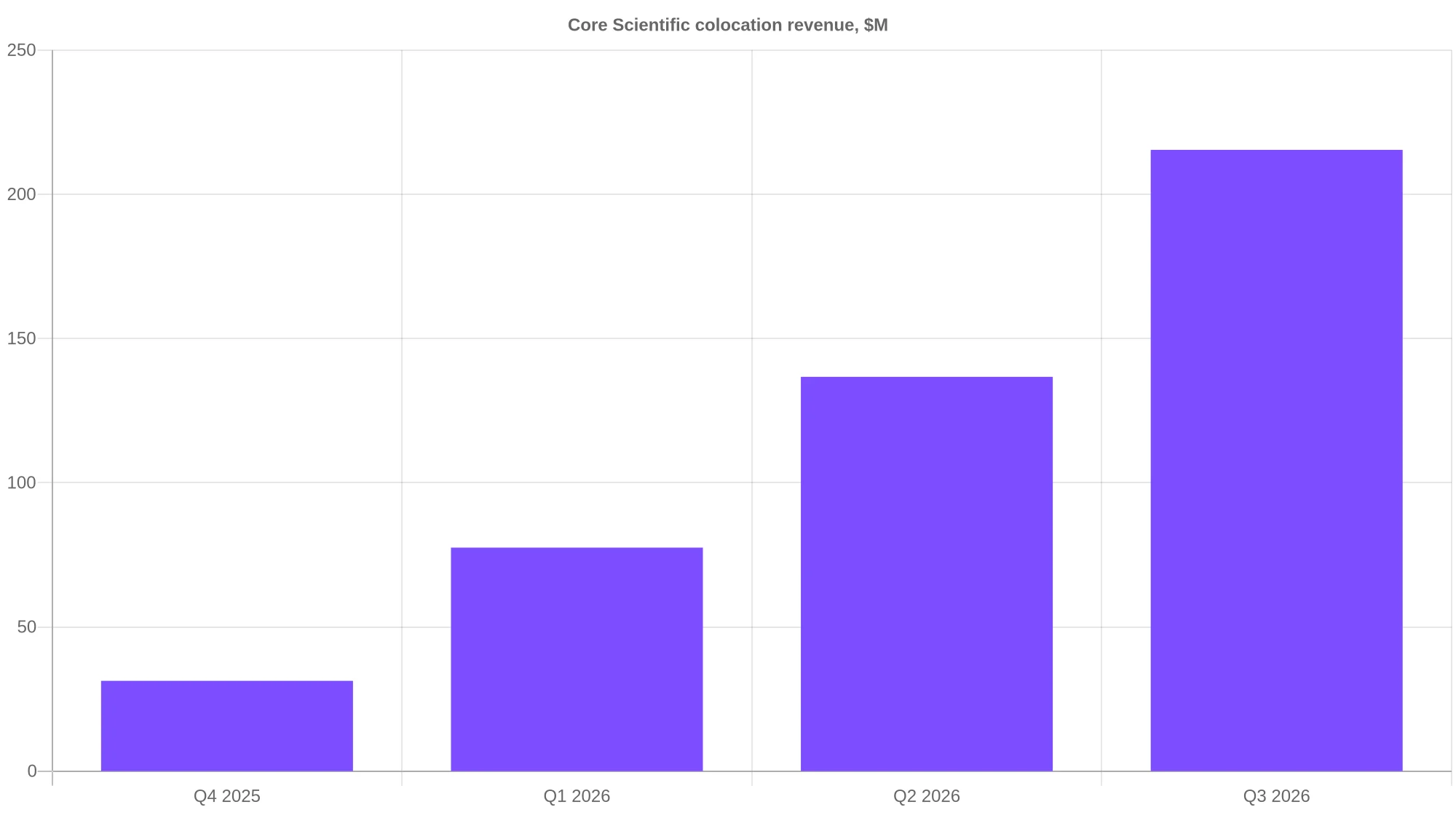
The mining residual has moved the other way. Subtracting colocation from total revenue leaves $66.1 million in the third quarter of 2025, $27.5 million in the second quarter of 2026 and $17.5 million now, a 73.5% decline year over year and 36.4% quarter over quarter. Gross profit tells the same story from the other side: $3.9 million on $81.1 million of revenue a year ago, a 4.8% margin, against $123.3 million on $232.9 million now, or 52.9%.
A $1.18 billion profit that came from warrants
Net income was $1,178.1 million, against a $1,155.3 million net loss in the second quarter and a $144.0 million loss a year earlier. The release is explicit about the source of the swing: “Net income (loss) for the quarters ended September 30, 2026 and June 30, 2026 were primarily driven by the change in fair value of warrants, reflecting changes in the Company’s stock price during the periods.”
Adjusted EBITDA, which removes that line along with interest, taxes, depreciation, stock compensation and impairment, was $133.6 million. That is 57.4% of total revenue and 62.0% of colocation revenue, against $41.1 million in the second quarter and $6.5 million a year earlier. Set the two numbers side by side and roughly 89% of reported net income was a non-cash revaluation of the company’s own warrant liabilities rather than cash earned from renting space.
For anyone holding the equity, that cuts both ways. Warrant marks are a mechanical function of the share price and will keep pushing reported earnings around in both directions. The operating signal in this quarter sat in the revenue line, the billing megawatts and adjusted EBITDA, all three of which rose sequentially.
Two counterparties behind more than $24 billion of commitments
The deck puts contracted revenue at more than $24 billion across about 1.1 gigawatts of customer-contracted power, split between two relationships. The first is CoreWeave: roughly 590 MW leased across Denton, Texas; Dalton, Georgia; Muskogee, Oklahoma; Marble, North Carolina; and Austin, Texas, under a 12-year contract with two five-year options and about 800 MW gross. The deck values it at more than $10 billion of revenue potential over the term, at a fixed cost with an annual escalator, and describes the structure as “take-or-pay”, meaning the tenant pays whether or not it uses the capacity. The client funds capex, power and utilities, and 80% to 85% profit margins are anticipated.
The second is the AMD-backed block. Core Scientific lists about 530 MW leased against AMD-linked neocloud and direct arrangements, with initial AMD delivery expected in early 2027 and the full 530 MW delivered by the end of 2028. Across both, the deck states an average annualized colocation GAAP revenue of about $1.8 billion and about $1.6 billion of annual net operating income, with more than half of cash flows backed by investment-grade credit.
Concentration is the trade-off, and the deck does not hide it. CoreWeave revenue is paid into a lockbox tied to the company’s $3.3 billion of senior secured notes due 2031, and the contract summary describes “no ability to unilaterally terminate, with aligned joint execution risk”. A single tenant with a 12-year take-or-pay agreement is a very different asset than a spot hosting book, and it is also a single point of failure if that tenant’s own financing or buildout schedule changes. Core Scientific’s $24 billion of AI contracts left that question open in August, and the third quarter adds capacity to the answer without settling it.
$985 million of capex for 90 megawatts
The cash cost of the conversion shows up in capital expenditure. Core Scientific spent $985.1 million on property, plant, equipment, land and development rights in the third quarter, against $797.5 million in the second quarter and $244.5 million a year earlier. Billing capacity rose by 90 MW over the same period, which works out to about $10.9 million of quarterly capex per incremental billable megawatt.
That spend is not covered by operating cash flow at current run rates. Adjusted EBITDA of $133.6 million against $985.1 million of capex leaves a gap that has to be closed with debt, equity or customer prepayments. Liquidity and debt service reserves, which the company defines as cash, digital assets, revolver availability and restricted cash, fell from $2,601.1 million at June 30 to $1,744.2 million at September 30. At the third-quarter capex pace, that cushion covers about 1.8 quarters before new financing. The company added $600 million of senior secured credit facilities in August, and the pro forma diluted share count is now about 509 million, against a fully diluted market capitalization the deck puts at $6.5 billion based on the November 4 close. Dividing one by the other implies roughly $12.77 per share.
The same arithmetic frame applies to peers making the identical conversion. Riot Platforms’ $28 billion Corsicana lease is the largest version of the trade announced this year, and it follows the same logic: sell contracted compute capacity against power, and let the bitcoin mining book shrink.
What the release does not say about mining
The word “exit” does not appear. What the filing says is narrower: “The Company is in the process of repurposing its remaining mining facilities to support its high-density colocation services business as circumstances allow.” That is a description of an ongoing conversion, not a dated shutdown, and “as circumstances allow” leaves the timing dependent on construction schedules and power contracts rather than on a public target.
Two things follow. First, the mining segment is still in the numbers, and at $17.5 million it is small enough that a further halving would barely move consolidated revenue. Second, a complete exit would be a material operational change and would normally arrive with its own disclosure, not as a clause inside a segment description. Readers should treat any claim that mining stops on a specific date as unconfirmed until the company states it in a filing or on the record.
The sites themselves are being repurposed rather than sold. The release lists facilities in Alabama, Georgia, Kentucky, North Carolina, North Dakota, Oklahoma and Texas, eleven in total, which is the physical base the colocation business is being built on. Conversion, not divestiture, is the mechanism.
What the fourth quarter has to answer
Three numbers matter more than the rest. The first is Dalton: about 175 MW leased, of which only about 75 MW was billing on November 5, with completion estimated in early 2027. Until that site bills in full, the $1.44 million per megawatt contract average and the $1.78 million per megawatt realized figure will keep diverging.
The second is AMD delivery. The deck maps three power pathways under the AMD reservation: about 385 MW secured through existing grid connections, about 600 MW progressing through load studies, and about 940 MW evaluated behind the meter. Only the first is contracted capacity today, and the gap between a load study and an energized hall is where construction schedules usually slip.
The third is funding. A company spending close to $1 billion a quarter to add roughly 90 MW of billable capacity is, in effect, converting its balance sheet into long-duration contracts. If adjusted EBITDA keeps compounding at the rate it did this quarter, from $41.1 million to $133.6 million, the financing gap narrows on its own. If the ramp slows, the $1.74 billion liquidity figure and a warrant-heavy income statement become the story.
Core Scientific’s third quarter did not answer whether the AI data center trade is worth the capital it consumes. It did establish the shape of the company doing the spending: a colocation landlord with two large tenants, a shrinking mining appendix, and an income statement that will keep reporting warrant marks as earnings until the capital structure stops moving.
This article is for information only and is not investment advice. Prices, levels and market data are a point-in-time snapshot and can change quickly. Always do your own research.
0
0

 Manage all your crypto, NFT and DeFi from one place
Securely connect the portfolio you’re using to start.
 Where will Bitcoin trade next?
Live Polymarket and Kalshi odds on Bitcoin price targets, compared side by side.
See Bitcoin price odds


