
USDT Traders in Russia May Pay 22% VAT as Moscow Exchange Adds Crypto Trading

0
0
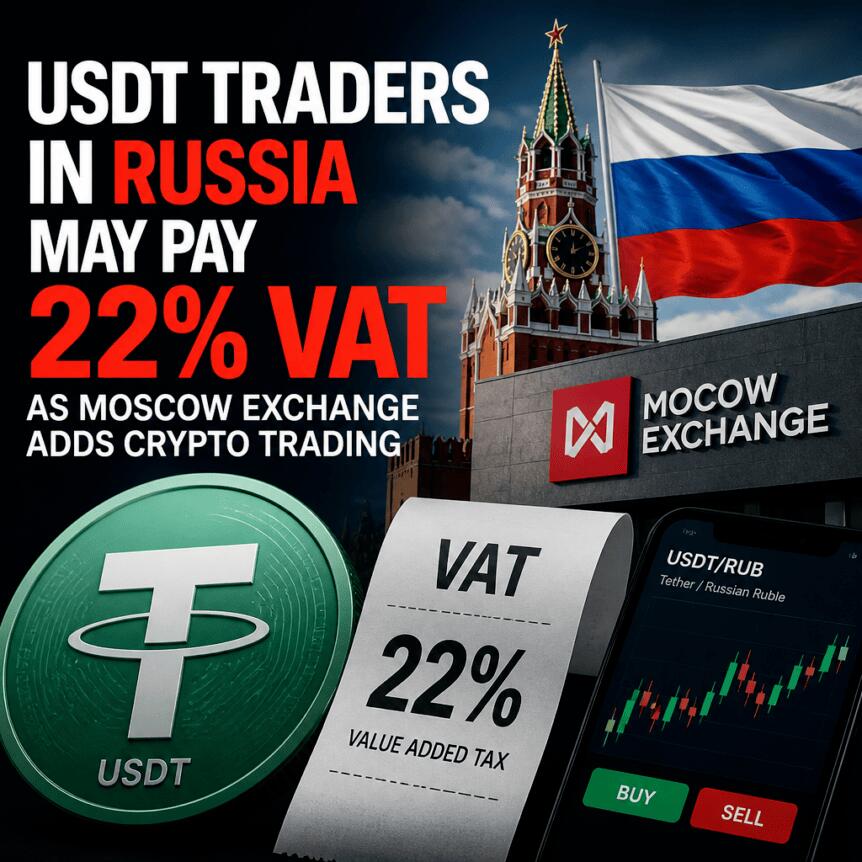
Moscow Exchange (MOEX) is set to open regulated crypto trading on Dec. 1, but Tether’s USDt (USDT) will come with a new cost for traders in Russia: a 22% value-added tax (VAT) applied on top of the trade price.
According to documentation published by MOEX’s National Clearing Centre (NCC), VAT will be charged on purchases, sales, and swaps of USDT via the exchange until Dec. 31. The NCC says the tax will be applied to the transaction value, meaning a buyer paying 100,000 rubles for USDT would add 22,000 rubles in VAT.
Key takeaways
- USDT trades on MOEX will be subject to a 22% VAT on top of the executed trade price from Dec. 1 through Dec. 31.
- The NCC’s interpretation hinges on USDT being treated as a “foreign digital instrument,” a category Russia distinguishes from domestic digital currencies like bitcoin and ether.
- Russia’s tax code exempts digital currency sales from VAT, but does not provide a clear VAT exclusion for foreign digital instruments.
- NCC says it has asked tax and finance authorities for clarification and could revise how VAT is handled if lawmakers intervene.
Why USDT faces VAT where BTC and ETH may not
Russia’s legal framework draws an important line between different kinds of crypto assets. The exchange’s clearing documentation notes that bitcoin (BTC) and ether (ETH) are classified as “digital currencies” under Russian rules, while USDT falls under a separate legal category referred to as a “foreign digital instrument.”
That distinction matters because the Russian tax code excludes sales of digital currencies from VAT. However, the documentation states there is no explicit exemption for transactions involving foreign digital instruments, leaving the NCC to apply VAT to USDT dealing.
The practical effect for market participants is straightforward: even if the underlying USDT quote is unchanged, the total cost of entering or exiting a position through MOEX will be higher because VAT is layered onto the transaction.
How long the tax applies and what the NCC is asking
The NCC said it would apply VAT to USDT purchases, sales, and swaps through Dec. 31. The exchange’s documentation also indicates that the NCC is actively seeking confirmation from Russia’s Federal Tax Service and the Ministry of Finance.
If guidance clarifies that VAT should not apply in certain circumstances—or if lawmakers decide to exempt trades executed before Jan. 1, 2027—the NCC said it would update market participants accordingly.
For traders and institutions, this introduces a near-term uncertainty: while the rules appear clear enough for the NCC to charge VAT starting Dec. 1, the final shape of the policy may change if regulators or lawmakers issue a carve-out.
MOEX’s regulated crypto rollout sets the stage
MOEX’s VAT note comes amid a broader shift toward regulated crypto access in Russia. Earlier coverage referenced in the documentation points to Bank of Russia rules that took effect Nov. 17, enabling non-qualified investors to buy BTC, ETH, and USDT through intermediaries.
Those rules reportedly include an annual purchase cap of 300,000 rubles per intermediary (about $3,650). While the VAT development is specifically tied to USDT’s classification, the larger rollout matters because it defines how retail and smaller participants may access crypto in a supervised environment.
In that context, the VAT surcharge could influence order flow and product preferences, especially for participants comparing USDT against assets that are treated as “digital currencies” for tax purposes. Even modest differences in friction can affect execution strategies, hedging decisions, and how traders evaluate the effective cost of holding stablecoins.
What to watch next for MOEX USDT trading
For now, the clearest takeaway is that USDT trades on MOEX are expected to carry an additional 22% VAT component through the end of December, based on the NCC’s interpretation of how USDT is categorized under Russian tax law. However, the NCC’s stated effort to obtain guidance from tax and finance authorities suggests the policy could evolve.
Traders should monitor for any formal clarification from the Federal Tax Service or the Ministry of Finance, as well as any legislative action that could change how VAT is applied—or potentially limit it for trades conducted before Jan. 1, 2027. If the guidance shifts, it may affect not only pricing and profitability calculations but also liquidity and execution patterns in MOEX’s early stablecoin trading window.
This article was originally published as USDT Traders in Russia May Pay 22% VAT as Moscow Exchange Adds Crypto Trading on Crypto Breaking News – your trusted source for crypto news, Bitcoin news, and blockchain updates.
0
0

 Manage all your crypto, NFT and DeFi from one place
Securely connect the portfolio you’re using to start.


