
EthLabs Withdraws Hegotá Slot Proposal to Refocus 2027 Quantum Plan

0
0
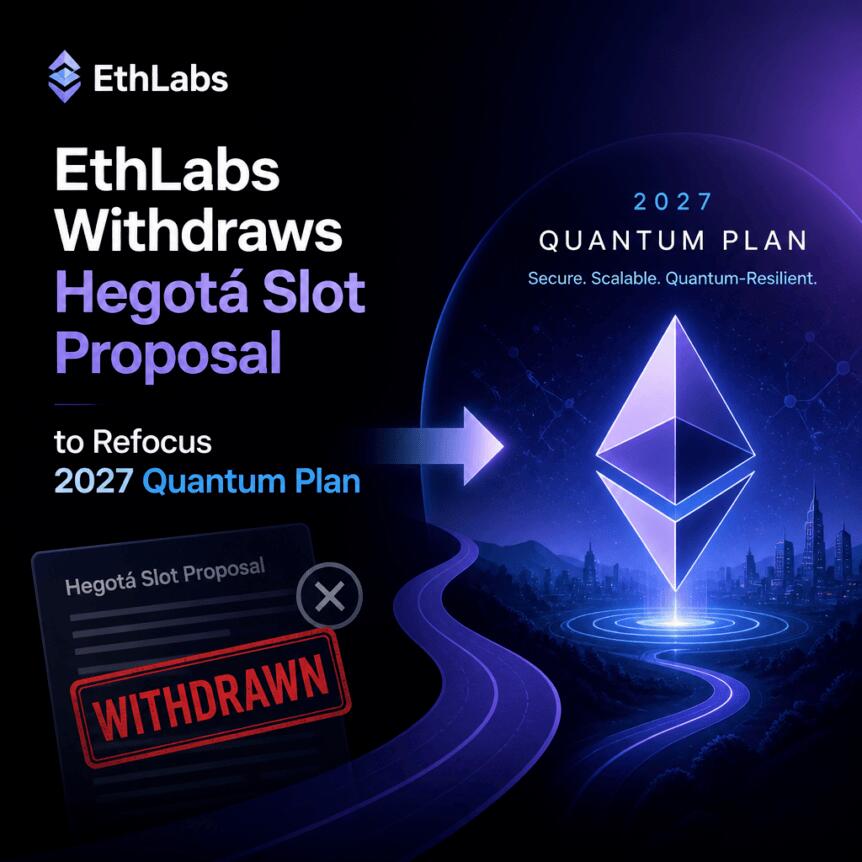
Ethereum research group Ethlabs says it will withdraw its proposal aimed at speeding up the network’s block production through the upcoming Hegotá upgrade. Instead of prioritizing faster block times, the group is urging Ethereum core developers to focus on preparing the chain for quantum-based attacks by 2027, as part of a broader “pqai27” timeline intended to address both quantum computing risks and advances in artificial intelligence.
In an outline posted this week on the Ethereum Magicians forum, Ethlabs presented its “pqai27” roadmap and argued that other upgrades should be reconsidered if they distract from quantum readiness. The group’s decision also reframes how timing and sequencing may matter for Ethereum’s long-running post-quantum transition.
Key takeaways
- Ethlabs is withdrawing its block-production acceleration proposal tied to the Hegotá upgrade.
- The group is urging Ethereum to prioritize “pqai27,” a roadmap aimed at quantum readiness by 2027.
- Ethlabs says faster “Quick Slots” should still be pursued later, while resources shift toward post-quantum and related preparations.
- For Hegotá-specific features, Ethlabs wants censorship-resistance steps evaluated against whether they affect quantum readiness.
- Glamsterdam should, in Ethlabs’ view, proceed as planned.
Ethlabs backs a “pqai27” focus, not faster blocks at Hegotá
Ethlabs’ announcement comes after it previously supported an approach to reduce Ethereum’s slot time via pqai27, which the group describes as a protection plan against quantum computing threats alongside the growing capabilities of AI. In its post, Ethlabs characterized the roadmap as a way to structure Ethereum’s near-term priorities around security requirements that may intensify ahead of the post-quantum transition.
The group’s withdrawal of the Hegotá block-speed proposal signals a change in emphasis: rather than pushing immediate performance changes at the expense of security sequencing, Ethlabs wants core developers to concentrate on preparations for quantum attacks by 2027.
What happens to “Quick Slots” and the slot-time reduction plan
Ethlabs had previously backed Ethereum Improvement Proposal (EIP)-8198, also known as “Quick Slots.” That proposal, according to prior reporting, was designed to reduce Ethereum’s slot time from 12 seconds to 10 seconds to improve responsiveness and network efficiency.
While Ethlabs says it is redirecting resources away from the Hegotá acceleration work, it also states that it will still pursue faster slots later—targeting 2028. That indicates the group’s preference is not a rejection of performance upgrades altogether, but a desire to adjust when they take effect relative to quantum-readiness milestones.
Hegotá features: proceed with caution on quantum readiness
Within its Hegotá guidance, Ethlabs singled out specific components and tied their approval to quantum-readiness considerations. The group argued that FOCIL—a planned censorship-resistance feature—should proceed only if it does not jeopardize quantum readiness.
Ethlabs also described the “Frame Transactions” concept as central to the proposed transition. Frame Transactions are intended to support more flexible account authentication, a capability the group appears to view as important to how Ethereum adapts its mechanisms in the run-up to post-quantum requirements.
At the same time, Ethlabs took a more permissive stance on the upgrade immediately before Hegotá. It said “Glamsterdam,” the preceding upgrade, should proceed as planned.
Wider Ethereum timelines remain in flux—core developers have not approved
Ethlabs’ position does not yet translate into a decision by the broader Ethereum engineering community. Ethereum core developers have not approved the proposal in question, and the broader posture toward post-quantum readiness continues to evolve.
The Ethereum Foundation has published a protocol-priorities roadmap that, as reported, still targets December 2029 for quantum resistance. Separately, at Devcon, researcher Justin Drake said he hopes to complete the transition in 2028, suggesting there is ongoing debate about whether the industry should compress milestones or keep them aligned with the foundation’s longer-term planning.
In practical terms, Ethlabs’ move highlights a tension many Ethereum participants may be weighing: how to sequence upgrades when the cryptographic threat model involves both long-horizon quantum risks and near-term uncertainty around evolving AI capabilities. Ethlabs is effectively asking developers to treat that uncertainty as a scheduling constraint rather than something that can be addressed after performance-focused changes.
Related coverage from earlier this year noted additional concerns about upgrade sequencing and smart-contract risk, including how developers may approach forks if those risks have not been resolved—underscoring that even within the same upgrade cycle, priorities are contested.
Why Ethlabs’ withdrawal matters for users and builders
For validators, developers, and application teams, the main consequence of Ethlabs’ decision is not simply a slower block-time roadmap—it is the signal that Ethereum’s upgrade calendar may increasingly be driven by post-quantum readiness rather than incremental operational improvements. That can affect expectations around timeline planning, contract assumptions, and how quickly new transaction features move from proposal to deployment.
At the same time, Ethlabs is not advocating a pause on all evolution. By calling for Glamsterdam to proceed and maintaining that faster slots remain a 2028 objective, the group is drawing a line between upgrades that it considers compatible with quantum preparations and those it believes could distract from—or potentially complicate—critical transition work.
Readers should watch how the Ethereum developer community responds: whether Ethlabs’ “pqai27” framing gains traction, how Hegotá components like FOCIL and Frame Transactions are evaluated, and whether the network’s publicly stated post-quantum milestones move closer or remain anchored to the December 2029 target.
This article was originally published as EthLabs Withdraws Hegotá Slot Proposal to Refocus 2027 Quantum Plan on Crypto Breaking News – your trusted source for crypto news, Bitcoin news, and blockchain updates.
0
0

 Manage all your crypto, NFT and DeFi from one place
Securely connect the portfolio you’re using to start.
 Where will Ethereum trade next?
Live Polymarket and Kalshi odds on Ethereum price targets, compared side by side.
See Ethereum price odds


