
Shiba Inu Exchange Listings History: From Meme Coin to Global Markets

0
0

How Shiba Inu Exchange Listings Expanded SHIB’s Market Reach
Shiba Inu exchange listings show how a joke-inspired token grew into an asset that trades across dozens of countries. SHIB launched in August 2020 as an ERC-20 token on Ethereum, created by the pseudonymous developer known as Ryoshi. Today it appears on both centralized and decentralized platforms.
Interest in the topic stays high because listings shape liquidity, visibility, and risk. A token traded on one platform behaves very differently from a token traded on seventy. The sections below trace the main milestones behind Shiba Inu exchange listings, the current footprint, and the market data that gives them context.
What Is Shiba Inu, and Why Do Its Listings Matter?
Shiba Inu (SHIB) is a meme coin themed around a Japanese dog breed, a mascot it shares with Dogecoin. When Binance announced its listing, the exchange described SHIB as an experiment in decentralized community building.
An exchange listing is the moment a platform opens a trading market for a token. It decides who can buy the asset, which currencies can be used to pay for it, and how easily large orders get filled. For a token with a huge supply and a very small unit price, Shiba Inu exchange listings often matter more to everyday access than any project announcement.
What Happened When Binance Listed SHIB?
The best-documented milestone came on 10 May 2021. Binance opened SHIB/USDT and SHIB/BUSD trading at 11:00 UTC and placed the token in its Innovation Zone, a section for newer assets that carry higher volatility and risk. The announcement stated a listing fee of 0 BNB.
The notice also included a blunt warning about ownership. At the time of writing, the three largest wallets held 50.5%, 7.0%, and 3.0% of total supply. Concentration like that is a known risk for young tokens, because one large holder selling into a thin market can move the price sharply.
The listing did not create the community behind SHIB, but it gave that community a high-volume venue. Among all Shiba Inu exchange listings, Binance still ranks in the top two by volume today. Any causal link is an analyst interpretation, since many other factors shaped demand.
Where Do Shiba Inu Exchange Listings Stand Today?
Aggregated market data checked on 13 October 2026 shows 72 Shiba Inu exchange listings in total. Of those, 58 sit on centralized exchanges and 14 on decentralized platforms. Tracked volume across all venues came to $71.52 million.
Venue type | Listings | Examples |
Centralized exchanges | 58 | KuCoin, Binance, OKX, Kraken, Coinbase |
Decentralized exchanges | 14 | Uniswap, PancakeSwap, SushiSwap |
A centralized exchange runs an order book and holds customer funds in its own accounts. A decentralized exchange lets users swap tokens straight from a wallet through smart contracts, which removes the account but adds wallet and contract risk.
Which Markets and Venues Drive Most SHIB Trading?
Geographic spread is a clear strength of the current set of Shiba Inu exchange listings. Bithumb and Coinone serve South Korea, BTCTurk serves Turkey, Bitvavo serves Europe, VALR serves South Africa, and CoinDCX serves India. Each handles only a small share of volume.
Volume is far more concentrated than the headline count suggests. KuCoin leads with about $10.74 million, followed by Binance at $10.41 million, then BTCC, Bitrue, and Toobit. The top five together account for roughly 46% of tracked volume, while the decentralized listings add well under 1%.
A long listing table can look like deep liquidity, but most trading happens on a handful of platforms. Shiba Inu exchange listings are better judged by where the volume sits than by how many logos appear on a tracker.
What Do Market Cap and FDV Say About SHIB Today?
Metric | Value |
Price | $0.0000053 |
Market cap | $3.1 billion |
Fully diluted valuation (FDV) | $3.1 billion |
Circulating supply | 589.2 trillion |
Total supply | 589.6 trillion |
All-time high | $0.0000885 |
Market cap multiplies price by circulating supply. FDV multiplies price by total supply, which shows what the token would be worth if every token already circulated.
That matters because many newer tokens carry large unlock schedules that can add supply later. SHIB-does not face that pressure in the same way, though the price still sits about 94% below its all-time high. Any Shiba Inu price prediction rests on assumptions about demand that no listing can guarantee.
How Do Shibarium and Ecosystem Tokens Fit In?
The project lists SHIB alongside BONE, LEASH, and TREAT as separate tokens on its official token pages. Each has its own supply and role, so a SHIB listing does not automatically extend to the others.
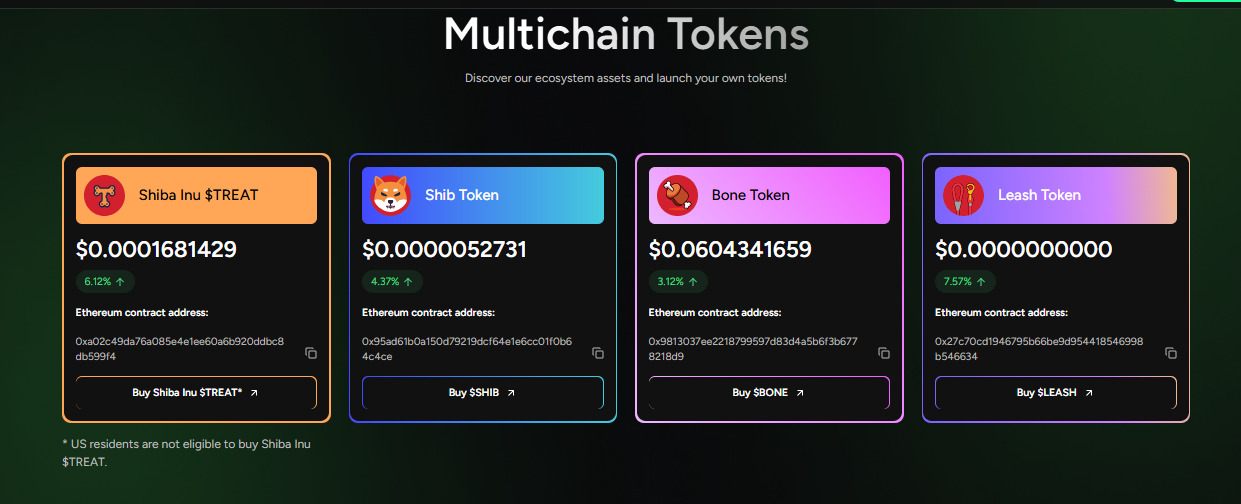
The project's Shibarium network is a layer-2 chain, meaning a secondary network built on top of Ethereum to lower fees. BONE, not SHIB, pays gas fees there. Shiba Inu exchange listings therefore capture only part of the ecosystem's market activity.
The abridged ShibPaper document makes several claims worth separating from fact. It says thousands of retailers worldwide accept SHIB and cites a lifetime gain of 15 million percent at the time of drafting.

It also states that the deflationary design does not ensure a higher value, only that circulation falls. Those are the project's own statements and remain unverified here.
What Risks Come With Wide Shiba Inu Exchange Listings?
Volume concentration: roughly half of tracked volume sits on five platforms, so one outage could hurt liquidity.
Holder concentration: the original listing notice flagged large wallets, so current on-chain holder data deserves a fresh review.
Venue quality: not all 72-listings are equal, and some platforms are ranked as unverified by market trackers.
Price volatility: the gap of about 94% to the all-time high shows how sharply meme assets can fall.
Regulation: local rules differ by country, so availability on a given platform can change.
None of these risks is unique to SHIB. Shiba-Inu exchange-listings confirm only that a platform chose to open a market, and they say little about the project's long-term health.
What Do Shiba Inu Exchange Listings Really Show?
SHIB-began as an Ethereum meme token and now trades on 72 venues across centralized and decentralized markets. The standout points are the Binance milestone, the regional spread, and a market cap that equals its FDV. Shiba-Inu exchange-listings clearly widened access.
What remains uncertain is how much volume reflects organic depth rather than a few dominant platforms. Project claims about retail acceptance also lack independent confirmation.
Disclaimer:
This article is for general information only and does not constitute financial, investment, or legal advice. Cryptocurrency prices are volatile, and tokens can lose most of their value. Independent research and advice from a licensed professional are important before any decision.
0
0


 Manage all your crypto, NFT and DeFi from one place
Securely connect the portfolio you’re using to start.
 Where will Ethereum trade next?
Live Polymarket and Kalshi odds on Ethereum price targets, compared side by side.
See Ethereum price odds


