
Base Chain: What the Network Is and How to Swap Onto It

0
0
Base is an Ethereum layer-2 network, not Ethereum mainnet. It has its own balances, transactions, and apps, even when your wallet shows the same 0x address on both networks. So when people ask what Base crypto is, the short answer is a network, not a coin you buy.
You may want the network explained, or you may want coins on it. Both come down to one rule: the receiving side must be Base. The network is changing fast: Base cut its block time to 200 milliseconds on November 5, 2026, and its DeFi apps held $5.11 billion two weeks later.
To move Base chain crypto from another network, StealthEX offers a non-custodial, wallet-to-wallet swap when its live widget lists the asset on Base. A standard crypto-to-crypto swap needs no account, although verification may be requested if a wallet or transaction is flagged. The catch: if your wallet is not on Base, the coins seem to vanish.
What Is Base Chain?
Base chain is a network for sending assets and using apps. It is not a coin, and it is not Ethereum mainnet. In practice, the Base blockchain is a distinct Layer 2 solution for Ethereum, where fees are paid in ETH, and applications run on their own smart contracts. You do not need a token called BASE to use the Base blockchain.
A Layer 2, Not Ethereum Mainnet
A layer 2 processes transfers on its own network and uses Ethereum to record data and settle its state. As a Base L2 balance, your ETH belongs to Base. Receiving ETH on Ethereum does not increase the balance shown under Base, and switching the network in a wallet does not move any coins.
Both networks use the Ethereum Virtual Machine, or EVM. A self-custody wallet can therefore use the same keys and display the same 0x address on each. Matching address text is not enough: the network name in the wallet still has to say Base.
Base vs Ethereum is a question of two separate networks, not one network with two speeds. A send that starts on Ethereum mainnet still pays Ethereum gas, even when its goal is to reach Base.
| Detail | Base | Ethereum Mainnet |
|---|---|---|
| What you are using | A layer-2 network | The Ethereum main network |
| Balance | ETH or a token on Base | Not the same balance as Base |
| Wallet screen | The network name has to say Base | An Ethereum screen does not receive a Base transfer |
| Fee | The Base network fee, in ETH on Base | Ethereum gas, when the transfer starts on mainnet |
| Chain ID | 8453 | 1 |
Why the Name Includes Coinbase
Coinbase developed Base and opened it to everyone on August 9, 2023, according to the official launch post. That makes Coinbase the builder of the Base blockchain, not the custodian of every wallet on it. You do not need a Coinbase account to hold your own keys or receive assets on Base, and Coinbase cannot move coins from a self-custody wallet. Inside a Coinbase exchange account, Base is one of the networks you can pick for an ETH withdrawal.
Base’s protocol overview says Base runs one active sequencer, which orders transactions into blocks, as part of a high-availability cluster. That role is separate from your wallet: the operator never sees your seed phrase when you add the network. The sequencer still matters for normal transaction inclusion, and the network status page reports outages.
How Base Chain Works
A wallet sends a signed transaction to Base. The sequencer orders it into a block, nodes check the resulting state, and batches of transaction data go to Ethereum, which makes Base an Ethereum layer 2 blockchain. The transaction hash is your record of that send.
What the Rollup Changes for You
Base groups many transactions and publishes their data to Ethereum, instead of making every transfer a separate Ethereum mainnet transaction. Your transfers run on Base, while the security claim depends on Ethereum settlement, where every batch is finally recorded.
Base began with the OP Stack, and its upgrade history now lists its own releases, starting with Azul in May 2026. ETHBEAT, the former L2BEAT, lists Base as an optimistic rollup at Stage 1, with $14.13 billion in value secured. Stage 1 means the rollup runs a working proof system, while a security council can still step in during an emergency. A fast wallet confirmation is not the same stage as final settlement on Ethereum.
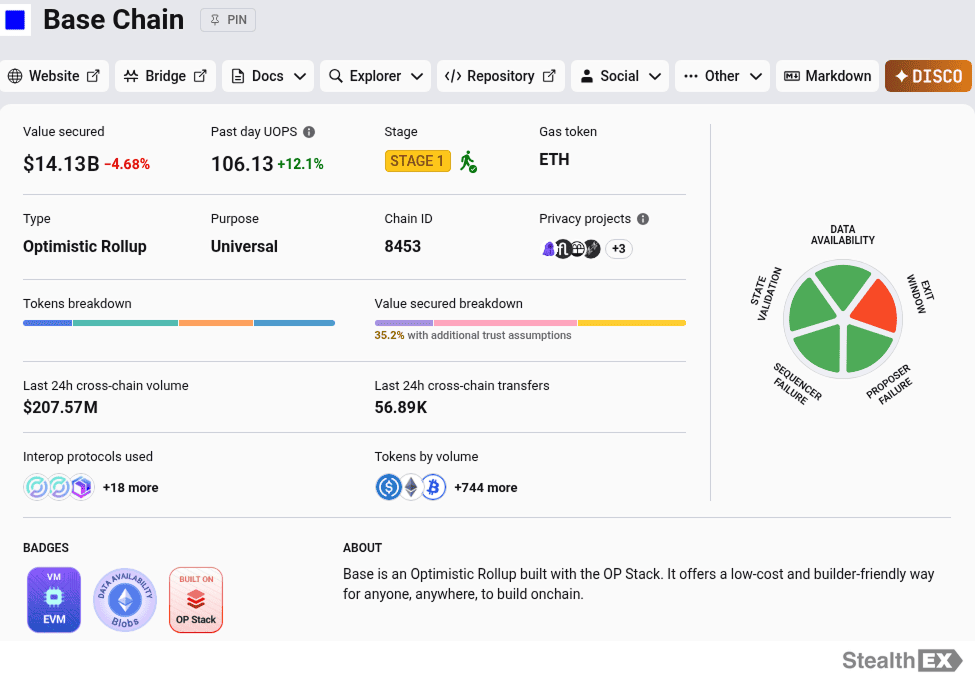
Base rollup summary. Source: ETHBEAT
The Base Chain ID Wallets Use
The official connection guide lists 8453 for Base mainnet. The Base chain ID 8453 is how a wallet tells Base mainnet apart from Ethereum mainnet, which uses 1, and from the Base Sepolia test network, which uses 84532.
When adding Base by hand, copy the whole mainnet entry from the official guide. A wallet can give a custom entry any name; the chain ID and the endpoint decide the real network. Pasting the Sepolia RPC into an entry named Base gives you a test network with a wrong label. Most wallets show the chain ID in the network settings, so you can check it after saving.
| Setting | Base Mainnet | Base Sepolia |
|---|---|---|
| Chain ID | 8453 | 84532 |
| Currency | ETH | Test ETH |
| RPC endpoint | https://mainnet.base.org | https://sepolia.base.org |
| Explorer | https://basescan.org | https://sepolia.basescan.org |
| Purpose | Real assets and transactions | Testing with assets that have no intended monetary value |
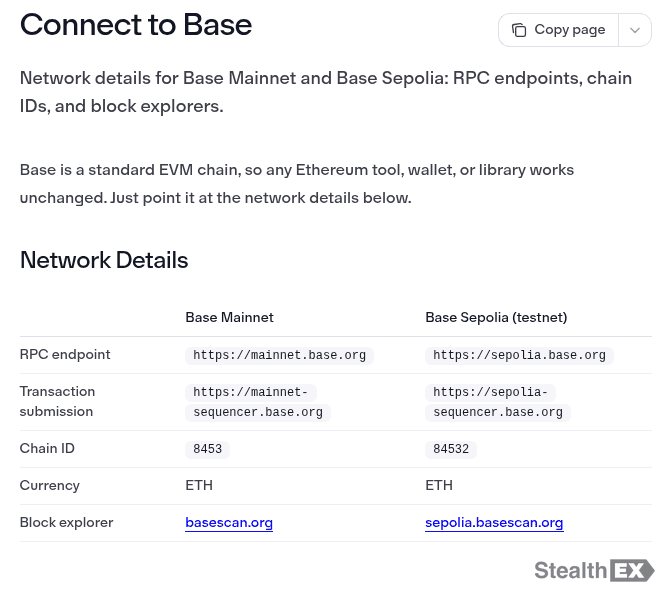
Base network settings. Source: Base docs
RPC and the Block Explorer
An RPC is the endpoint your wallet uses to reach Base, read balances and submit transactions. The Base chain RPC URL in the official docs is https://mainnet.base.org. It is rate-limited, so a slow response does not mean the funds are missing.
The Base chain explorer is BaseScan. Paste your transaction hash there to check the status, sender, recipient, token and fee. An Ethereum explorer cannot show a Base transaction just because both networks use 0x addresses. A transaction hash starts with 0x followed by 64 characters, so copy it whole. The BaseScan search box also accepts a wallet address and lists every Base transfer for it.
Fees and Speed
Base and Ethereum are two networks with two fee markets. A Base fee pays for work on Base and for publishing data to Ethereum. It does not cover an Ethereum transaction you make first, and a fast Base block does not make every bridge route fast.
A Base Fee Is Not Mainnet Gas
A transfer already on Base pays Base network fees in ETH on Base. A wallet holding only a token, such as USDC, can receive it but still needs ETH on Base to send it later. Some apps sponsor gas, but that is a feature of the app, not a rule for every single transfer.
The fee documentation splits Base chain gas fees into execution on Base and the cost of publishing data to Ethereum. BaseScan’s gas tracker showed a standard gas price of 0.005 gwei, with an ERC-20 transfer at about $0.001. The fee docs also list an operator fee, which applies only when its parameters are set above zero. A gwei figure is a price per unit of gas, and the gas used depends on what the transaction does.
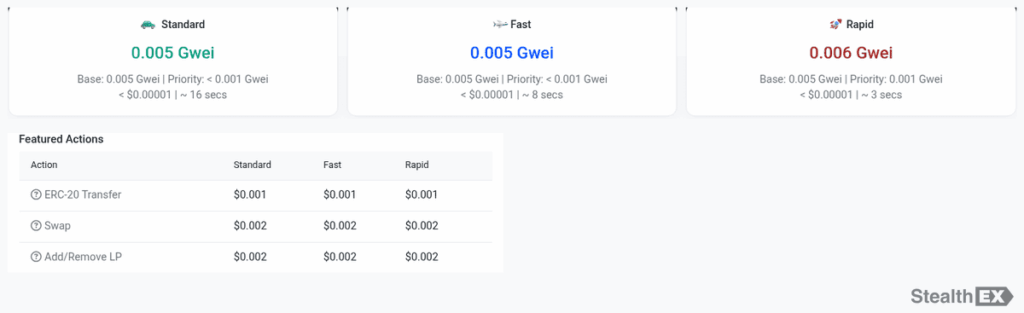
Base gas prices. Source: BaseScan
Sending ETH from Ethereum to a bridge still costs Ethereum gas, and a later Base transfer has its own fee.
Why a Speed Number Changes
Base’s finality guide gives a Base chain block time of 200 milliseconds since the Denim upgrade on November 5, 2026. The same page lists about two minutes for a batch to reach Ethereum and about 20 minutes for Ethereum batch finality.
Base blockchain TPS depends on the transaction mix and on how it is counted, so two sites can show different figures on the same day. An exchange may also wait for extra confirmations before it credits a deposit.
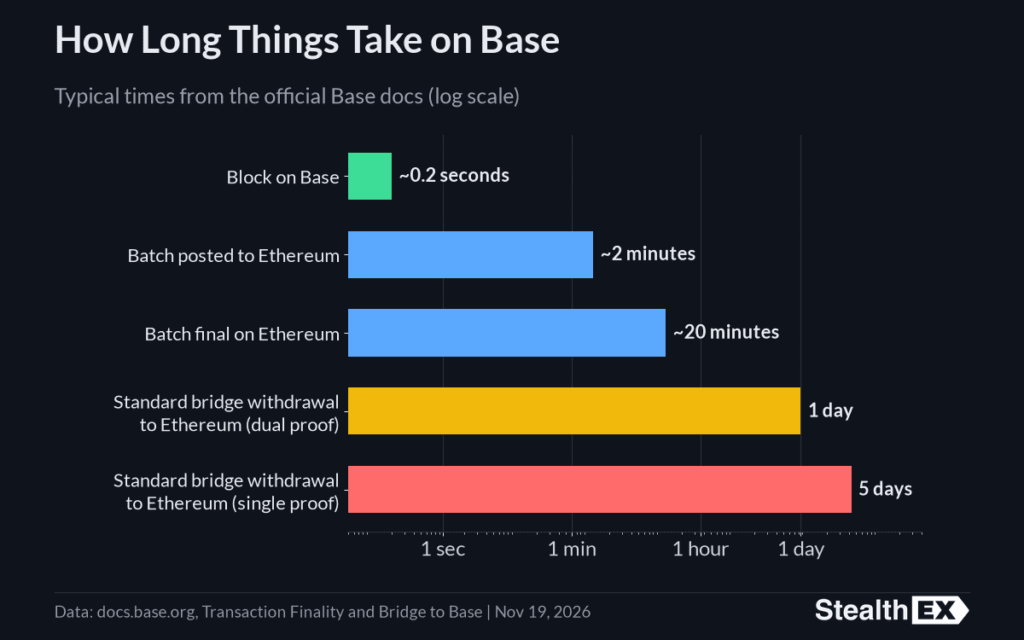
Base transaction and bridge timing. Source: Base docs
Check the Token Story Before You Swap
On November 19, 2026, Base had no live official network token, and its network currency was ETH. Coinbase warns about fake Base tokens on its help page. That page still carries wording from the testnet period, so the BaseCamp post is the newer statement. Fake tokens often copy the Base name and logo and ask you to sign a wallet approval.
The main Base chain news on a token is the State of Base post from BaseCamp 2025, which says Base is exploring a network token, with no timing, design or governance details. Exploring a token is not a launch or an airdrop. A tradable asset called BASE, or a message asking you to connect a wallet to claim one, is not proof that Coinbase issued it. You do not need such a token to receive ETH on Base.
How to Get Coins Onto Base
Getting coins onto Base means the receiving side is the Base network, whether you use a swap, a bridge or an exchange withdrawal. For how to buy on Base chain with crypto you already hold, the core path is crypto-to-crypto. A coin ticker alone does not set the destination network.
Swap Into a Base Address
StealthEX is a non-custodial, custody-free exchange, and a standard crypto-to-crypto swap does not require an account. On November 19, 2026, its live widget listed Ethereum (ETHBASE), which is ETH on Base, as a receiving asset. A quote for 0.1 ETH on Ethereum returned about 0.098551 ETHBASE. ETHBASE is only the widget’s label for ETH on Base, not a Base token.
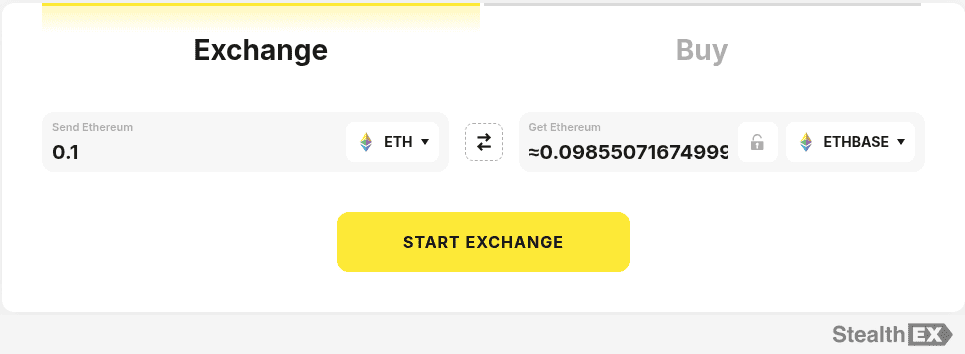
ETH to ETH on Base quote. Source: StealthEX
Pick a fixed or a floating rate, then paste the receive address from the Base screen in your wallet, not from Ethereum mainnet. The estimate includes the network fee and the liquidity provider fee, and you still pay the source network’s own fee to send the deposit. StealthEX does not set blockchain fees or keep the coins after the swap. Verification may be requested if a wallet or transaction is flagged. Start from the Ethereum page and follow the swap steps.
Swap to Base with no registration
A Bridge Moves the Same Asset
A bridge moves the same asset between networks, while a swap exchanges one asset for another. If you are looking up how to bridge to Base, remember that a bridge from Ethereum still starts with an Ethereum transaction and its gas.
The official bridge guide separates the standard Base chain bridge from third-party routes. Standard withdrawals from Base to Ethereum have a five-day finalization window, or one day when both TEE and ZK proofs support the proposal. That window applies to withdrawals, not to deposits into Base.
Third-party fast bridges use their own liquidity and carry their own contract risk. Any bridge only works for assets the route supports on both networks. A cross-network swap also delivers coins to Base, but it is an exchange order, not the standard bridge.
The Wallet Has to Be on Base
There is no single best Base chain wallet. A useful wallet for Base can add the Base network and show a Base receive screen for the asset you expect. The best wallet for Base chain use is whichever one shows that screen for your asset. An app that supports Ethereum is not proof that a custodial deposit service accepts Base.
Add the Network, Then Copy the Address
Add Base with the chain details from the official docs, or from your wallet’s network list. Open the Base receive screen and copy the address from that screen. An Ethereum mainnet screen is the wrong screen, even when the address text looks the same, because the coins and the wallet must be on the same network.
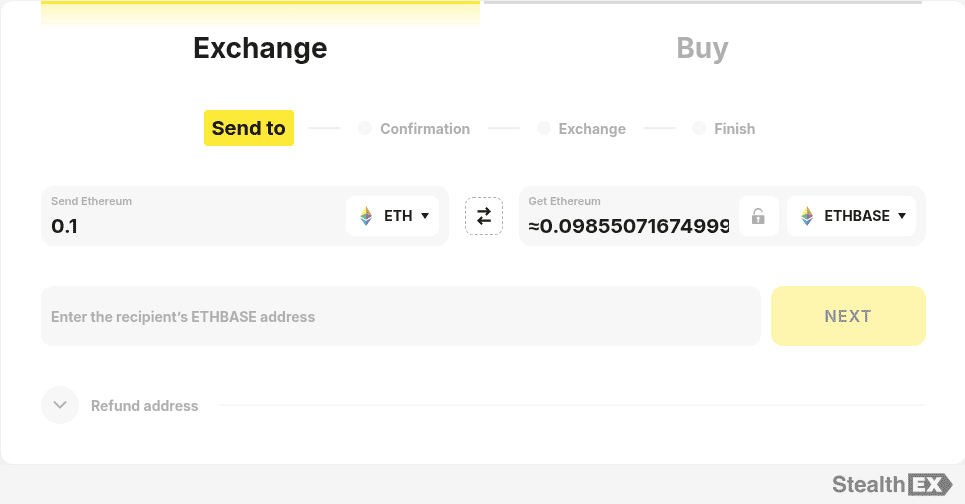
Recipient field for ETH on Base. Source: StealthEX
Protect the wallet with these wallet security checks. Your seed phrase restores the keys and never goes into an address field.
| Check | What to Confirm | Do Not Assume |
|---|---|---|
| Network | The wallet is on Base, not Ethereum or Sepolia | That an EVM address works on every network |
| Address | It was copied from the Base receive screen | That a similar-looking address is enough |
| Path | You know whether this step is a swap or a bridge | That a bridge and a swap are the same action |
| Widget | The live StealthEX widget offers the pair and the Base side | That every asset can be swapped onto Base |
Where the Network Is Used
The Base blockchain ecosystem includes token trading, lending and payments. Each use carries its own risk: a successful transfer says nothing about whether a lending contract is safe. Apps on Base use the same 0x addresses and ETH for gas.
Where Base Figures Come From
On November 19, 2026, DefiLlama showed $5.11 billion locked in Base DeFi apps, the Base chain TVL. Its protocol data showed $3.76 billion in Morpho Blue, $445.5 million in Aave V3 and $276 million in Uniswap V3 on Base. These are deposits measured in dollars, not a count of users. DefiLlama counts coins deposited in protocols, not ETH that sits in wallets.
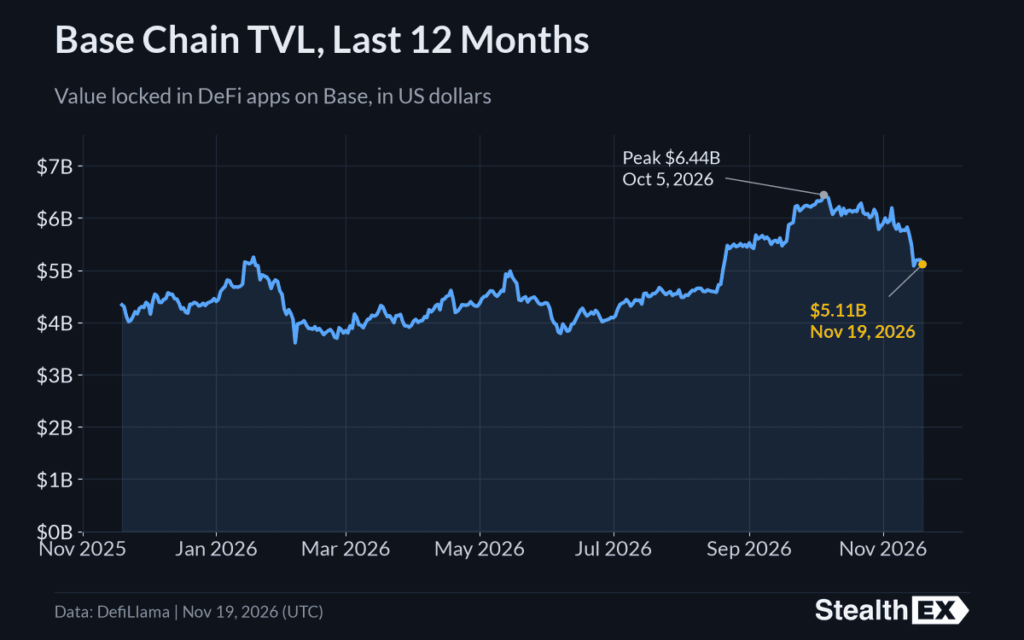
Base DeFi value locked. Source: DefiLlama
The total was below its 12-month high of $6.44 billion on October 5, 2026. TVL moves with asset prices as well as deposits and withdrawals, so a fall does not prove that users left.
Frequently Asked Questions
What Is the Base Sepolia Chain ID For?
84532 is the Base Sepolia chain ID in the official docs. Sepolia is the test network, where developers try apps with test ETH that has no intended value. Real coins do not belong there. For real assets, use Base mainnet, chain ID 8453. A faucet gives test ETH for Sepolia, which cannot be sold or swapped for real ETH.
Is ETH on Base the Same as ETH on Ethereum?
No. They are ETH balances on two different networks. ETH received on Base does not appear in your Ethereum mainnet balance. The wallet has to be on Base to show the Base balance, and switching the view does not bridge the funds.
Do You Need a Coinbase Account to Use Base?
No, not for a wallet where you hold the keys. Coinbase developed the network, but that is not the same as an account on the Coinbase exchange. A self-custody wallet can receive, hold and send coins on Base without one, as long as it has ETH on Base for fees.
Where Do You Confirm the Base RPC?
On the official Base docs, on the day you add the network. The guide lists mainnet.base.org for mainnet and sepolia.base.org for the testnet. Do not copy a Base blockchain RPC from a third-party guide or from memory.
Is the Base Network Fee Already in a Swap Estimate?
On StealthEX, the estimate includes the network fee and the liquidity provider fee. You still pay the source network’s fee to send the deposit. When the coins start on Ethereum mainnet, that deposit pays Ethereum gas, and the estimate does not remove it.
What If the Wallet Was on Ethereum While the Coins Moved on Base?
That is not a normal transfer, and recovery is not guaranteed. Stop and check the transaction hash on BaseScan, then check whether the receiving wallet can switch to the Base network. An address that looks the same is not proof that the networks matched. A custodial service may need its support team to look at the case.
Conclusion
Base chain is a separate layer-2 network with Ethereum settlement, chain ID 8453 and ETH as its gas currency. Your coins reach it only when the wallet, the address and the network all say Base. A bridge moves the same asset, while a swap exchanges one asset for another. Fees on Base are paid in ETH on Base, and a send from Ethereum mainnet still pays Ethereum gas. A self-custody wallet needs no Coinbase account.
Before sending, check the chain ID 8453, the Base receive screen and the live widget. Then start a swap on StealthEX with no registration after the widget confirms the asset and the Base destination. Use the Ethereum exchange page and the swap instructions, and keep your keys safe with these wallet security checks.
Don’t forget to do your own research before buying any crypto. The views and opinions expressed in this article are solely those of the author.
Tags: BASE Base chain blockchain Coinbase EthereumThe post Base Chain: What the Network Is and How to Swap Onto It first appeared on StealthEX.
0
0

 Manage all your crypto, NFT and DeFi from one place
Securely connect the portfolio you’re using to start.
 Where will Ethereum trade next?
Live Polymarket and Kalshi odds on Ethereum price targets, compared side by side.
See Ethereum price odds


