
Vitalik Buterin on Kimi 3.1: Can AI Safety Avoid KYC Restrictions?

0
0

Kimi 3.1 has landed in a debate about who gets access to powerful AI. Vitalik Buterin said he is okay with the model leaving top-end offensive cyber capabilities out of its training data.
He also warned that poor handling of AI risk could push the world toward KYC gates on everything. This crypto news today report sticks to what the two posts say.
Key Takeaways
Vitalik Buterin said he is okay with Kimi 3.1 leaving top-end offensive cyber capabilities out of its training data, arguing that discriminating against use cases is far less bad than discriminating against users.
He warned that mishandling the first big wave of AI risk could bring locked-down models, KYC gating, and tiered access based on credentials and nationality.
The two posts show a debate, not a rule: neither says Kimi 3.1 requires identity checks, and no statement from the Kimi team is included.
What Did Vitalik Buterin Say About Kimi 3.1?
Buterin wrote on X that he is okay with Kimi 3.1 deliberately leaving top-end offensive cyber capabilities out of its training data.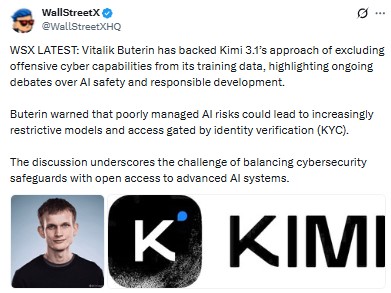
Source: @VitalikButerin on X, captured October 26, 2026
He said discriminating against use cases is "much less bad than discriminating against users."
He says he is okay with the choice, which is softer than a full endorsement. The update does not describe how the model was trained or tested.
Why Does Buterin Separate Use Cases from Users?
Buterin argues that the world needs time to prepare for strong cyber-attacks. He lists hardening systems, checking old code, and formally verifying new code as the work that time buys.
Limiting what a model can do is, in his view, far less harmful than limiting who may use it.
What Did He Warn About KYC and Locked-Down Models?
Buterin warned that mishandling this first big wave of AI risk could lead to a dystopia. He described highly locked-down models, KYC gating on everything, and intrusive surveillance.
He also described a society with tiered access, where credentials and nationality decide which model a person may use. None of them says Kimi 3.1 requires KYC.
Does the update argue for no limits at all?
The update does not argue for zero limits. Buterin accepts one kind of limit, on model capabilities, and warns against another, limits tied to a person's identity.
His own examples of the second kind are KYC, surveillance, and access tiers based on credentials and nationality.
The first kind, he argues, buys time. The second kind changes who gets to use AI at all. For crypto news readers, that difference is the heart of the debate.
How Did WallStreetX Frame the Story?
A WallStreetX update says Buterin backed Kimi 3.1's approach of excluding offensive cyber capabilities from its training data.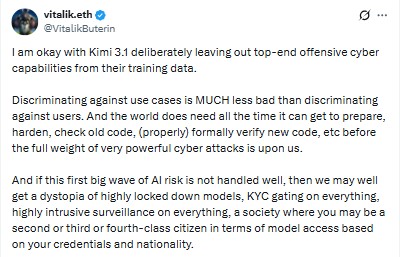
Source: @WallStreetXHQ on X, captured October 26, 2026
It repeats his warning that poorly managed risks could bring restrictive models and identity-gated access.
The update calls the issue a balance between cybersecurity safeguards and open access.
That summary is the outlet's framing, and "backed" is stronger than Buterin's own words, a gap common in the latest crypto news summaries.
What Do the Two Posts Not Show?
Neither update includes a statement from the Kimi team. Neither describes how Kimi 3.1 handles cyber requests in practice or says what data was left out.
No source here shows that Kimi 3.1 requires identity checks, or that any other AI service has added them.
The debate is about direction, not a rule in force. Readers following the latest crypto news on AI should keep that line clear.
Conclusion
Kimi 3.1 is the example in this debate, and this crypto news today report finds no KYC rule in either post. Buterin's point is about direction, and WallStreetX's summary follows it. Whether AI developers can limit risky capabilities without limiting people is the question that remains open.
YMYL Disclaimer
This article is for informational purposes only and is not financial or investment advice. Cryptocurrency and technology markets carry a significant risk of loss. Readers should verify details with official sources and consult a qualified professional before making financial decisions.
0
0

 Manage all your crypto, NFT and DeFi from one place
Securely connect the portfolio you’re using to start.


