
Solana News: Can the 2027 Roadmap Double Network Compute Capacity?

0
0
What Did Anza Share About the 2027 Plans?
The latest Solana News comes from an official post dated November 19, 2026. It says Brennan Watt of Anza laid out a 2027 roadmap for the chain. The plan sits in four areas: performance, expressivity, market structure and resilience.
The roadmap follows Alpenglow, the earlier consensus upgrade. The post carries a short video of about two minutes. It was shared on the official account on X. Each pillar gets only a line or two, so the details stay brief. The post is the main source for every point below.
How Much More Compute Capacity Is Planned?
Performance is the first pillar. Compute units, or CU, measure how much processing a transaction needs.
Every block can hold only a set amount of compute, so capacity and CU use decide how much fits inside it. The Solana News here is about two targets:
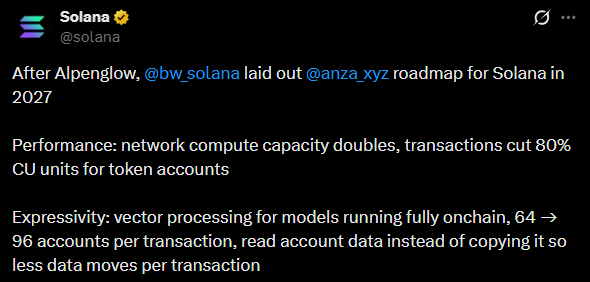
Network compute capacity is planned to double.
Transactions that use token accounts are planned to need 80% fewer CU.
Token accounts hold balances of assets such as stablecoins. Using fewer CU per transaction frees up space inside each block. The post gives no baseline for either figure, so the gain in raw transactions per second stays unstated.
Source: Official X Post
What Changes for Onchain Models and Accounts?
Expressivity covers what developers can build and run. Programs on the network read and write data kept in accounts, so account rules shape what an app can do. The post lists three items:
Vector processing, built so models can run fully on-chain.
A limit of 96 accounts per transaction, up from 64.
Reading account data in place instead of copying it, so less data moves per transaction.
Vector processing handles many values in a single step. Running a model on-chain means the logic executes on the network itself and not on an outside server.
A higher account limit lets one transaction touch more accounts at once. The move from 64 to 96 is a 50% rise in the cap.
What Does the Solana News Say About Constellation?
Market structure is the third pillar. It describes how blocks are shared and how transactions are ordered. The post ties Alpenglow to faster block distribution, which is how quickly a new block reaches validators.
Validators are the nodes that confirm transactions. It then names Constellation. According to the post, Constellation brings clearer ordering rules and more competition among validators.
Ordering rules decide which transaction lands first in a block. That part of the Solana News deals with how the network includes and arranges activity.
What Does the Post Leave Unconfirmed About Timing?
Resilience is the fourth pillar. Anza describes a simpler protocol with fewer special cases. Special cases are exceptions inside the rules. Removing some of them is how the plan aims to make changes safer.
The post is short on delivery details. It does not state:
Release dates for any upgrade.
The order in which the four pillars will ship.
How the doubled capacity and the 80% CU cut will be measured.
Which software clients will carry each change.
Because of this gap, the Solana News reads as a statement of direction and not a launch schedule.
How Is SOL Trading on November 20, 2026?
The roadmap post makes no price claim. The figures below are market context for this Solana News. Market cap is price multiplied by circulating supply. FDV, or fully diluted valuation, values the full supply at the current price.
Metric | CoinMarketCap reading |
Price | $72.45 |
24-hour change | down 2.59% |
Market cap | $42.88B, down 2.58% |
24-hour volume | $2.55B, up 11.42% |
Volume to market cap | 5.94% |
FDV | $46.21B |
Circulating supply | 591.85M SOL |
Total supply | 637.85M SOL |
Rank | #7 |
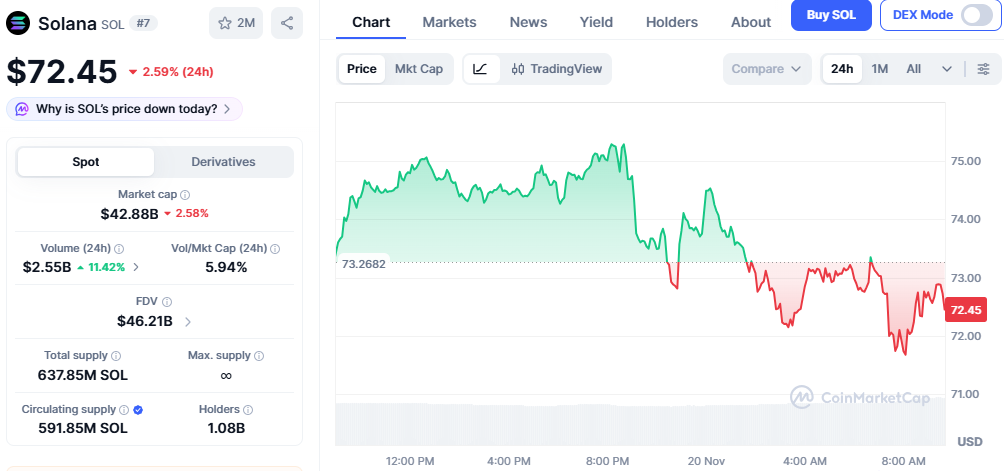
The 24-hour chart shows SOL moving between roughly $71.7 and $75.3. The volume to market cap ratio of 5.94% shows how much trading took place relative to the asset’s size.
Volume rose even as the price slipped, and the market cap fell by almost the same share as the price.
Source: CoinMarketCap Chart
Note: Prices can change quickly, so figures may not reflect the latest value. Readers should check a live price tracker for current data.
What Should Readers Watch Next?
The roadmap sets direction but gives no dates. Release timing will most likely appear on the official channels of Anza and the Solana team.
Items with clear numbers, such as the 80% CU cut and the 96-account limit, will be the easiest to verify once code ships. Until then, the roadmap works as a list of goals that developers and validators can plan around.
Readers following Solana News on this topic can check which pillar moves first. Alpenglow and Constellation are the two names to track under market structure. Any later Solana News on these items will depend on official posts and published code.
Disclaimer: This article is for information only and is not financial advice. It makes no price predictions and no promise of returns. Crypto assets carry risk, so readers should do their own research.
0
0


 Manage all your crypto, NFT and DeFi from one place
Securely connect the portfolio you’re using to start.


