
XRP price prediction: why 4.8 percent open leverage cushions the fall

0
0

XRP trades at $1.29 on Saturday evening, its lowest level in 30 days. To judge how firm that floor is, the place to look is not the spot market but the futures market: $3.92 billion sits in open perpetual futures there, counted across 120 contracts on all exchanges. Against a market value of $81.5 billion, that is 4.8 percent.
Two things are documented by that. The share sits close to Bitcoin's 4.2 percent, and it sits far below the 15.1 percent that Ethereum and Solana carry. Our assessment follows further down: a thin futures market takes the fuel out of a slide, but it says nothing about whether anyone is buying.
Where the price stands on a horizon of months is tracked continuously in our XRP price prediction. This piece takes on the day, and from the angle that carries the most weight on a Saturday.
Open leverage on XRP: $3.92 billion against $81.5 billion of market value
Open interest is the sum of all futures positions that have not yet been closed. Each of those positions has a buyer and a seller, and each has a level at which the exchange unwinds it by force. That is precisely why the number matters to a spot investor: it measures how much forced selling pressure sits in the market before a single person makes a decision.
Our own analysis of CoinGecko futures data from Saturday evening counts 120 perpetual XRP contracts holding $3.92 billion of open positions between them. CoinGecko itself reports around $4.07 billion on its XRP overview page, because contracts that do not track the XRP index cleanly are counted there too. The range from $3.92 billion to $4.07 billion is the honest figure, not a smoothed number somewhere in between.
The largest single position sits at Binance with $400.4 million. OrangeX follows with $307.5 million, Gate with $278.5 million and CoinW with $271.9 million. No exchange holds more than roughly a tenth of the total, so the leverage is spread widely. That too differs from phases in which a single venue dictates the liquidations.
How open interest acts on the price
The mechanism takes three sentences. If the price falls below the maintenance level of a leveraged long, the exchange sells that position into the market automatically. The sale pushes the price further, reaches the next maintenance level and triggers the next forced sale there. That is how a two percent dip becomes a ten percent drop within minutes.
The fuel for that sequence is open interest. The more leveraged positions are stacked on top of each other, the longer the chain runs. With only 4.8 percent of market value in leverage, the sequence breaks off sooner, because after a few steps there is simply no position left that would have to be sold automatically. Ethereum and Solana have more than three times as many steps lined up.
A second figure helps with the context: open interest against spot turnover. XRP turns over $1.38 billion on the cash market in 24 hours, and the futures market holds 2.83 times that. For Bitcoin it is 2.88, for Solana 3.51 and for Ethereum 4.43. On this calculation too, XRP sits at the low end of the large assets, at Bitcoin's level.
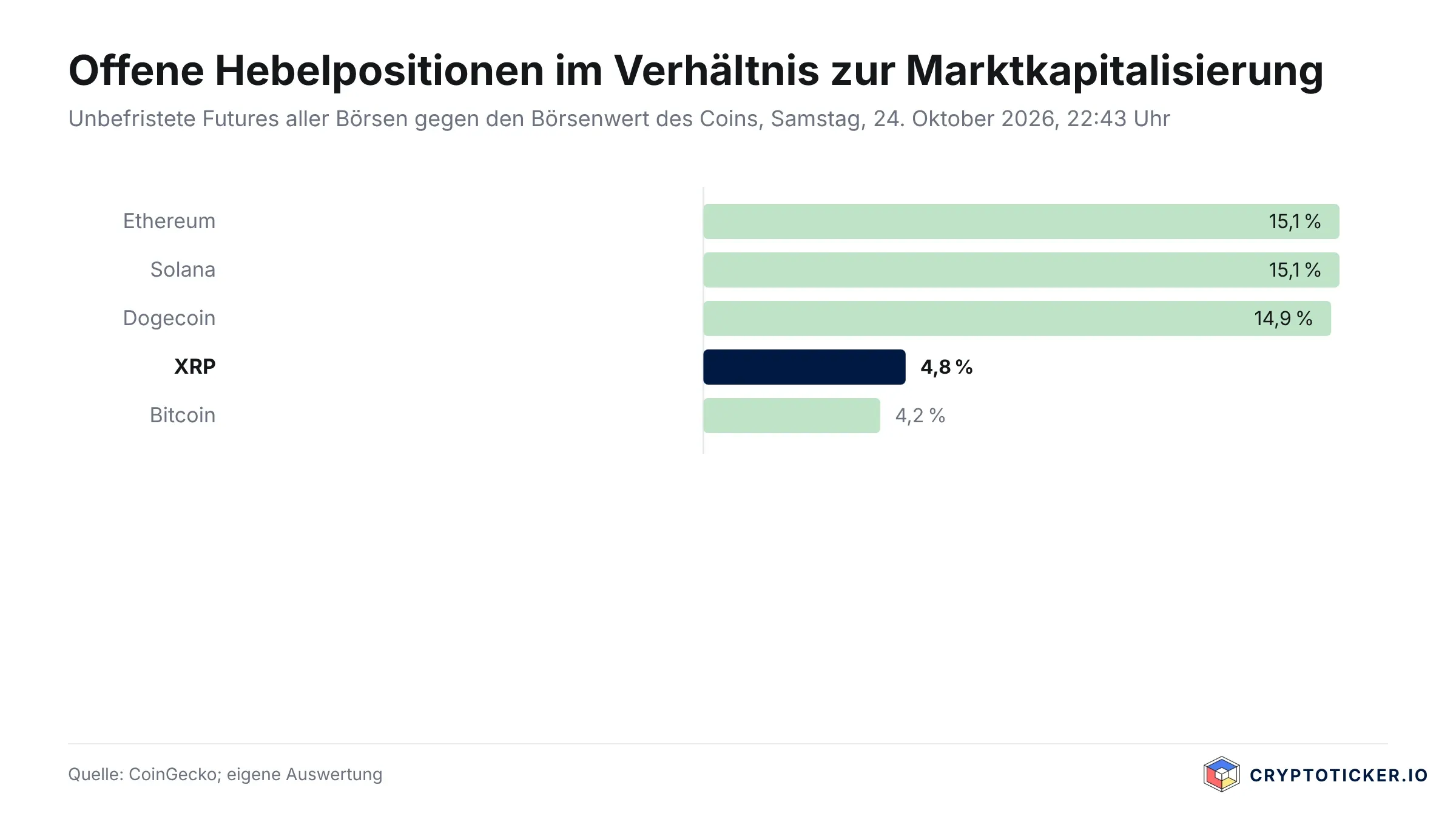
Ethereum, Solana and Dogecoin carry more than three times the leverage
The order on Saturday evening: Ethereum 15.1 percent, Solana 15.1 percent, Dogecoin 14.9 percent, XRP 4.8 percent, Bitcoin 4.2 percent. In absolute terms, Ethereum has $43.3 billion in the futures market, Bitcoin $68.0 billion, Solana $9.0 billion and Dogecoin $1.8 billion.
That distribution explains part of what investors have been watching for weeks. XRP has lost 15.9 percent in 30 days, Ether considerably more over the same period and, on days like Friday, twice as much as Bitcoin. Where more leverage sits, the swings are larger in both directions. The same holds on the way up: a thin futures market delivers no short covering to accelerate a rally either.
Current positions can be checked independently, for instance in the open interest overview at Coinglass. Anyone considering a leveraged entry will find the venues' terms in our rundown of the best perp DEXs.
The funding rate sits at a median of 0.0039 percent
The funding rate is the fee that flows between the two sides of a perpetual future every eight hours. When it is positive, leveraged buyers pay sellers and the market is crowded on the buy side. When it is negative, the money runs the other way.
Across all 120 contracts the median on Saturday evening is 0.0039 percent, just inside positive territory. Binance pays 0.0067 percent, Bybit minus 0.0031 percent, and 15 of the 120 contracts are negative in all. The range runs from minus 0.0115 to plus 0.030 percent. That paints a market without a tilt: buyers are not crowding in, and sellers are not betting as a bloc on lower prices.
For comparison with crowded phases: funding rates beyond 0.05 percent per payment amount to holding costs above 50 percent annualised, and they regularly precede a shakeout. XRP is a long way from that.
The 100-day average at $1.2897 has held since the cross
On Friday we described in this spot how the 100-day average rose above the 200-day average. Two things have changed since. The price, at $1.2904, is 0.3 percent lower than the $1.2938 of the previous day, but the cross itself has widened.
In numbers: the 100-day average now sits 1.06 cents above the 200-day average, where seven days ago it was 0.55 cents below it. The gap is growing, then, rather than closing again. The price itself, at $1.2904, sits almost exactly on the 100-day average of $1.2897, a distance of 0.05 percent.
$1.2791 and $1.4071 bound the range
On the downside, the next grounded level is $1.2791, the 200-day average. From $1.2904 that is 1.1 cents or 0.9 percent. Directly below it lies the session low of $1.26, which also marks the floor of the past trading week.
On the upside, two averages the price lost in October count: the 20-day at $1.3591, 5.1 percent away, and the 50-day at $1.4071, 8.3 percent away. The monthly high stood at $1.5681. Over 90 days, despite a weak October, XRP is up 16.0 percent; over seven days it is practically unchanged at minus 0.2 percent.

What a thin futures market changes for spot buyers
For someone holding XRP without leverage, the risk calculation changes in one place. A slide below the 200-day average would, with this leverage distribution, be less likely to tip into a chain reaction, because the forced sales run out after a few steps. The drawback of the same setup: a recovery gets just as little push from covered shorts.
In practice that means XRP's moves are currently carried more by inflows and news than by futures-market mechanics. On Friday, Franklin Templeton brought $150 million of tokenised fund units onto the XRP Ledger, and the price still gave way. To find a trigger, look there and not in the liquidation data.
Holding period and the exemption limit: the framework for investors in Germany
The tax difference between the two routes is larger than many expect, and for this topic it is the most practical point of all. Holding XRP in your own portfolio falls under private disposals in Germany, under section 23 of the income tax act: after a holding period of one year the gain is tax-free, below that your personal rate applies, and all private disposals in a single year together carry an exemption limit of 1,000 euros.
Trading perpetual futures with leverage, by contrast, sits in a different tax world. No holding period applies there, and gains count as investment income. The one-year clock that frees a spot holding after twelve months never starts. Considering a leveraged position because of the low funding rate therefore forfeits exactly the advantage the German framework grants the patient holder.
Whether the holding period survives has been open since the summer. We track the current state of the reform debate continuously at crypto holding period: the state of the reform. For keeping records of purchase dates and holding periods, there are tools that carry the portfolio with its purchase dates.
Our assessment: thin leverage is a buffer, not a buy signal
From the newsroom's point of view, the low leverage load is the most solid piece of good news Saturday offers for XRP. The numbers support it: 4.8 percent open interest against 15.1 percent at Ethereum, a funding rate at a median of 0.0039 percent, and a 100-day average that has pulled 1.06 cents clear of the 200-day average since the cross. Three figures pointing the same way.
Against it stands, just as plainly, that none of those figures is demand. The price sits at its 30-day low, 15.9 percent below where it stood a month ago, and Franklin Templeton's $150 million triggered no buying on Friday. A market without leverage falls more slowly, but that does not make it rise. Reading an entry signal into it mistakes a shorter drop for a reason to climb.
XRP at $1.29: 1.1 cents of room to the 200-day average
- Set the 200-day average at $1.2791 as the level to watch. If the daily close falls below it, the cross of October 21 is void and the zone down to $1.26 is the next field. Price alerts are free to set at most of the venues in our rundown of the best crypto exchanges.
- Before any leveraged position, check the current funding rate at your own venue, not the market average. On Saturday the range ran from minus 0.0115 to plus 0.030 percent per payment, an eightfold gap between the cheapest and the most expensive provider. The terms are in our rundown of the best perp DEXs.
- Record purchase dates without gaps for as long as the one-year rule under section 23 of the German income tax act applies. A holding bought in October 2026 is out of the period in October 2027 at the earliest. The tools for that are in the overview of crypto tax tools.
(As of October 24, 2026. This article is not investment advice. Prices and fee structures change; check the terms with the provider before you buy. Trading leveraged products can lead to the total loss of the capital employed.)
0
0


 Manage all your crypto, NFT and DeFi from one place
Securely connect the portfolio you’re using to start.
 Where will Ethereum trade next?
Live Polymarket and Kalshi odds on Ethereum price targets, compared side by side.
See Ethereum price odds


