
Ethereum price prediction: Glamsterdam upgrade delayed, what matters now

0
0

Analysis: Ethereum's next major upgrade is called Glamsterdam, and it was due to go live on the Hoodi testnet on October 26. That did not happen. What is documented: the developers halted the activation, there is no new date, and no schedule exists for the mainnet either. Our assessment follows further below. For the price, this weekend's delay is the smaller story, because the blockchain has a demand problem that can be read off the gas fee.
Ether traded at around $2,256 on Saturday evening, about 1.4 percent higher than 24 hours earlier. The daily low was $2,221 and the daily high $2,256. The price remains a good 54 percent below its record of $4,946. For where the price can head over a horizon of months, our Ethereum price prediction provides the context. This article sticks to what is measurable today.
Glamsterdam: what the developers halted on the Hoodi testnet
Glamsterdam succeeds the Fusaka upgrade and, like every Ethereum update, bundles several change proposals. Every upgrade passes through several testnets before it reaches the mainnet. Sepolia had its turn on October 6, and Hoodi was scheduled for October 26. Hoodi is the testnet where validator node operators rehearse their software under conditions as close to real as possible, before actual money depends on it.
That activation has been scrapped. According to the Ethereum Foundation's notice of October 22, the planned release of the Amsterdam execution layer and the Gloas consensus layer on Hoodi was taken out of the configuration again. A second item scheduled for the same moment falls away with it: the gas limit on Hoodi was meant to rise to 200 million, meaning the amount of computation that fits into a block. That too has been postponed. Neither a replacement date for Hoodi nor a date for the mainnet appears in the notice, as NewsBTC reports, citing the developer call.
EIP-8037 and the question that is still open
The developers name a single change proposal as the reason: EIP-8037. An EIP, short for Ethereum Improvement Proposal, is a formal proposal that changes a rule of the blockchain. What remains open is how this proposal interacts with contracts already running on the mainnet. Smart contracts are programs that sit immutably on the blockchain; changing a rule also changes the conditions under which those programs have been working for years.
That is precisely the reason for the caution. A proposal that runs cleanly in the lab can hit an old contract whose author priced in different costs five years ago. On a testnet, such a finding costs time. On the mainnet, it costs money that nobody can recover. The developers chose to settle the question first instead of holding the date.

Nothing changes on the mainnet for now
Anyone holding ether on an exchange or in their own wallet needs to do nothing because of this delay. The notice is addressed explicitly to the operators of nodes on the Hoodi testnet, who are asked to move their software to the updated releases. It states no action for mainnet users. Your balance, your addresses and your keys are untouched.
What shifts is the moment at which the improvements from Glamsterdam take effect. As long as no new date is fixed, the blockchain keeps the properties that Fusaka gave it. And that is exactly where it is worth looking, because those properties are currently barely being used.
The base fee stands at 0.06 Gwei
Every transfer on Ethereum pays a base fee. It is counted in Gwei, a billionth unit of ether, and it rises when many people want to fill blocks at the same time. That makes it the most honest measure of demand for computing time on this blockchain. On Saturday evening it stands at 0.058 Gwei. The average over the past 24 hours was 0.092 Gwei, and over the past 30 days 0.484 Gwei.
These numbers only carry weight in comparison. Since the base fee was introduced, its average has been 18.51 Gwei. Today's value is therefore around one three-hundredth of the long-run mean. For users, that is good news: a simple transfer currently costs cents rather than several euros. For the question of where the price is heading, it is the worse news, and the reason sits in the mechanics of the fee.
13.63 Gwei: the threshold above which Ethereum shrinks
Since the fee reform of 2021, the base fee is not paid out to validators but destroyed. This process is called burning. At the same time, the blockchain continuously creates new ether as a reward for validators. The two run against each other. If the burn exceeds issuance, the circulating supply falls. If it stays below, supply grows.
The point at which the two cancel out currently sits at 13.63 Gwei. The data service ultrasound.money publishes this value as the threshold. Measured against this evening's 0.058 Gwei, a factor of roughly 235 is missing for the sum to work out. That is no longer a nuance but a different order of magnitude.
The burn is correspondingly thin. Over the past 24 hours, 19.92 ether were destroyed, worth around $44,600 at the current price. Over seven days it was 1,964 ether, and over 30 days 3,150 ether. By way of comparison: since burning began, the blockchain has destroyed around 4.64 million ether in total. A full month's contribution therefore amounts to barely seven ten-thousandths of that sum.
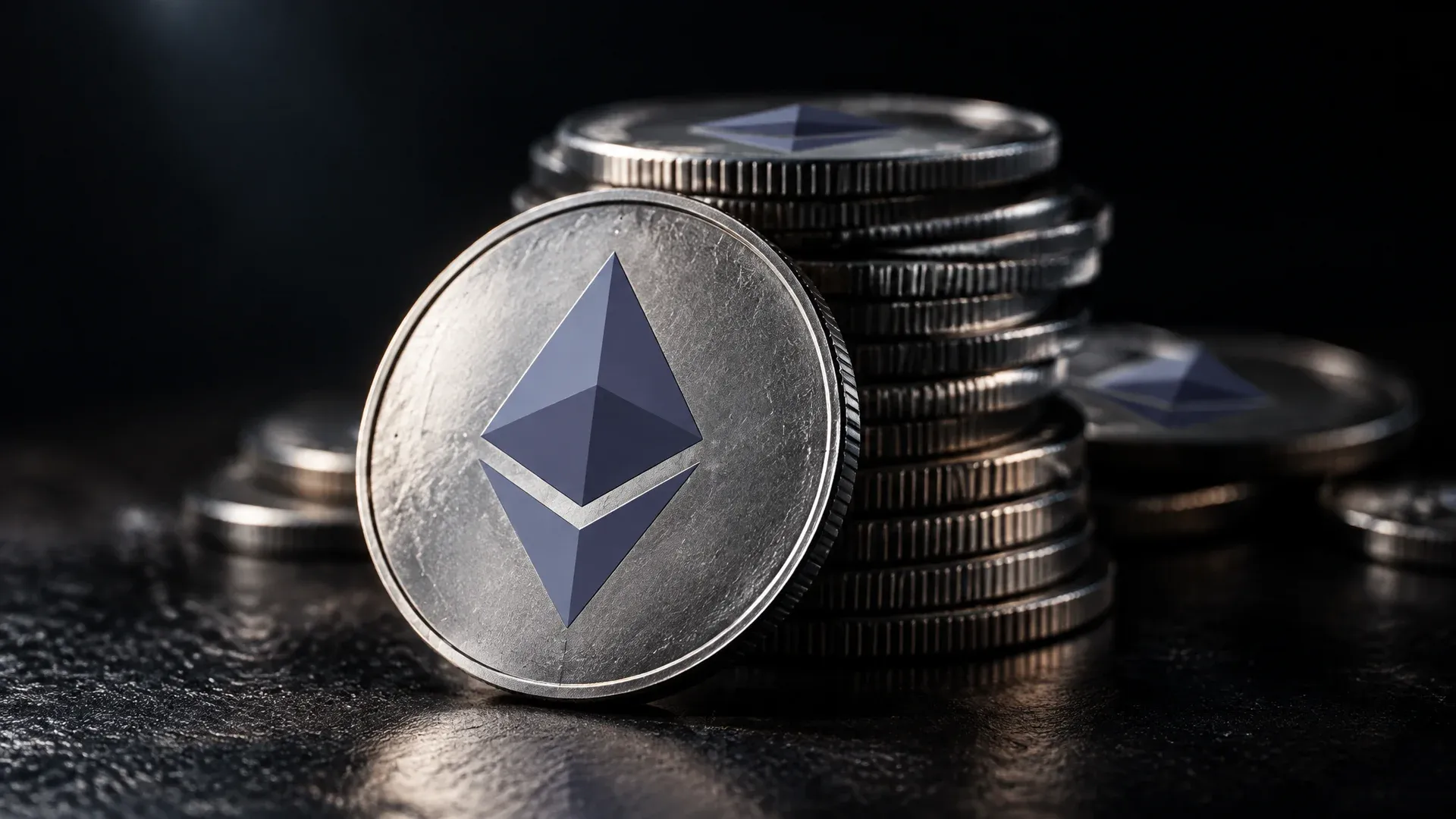
Supply is growing again by 2,954 ether a day
The consequence can be recalculated from the total holdings. Twenty-four hours ago the circulating supply stood at 122,174,288 ether, and on Saturday evening at 122,177,242 ether. That is 2,954 ether more in a single day. If that pace holds, around 1.08 million ether will be added over a year. Relative to today's holdings, that corresponds to an expansion of 0.88 percent a year. cryptoticker.io compiled this analysis itself on October 31, 2026, on the basis of the public network data from ultrasound.money.
That removes one of the arguments with which ether was marketed for years. The story of money growing scarcer only holds as long as enough people use the blockchain. At 0.06 Gwei, hardly anyone uses it. Part of the activity has also moved to the second layers, where transactions are cheaper and only land on the main blockchain in bundled form. Anyone buying ether today is not buying a shrinking supply. If you add to a position, the trading fee at your exchange matters more at small amounts than the entry price.
What has changed since the monthly expiry on October 30
Yesterday this slot focused on the monthly options expiry, with 68,199 puts in the money ahead of the 9 a.m. settlement. That is documented in our Ethereum analysis of October 30. That date has passed, and the feared follow-up pressure on the price did not materialise.
Comparing the averages shows where ether has stood since then. Over the past seven days, an ether cost $2,307 on average, and over the past 30 days $2,465. Today it is $2,256. The price therefore sits below both averages, and the gap to the monthly mean is a good 8 percent. The recovery after the expiry did not turn the monthly trend, it interrupted it.
Our assessment: a delayed upgrade does not move this price
In the editorial team's view, the Glamsterdam delay is the less important of the two stories this weekend. The numbers above support that: an upgrade that raises capacity solves a problem the blockchain does not currently have. With a base fee of 0.058 Gwei and a 30-day average of 0.484 Gwei, nobody is running into a limit. More room on an empty road does nothing for the traffic.
The longer view argues the other way. Glamsterdam is meant to make the blockchain faster, and cheap, fast blocks are the precondition for applications to come back. Anyone who had factored the upgrade in as a price driver now has to push that point back, without knowing how far. We deliberately name no price target here, because there is no basis for one that we could show.
The levels for the weekend: $2,221 and $2,465
On the downside, the daily low at $2,221 counts first. It is the most recent point at which buyers stepped in, and therefore the first reliable level. If it gives way, there is no orientation from recent days until the area of the October lows.
On the upside, the round level of $2,300 is the next hurdle, and behind it the 30-day average at $2,465. As long as the price stays below that average, every move higher is a counter-move within the downtrend and not a reversal. What would matter is a closing price above $2,465 that holds for more than a day.
Staking, the holding period and fees in Germany
Anyone holding ether who wants to bridge the time quickly arrives at staking. You make your ether available to the blockchain to secure it and receive interest in ether in return. The yield comes from the same issuance that expands the supply; you therefore receive a share of the dilution rather than compensation for it. Which providers work on which terms, and how long your balance stays locked up, is shown by the comparison of staking providers.
For tax, the one-year holding period still applies in Germany: anyone who holds ether for longer than twelve months and then sells pays no income tax on the gain. For staked holdings this period was once extended to ten years, which no longer applies. Because this rule is being worked on politically, we keep track of the current state of the crypto holding period reform. Staking rewards are taxable separately as other income in the year they accrue.
In practical terms: if you have been invested for more than a year anyway, a delayed testnet changes nothing about your position. If you add to a position, the exchange's fee weighs more heavily at current amounts than the difference between $2,256 and $2,300.
Glamsterdam halt: below 13.63 Gwei, supply keeps growing
- Keep an eye on the base fee rather than the upgrade date. Only when it approaches the threshold of 13.63 Gwei does the supply calculation tip back. How expensive your access to the market is becomes clear in the exchange comparison.
- Factor the dilution into your return expectations. With supply growth of 0.88 percent a year, a staking yield has to beat that value before anything is left in real terms. The conditions are listed in the comparison of staking providers.
- Keep your purchase date and your staking inflows cleanly apart, because the holding period and the taxation of inflows run separately. The programs in the comparison of crypto tax tools help with that.
(As of October 31, 2026. This article is not investment advice. Prices and fee structures change; check the terms with the provider before you buy.)
0
0

 Manage all your crypto, NFT and DeFi from one place
Securely connect the portfolio you’re using to start.
 Where will Ethereum trade next?
Live Polymarket and Kalshi odds on Ethereum price targets, compared side by side.
See Ethereum price odds


