
Polkadot Relay Chain Explained: How the Core Network Works

0
0
Polkadot Relay Chain Architecture: Security, Consensus, and Parachains
The Polkadot (DOT) Relay Chain sits at the center of the whole network, yet it rarely gets the attention that parachains and DOT price moves do. It runs no apps and holds no NFTs. Its job is narrower, and that is intentional.
Polkadot's developer documentation, last updated in June 2026, describes one chain that coordinates many specialized chains.
What Is the Polkadot Relay Chain and What Does It Do?
A relay chain is the main blockchain that links and secures a group of smaller chains running beside it. The Polkadot Relay Chain fills that role for the entire network, which calls itself a Layer-0 protocol, meaning a base layer that application chains are built on.
According to the project, the chain keeps its own functions deliberately minimal. Block production, core scheduling, data availability, and security for connected chains make up most of the workload.
How Does the Polkadot Relay Chain Keep Parachains Secure?
A parachain is an application-specific Layer-1 blockchain that runs in parallel with the relay chain. Under Polkadot's design, any chain that compiles to WebAssembly, a portable code format, and follows the Parachains Protocol can qualify.
The Polkadot architecture overview explains the bargain. Parachains skip the hard task of recruiting their own validators and borrow security from the relay chain, an arrangement called shared security.
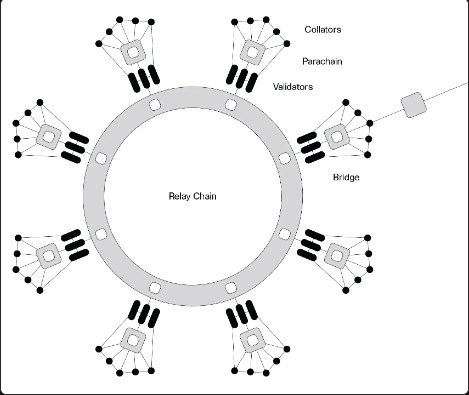
A Polkadot validator is a node that checks blocks and earns rewards for it. Validators lock DOT as a guarantee of honest behavior, which is what staking means, and nominators can back chosen validators with their own tokens.
One shared state ties the relay chain to every parachain. If the relay chain had to revert, all connected parachains would revert with it, so trust rests on a single validator set.
Teams usually build parachains with the Polkadot SDK, which includes the Polkadot Substrate framework as one of its parts.
How Do Validators Produce and Finalize Blocks?
Two protocols split the work on the Polkadot Relay Chain. One creates blocks and the other locks them in, which the docs call a hybrid consensus model.
Blind Assignment for Blockchain Extension, or BABE, hands out block slots through a randomness lottery. Slots last about six seconds. Sometimes two validators win the same slot, sometimes none does, and a backup method fills the gap.
Finality means a block can no longer be reversed. GRANDPA finalizes whole chains of blocks in one round, and the docs say it tolerates up to one fifth of nodes acting maliciously. BABE keeps the chain moving, while GRANDPA makes that progress permanent.
How Do Parachains Connect Through Cores and Coretime?
The wiki compares the relay chain to a processor with several cores. A parachain with a dedicated core behaves like a process that never stops, while an on-demand parachain shares cores and wakes only when needed.
Both types pay in DOT through core time, which is time on a core measured in relay chain blocks. Agile coretime lets parachains buy monthly bulk allocations, and renewals get priority. The docs call the older auction route deprecated.
Parachains then exchange data through XCM, a message format that defines structure but not delivery. The top Polkadot parachains each depend on a core of the Polkadot Relay Chain, though the way they obtain that core can differ.
What Role Does DOT Play on the Polkadot Relay Chain?
DOT is the network's native token. The docs list three main uses: governance, staking, and buying coretime. It also pays transaction fees and covers governance deposits.
Governance runs through OpenGov, where every decision goes to a public referendum open to any token holder. The Polkadot open governance model also lets treasury DOT be allocated to teams building for the ecosystem.
Each proposal follows the Polkadot referenda voting process, where token holders cast votes on-chain.
Relay Chain vs Parachains: What Each Layer Handles
Feature | Relay chain | Parachains |
Main job | Coordination, scheduling, data availability | Application-specific logic |
Block producers | Validators | Collators |
Security | Validators staked in DOT | Borrowed from the relay chain |
Access | Elected validator set | Coretime is bought with DOT. |
The split explains why the chain stays lean. Heavy work such as contracts or asset tracking sits on parachains, while the Polkadot Relay Chain concentrates on agreement and security.
What Is JAM and How May It Change the Core Network?
JAM, short for Join-Accumulate Machine, is described in the docs as the planned successor to the current relay chain design. Its stated goals include permissionless code execution and better use of block time.
The docs say JAM would arrive as one complete upgrade. No activation date appears in the official pages reviewed, so the timeline is unconfirmed, and the current Polkadot Relay Chain stays the live design.
What Risks and Open Questions Remain?
Documentation gaps: The wiki and developer docs describe the split of Polkadot staking and accounts differently, so the exact duties of the relay chain can look unclear.
Shared fate: Shared state means a serious relay chain failure would hit every connected parachain at once, which concentrates risk in a single place.
Ongoing cost: Parachains must keep paying for coretime in DOT, so each team carries a running expense that does not disappear after launch.
JAM timing: JAM remains a plan rather than a live feature, and no firm activation date appears in the official pages reviewed.
Conclusion
The Polkadot Relay Chain works as a lean coordination layer. Validators secure it, parachains borrow that security, and DOT pays for access through coretime.
What remains uncertain is how the documentation will settle the split of duties and when JAM may arrive. Any change would show up first on Polkadot's official platform and in the developer docs, so dated pages carry more weight than older summaries.
Disclaimer:
This article is for information only and is not financial advice. Crypto assets are volatile and carry a risk of loss. Independent research is advised before any decision.
0
0

 Manage all your crypto, NFT and DeFi from one place
Securely connect the portfolio you’re using to start.


