
Bitget Trading Bot: Grid, DCA and Futures Bots Explained

0
0

A Bitget trading bot places buy and sell orders for you according to rules you set once: a grid bot trades a price range, a DCA bot buys in steps, a signal bot executes alerts from TradingView. Bitget offers grid, Martingale, auto-invest, portfolio, trend-following and signal bots, and according to its bot guide they cost nothing extra: you pay the normal trading fees, plus funding and interest where leverage is involved. The futures grid bot works on USDT-M perpetuals with leverage of up to 150x, which is also where the largest risk sits.
Bitget trading bots: the key facts
- Bot types: spot grid, futures grid, position grid, spot and futures Martingale, auto-invest, Smart Portfolio, trend-following and the futures signal bot.
- Cost: no bot fee; standard trading fees of 0.1 percent on spot and 0.02 or 0.06 percent on futures apply.
- Leverage: the futures grid bot allows up to 150x on USDT-M perpetuals.
- No coding: every bot is set up through a guided screen in the app or on the website.
- Change: Bitget discontinued its custodial Futures Martingale bots on 12 October 2026, according to its bot page.
This guide explains which Bitget trading bot fits which market, calculates a grid bot on Bitcoin with today’s price and shows why too many grids lose money to fees. Bots trade on the same spot and futures markets as manual orders, so the costs in our overview of Bitget fees apply to every bot order. Bitget is not listed in ESMA’s register of crypto-asset service providers authorised under MiCA, so this guide is for readers outside the EU in countries where Bitget operates.
Which Bitget trading bot fits which market
Every bot follows one strategy, and every strategy has a market in which it works and one in which it fails. Bitget sorts its bots by trading goal:
| Your goal | Bitget bot | Market it is built for |
|---|---|---|
| Earn from prices moving up and down in a range | Spot grid, futures grid, position grid | Sideways, range-bound |
| Build a position step by step | Auto-invest, spot Martingale | Rising or fluctuating |
| Trade a range with leverage | Futures grid | Medium to high volatility |
| Hold several coins in fixed proportions | Smart Portfolio | Long-term, stable or rising |
| Follow indicators such as MACD or RSI | Trend-following bot, spot and futures | Trending, breakouts |
| Execute your own TradingView alerts | Futures signal bot | Any, signal-driven |
Bitget names the spot grid and the auto-invest bot as the easiest starting points. Both work without leverage, so a mistake in the settings costs time and fees, not a liquidated position.
Bitget grid bot: how spot grid and futures grid work
A grid bot divides a price range into equal steps and places a buy order at every step below the current price and a sell order at every step above it. When the price falls one step, the bot buys; when it rises one step again, it sells that amount with a profit of one step. Each completed buy and sell pair is one grid round.
- Spot grid: trades coins you actually buy, without leverage. The worst case is holding Bitcoin bought at higher prices when the price leaves the range at the bottom.
- Futures grid: runs the same logic on USDT-M perpetuals, long, short or neutral, with leverage. Here the worst case is liquidation.
- Trailing grid: moves the range along when the price leaves it, available for both spot and futures grids.
- Position grid: sets range and grid count itself once you enter the amount.
How many grids? A Bitget grid bot example with Bitcoin
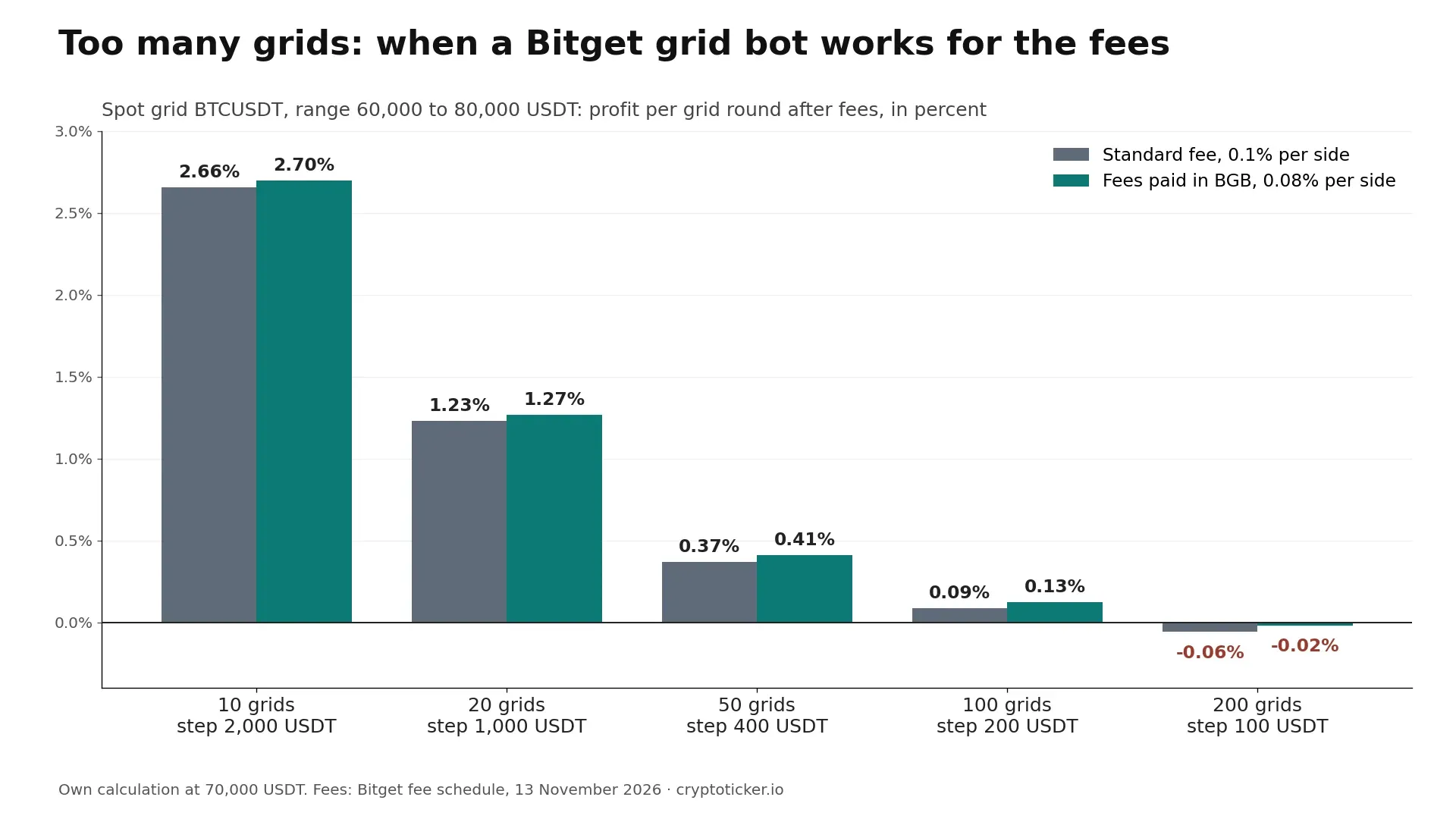
The example uses a spot grid on BTCUSDT, Bitcoin against the Tether stablecoin USDT, between 60,000 and 80,000 USDT, a range around the Bitcoin (BTC) price of about $68,970 on 13 November 2026 (CoinMarketCap, 20:01 UTC). Every grid round pays the spot fee twice, once for the buy and once for the sell: 0.2 percent in total at the standard level, 0.16 percent if you pay fees in BGB.
| Number of grids | Step size | Gross profit per round | After fees | After fees with BGB |
|---|---|---|---|---|
| 10 | 2,000 USDT | 2.86% | 2.66% | 2.70% |
| 20 | 1,000 USDT | 1.43% | 1.23% | 1.27% |
| 50 | 400 USDT | 0.57% | 0.37% | 0.41% |
| 100 | 200 USDT | 0.29% | 0.09% | 0.13% |
| 200 | 100 USDT | 0.14% | minus 0.06% | minus 0.02% |
Profit per round is measured at the middle of the range, 70,000 USDT. Above about 142 grids in this range, a round no longer covers the standard fees; with BGB the limit lies at about 178. More grids mean more rounds when the price moves little, fewer grids mean more profit per round when it moves a lot. A step of at least 0.5 percent of the price keeps the fee share below half of the gross profit.
Bitget trading bot fees: what you pay
Bitget charges no subscription and no fee for the bot itself. Every order the bot places is a normal trade, so the costs depend on the market the bot trades.
| Bot | Costs per order | Additional costs |
|---|---|---|
| Spot grid, spot Martingale, auto-invest, Smart Portfolio | Spot fee, 0.1% at the standard level, 0.08% with BGB | None |
| Futures grid, futures trend-following, futures signal bot | Futures fee, 0.02% maker and 0.06% taker | Funding every eight hours, paid between traders |
For grid bots the trading fee is the decisive cost, because they trade often and earn small steps. External bot services that connect to Bitget through an API usually charge their own subscription on top; Bitget’s built-in bots avoid that layer.
How to set up a Bitget trading bot in five steps
The setup follows the same pattern for every bot type. The example is a spot grid, the starting point Bitget recommends for beginners.
| Step | What you do | What to watch |
|---|---|---|
| 1 | Open Trading bots in the app or on the website and choose Spot grid | Check which bots are offered in your country |
| 2 | Pick the pair, for example BTCUSDT | Liquid pairs fill grid orders more reliably |
| 3 | Set the lower and upper price and the number of grids | Keep each step well above 0.2 percent of the price |
| 4 | Enter the amount and optional stop-loss and take-profit levels | A stop-loss below the range limits the damage of a breakdown |
| 5 | Start the bot and follow it on the bot dashboard | You can stop it at any time; open positions are then settled at the market price |
Bitget lets you run several bots at the same time on different pairs, as long as your balance covers them. Strategies can be tested beforehand with virtual funds in Bitget demo trading.

Bot copy trading on Bitget
If you do not want to choose the settings yourself, Bitget offers bot copy trading: according to Bitget, you follow trading bots created by elite bot traders. Before you copy one, check the price range and the leverage the bot uses, because they decide your risk.
Copying human traders instead of bots works through Bitget’s copy trading for futures and spot, explained in our guide to Bitget copy trading.
Risks of Bitget trading bots
A bot executes rules without hesitation, in good and in bad markets. Four risks deserve attention before you start one:
- The price leaves the range. Below the range a spot grid holds coins bought at higher prices; above it the bot has sold everything and stops earning.
- Leverage in futures bots. At 20x, a 5 percent move against a futures grid consumes its margin, even before maintenance margin and fees are counted. How leverage and liquidation work is explained in our guide to Bitget futures trading.
- Martingale logic. Buying more as the price falls lowers the average price but enlarges the position in a falling market.
- Past returns. The returns shown for bots and bot traders describe the past and say nothing about the next weeks.
Bitget trading bot or another provider?
Bitget’s bots run inside the exchange, need no API key and cost nothing beyond the trading fees. Independent bot platforms connect to several exchanges at once and offer more strategy settings, usually for a monthly fee. Our comparison of the best crypto trading bots lists both kinds with prices and supported exchanges.
If you are still choosing an exchange, our crypto exchange comparison shows which platforms offer built-in bots and at what fees. New Bitget accounts can be opened through Bitget’s sign-up page with our referral code already filled in; the conditions of the welcome pack are on our Bitget referral code page.
Where you can use Bitget trading bots
Bitget’s bots are available wherever Bitget accepts customers, with the limits that apply to the exchange as a whole:
- European Union: Bitget is not listed in ESMA’s register of crypto-asset service providers authorised under MiCA (version of 11 November 2026). EU readers find licensed exchanges in our comparison of regulated crypto exchanges.
- Excluded countries: Bitget’s Terms of Use exclude, among others, the United States, Canada, Singapore, Japan, Hong Kong, Germany, France and Austria.
- Australia: ASIC has warned investors that Bitget’s crypto futures are not licensed there. Australians use the spot bots: spot grid, auto-invest and Smart Portfolio.
Bitget trading bot: our assessment
Bitget’s bot range is broad and free to use, and the spot grid is a sensible way to automate a clear view: “Bitcoin will move sideways between two prices for a while.” The bot does not create that view, it only executes it. The grid example shows where most of the work lies: choosing a range that fits the market and a step size that leaves enough after fees.
Start with a spot grid or auto-invest, a small amount and a stop-loss below the range, and leave futures bots for later. Bots with leverage can lose the full margin within hours. This guide explains how the bots work; it is not investment advice.
0
0

 Manage all your crypto, NFT and DeFi from one place
Securely connect the portfolio you’re using to start.
 Where will Bitcoin trade next?
Live Polymarket and Kalshi odds on Bitcoin price targets, compared side by side.
See Bitcoin price odds


