
Justin Drake Calls for “Bunker Mode” as AI Threat Grows Rapidly

0
0
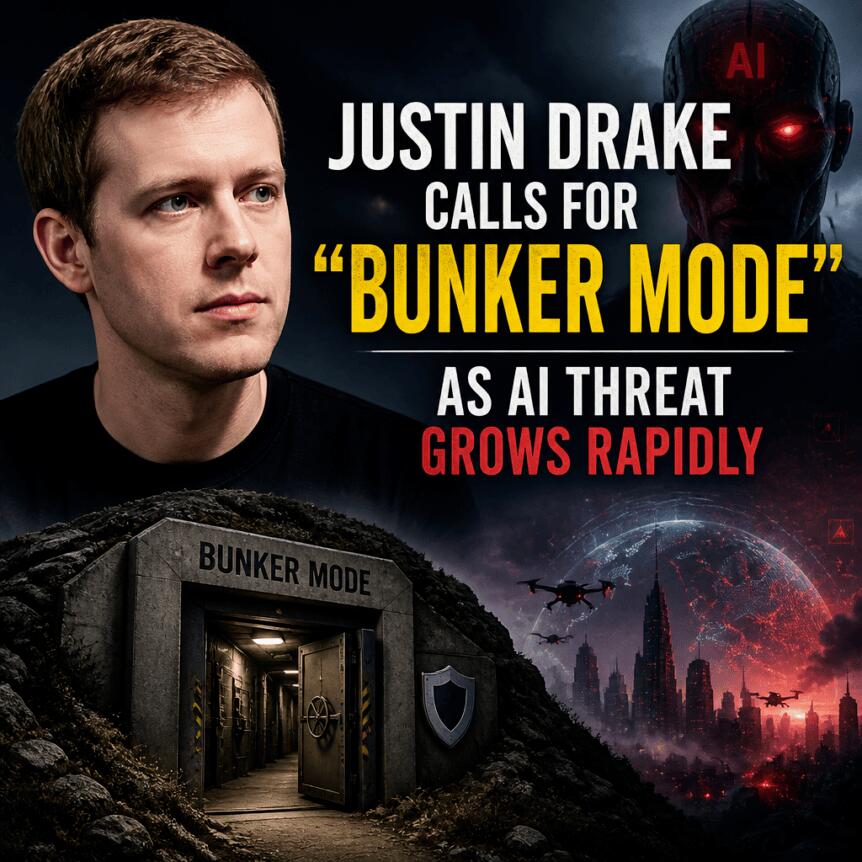
Ethereum researcher Justin Drake is urging the crypto industry to begin planning for a scenario he describes as “bunker mode,” recommending that users gradually shift funds to fresh wallet addresses. His warning is rooted in recent strides in artificial intelligence and advanced mathematical problem-solving, which he argues could shorten the timeline for breaking the elliptic curve digital signature algorithm (ECDSA) used to secure many cryptocurrency wallets.
In an X post on Wednesday, Drake pointed to AI progress—especially work highlighted by OpenAI—as a reason to consider whether ECDSA could be compromised sooner than many people assume, potentially in “months not years” in a worst-case scenario. Rather than waiting for fully realized quantum computing breakthroughs, he suggests preparing for a cryptographic threat that could arrive earlier through other routes.
Key takeaways
- Drake argues recent AI-linked mathematical advances make it prudent to consider that ECDSA security could degrade faster than expected.
- He recommends a “controlled” migration to new wallet addresses rather than a single all-at-once move.
- Fresh addresses can reduce exposure by concealing public keys behind cryptographic hashes—until a transaction reveals them again.
- Large, sophisticated holders should prioritize moving first, followed by smaller remaining balances after signing transactions.
- Drake cautions that rushed migration could create additional operational risk and “do more harm than good.”
Why Drake is pushing “bunker mode”
Drake’s core concern is that AI could eventually enable attackers to recover private keys from exposed public keys. In his framing, the practical impact would be earlier than what many discussions associate with quantum computing timelines—because the relevant cryptographic weakness might be achieved without waiting for sufficiently powerful quantum machines.
He explicitly said it is “reasonable to brace for the possibility that ECDSA breaks before qday,” adding that in the worst case the timeframe could be “in months not years.” For users, the difference matters: it implies that defenses should be considered now, not only at the point when quantum capabilities become unavoidable.
Drake also emphasized how difficult it has become to rely on long-held assumptions about mathematical intuition. “Recent days have been humbling for human mathematical intuition. Long-held, unquestioned hypotheses have fallen,” he wrote, connecting that broader theme to the kinds of breakthroughs he believes could matter for cryptography.
OpenAI’s math progress as a signal
A key part of Drake’s argument points to developments in AI systems that appear to accelerate mathematical research. In a post referencing OpenAI’s work, he cited the company’s report on sharing AI progress in mathematics, which describes hundreds of new mathematical findings across domains including algebra, theoretical computer science, and mathematical logic. OpenAI’s summary frames this as a meaningful leap in what AI can assist with in recent days.
Drake further referred to an earlier OpenAI update last month about using a large team of autonomous AI agents to solve the Navier–Stokes equation—described by OpenAI as achieved in 88 hours—an example intended to show speed and scale in tackling hard problems. OpenAI’s post is part of the same narrative of escalating capability.
In Drake’s view, these advances suggest that cryptographic assumptions should be stress-tested against the possibility that new mathematics (not just new hardware) can shift timelines. He also argued that elliptic curves may be particularly exposed to “fancy tricks,” noting that curves carry structured algebraic properties that could be exploited, while hashes are engineered to minimize such structure.
What a defensive move looks like: changing addresses
Drake’s proposal is not a call to abandon existing cryptography immediately, but a practical mitigation: start moving funds to fresh addresses. “My personal recommendation is to set in motion a controlled mass migration of assets to fresh addresses,” he wrote.
His approach includes a staged plan. He suggested that large and more sophisticated holders move first. He also recommended that users move any remaining funds to a new address after signing a transaction. The distinction is important because Drake’s rationale centers on exposure of public keys.
According to Drake, certain address types can keep a public key effectively hidden behind a cryptographic hash. That matters because attacks that recover private keys from public keys generally require public key knowledge. However, when a transaction is signed, the public key can become revealed. For that reason, he argues that users should avoid leaving balances sitting on addresses whose public keys have already been exposed.
At the same time, Drake stressed that migration must be gradual and carefully managed. He warned that “a rushed migration would do more harm than good,” implying that operational errors, coordination problems, or avoidable transaction costs could outweigh the benefits if the move is not handled with discipline.
Why this matters beyond one wallet or one chain
Even though Drake’s comments focus on ECDSA and address-level mitigation, the broader implication is about how quickly crypto can respond to changing cryptographic risk. Many security discussions emphasize long lead times for quantum-driven threats; Drake is effectively urging the community to also plan for earlier failure modes enabled by advances in mathematics and AI-driven reasoning.
For market participants, this kind of guidance translates into a question of execution: how can large holders, institutions, and everyday users reduce cryptographic exposure without introducing new mistakes? Drake’s emphasis on controlled migration reflects that tension—security improvements are only useful if they can be implemented safely and consistently.
Readers should watch whether wallet providers, custody firms, and developers incorporate this kind of address-rotation guidance into best practices—and whether additional technical analysis clarifies what “months not years” would mean for real-world wallet designs and threat models.
This article was originally published as Justin Drake Calls for “Bunker Mode” as AI Threat Grows Rapidly on Crypto Breaking News – your trusted source for crypto news, Bitcoin news, and blockchain updates.
0
0

 Manage all your crypto, NFT and DeFi from one place
Securely connect the portfolio you’re using to start.


