
$25M Ethereum MEV Acquittal Tests Limits of Criminal Enforcement

0
0
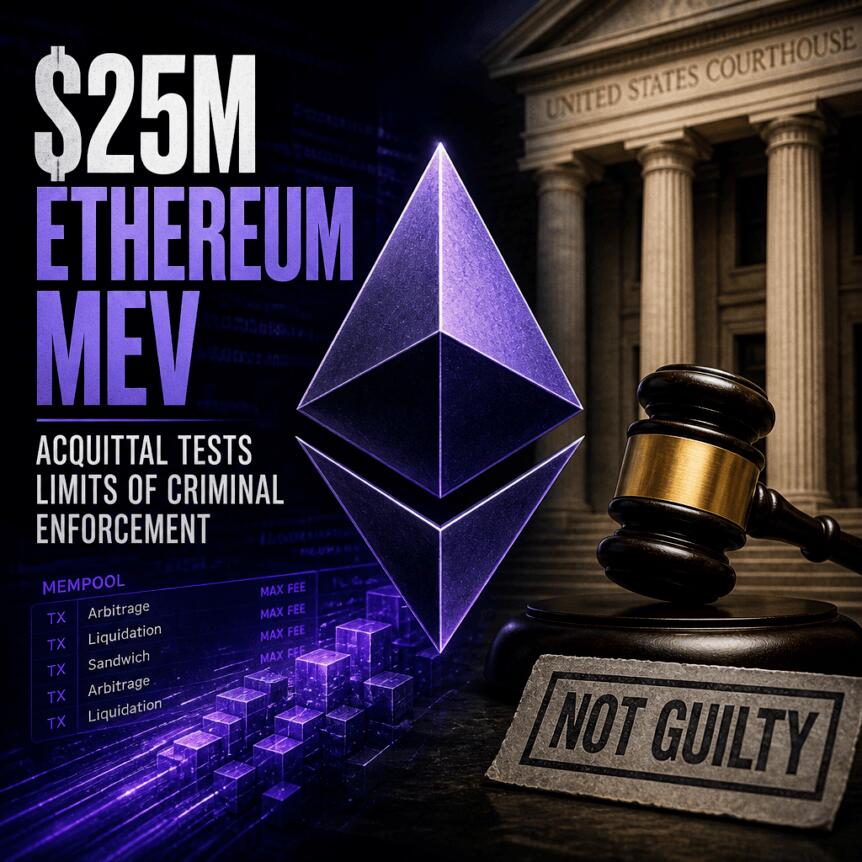
BlackRock’s Ether staking strategy is linked to a specific, controversial source of value on Ethereum: revenue that can come from the competitive process traders use to have their transactions processed ahead of others. In its filings for a staked Ether ETF, the firm points to that income stream when discussing legal risk—specifically, concerns raised around the prosecution of Anton and James Peraire-Bueno.
The brothers were ultimately acquitted, leaving some of the practical questions about how Ethereum transaction-ordering protections and validator obligations are treated under fraud standards still unresolved. For market participants, the case underscores how “ordering” and “execution” dynamics can spill into compliance and contractual disputes—particularly when large asset managers rely on staking providers and third-party block construction or transaction-selection services.
Key takeaways
- BlackRock’s staked Ether ETF prospectus links staking economics to payments traders make to get their transactions processed sooner than competing orders.
- BlackRock flagged the Peraire-Bueno brothers’ prosecution as a potential disruption risk, arguing that an adverse legal finding could impair its staking program.
- The acquittal hinged on narrower evidentiary issues, including what prosecutors could prove about the exact terms the validators agreed to with a service.
- BlackRock’s filings also emphasize contract language—such as requirements for how validators screen and handle sanctioned wallets—that may support enforcement through intermediaries like Coinbase.
Why transaction ordering matters to a staked Ether ETF
In BlackRock’s ETF prospectus, the firm describes how its staked Ether exposure can generate income that is tied to transaction ordering on Ethereum. The mechanism referenced in the filing is the concept often discussed as value captured from producing or including one transaction before another—income that arises when traders pay to influence processing priority.
BlackRock’s concern was not abstract. The prospectus warns that if a court were to find certain behavior related to transaction ordering unlawful, it could interfere with how staking rewards are earned or distributed within its product structure.
That is why the prospectus specifically addresses the legal proceedings involving Anton and James Peraire-Bueno. According to the filing, BlackRock’s ability to operate a staking program could be disrupted if profits connected to transaction-order practices were deemed unlawful.
What the acquittal left unresolved
While the case against the brothers ended in an acquittal, the filing’s risk narrative remains relevant because the fraud case turned on a narrower question than many observers might assume. The core dispute did not settle, on its own, the broader topic of whether transaction-ordering income mechanisms can be regulated in a particular way.
The prospectus describes that three traders lost roughly $25 million after trades were executed in an order different from the order their signed validator proposal had specified. However, prosecutors were required to meet a particular burden: they needed to show that by signing the proposed block, the brothers effectively promised to publish trades in that agreed-upon order.
BlackRock’s prospectus indicates prosecutors struggled to establish the exact terms the brothers accepted from the service that provided the block. In other words, the case did not come down to a simple conclusion about transaction ordering practices in general—it came down to what the government could prove about the promises embedded in the validators’ participation and what contractual or operational terms were actually agreed.
Contract language as a practical line of defense
Beyond the criminal-case uncertainty, BlackRock’s filing points to a more operational concern: ensuring validators follow specific compliance controls, including how sanctioned wallets are handled.
According to the prospectus, when the fund wants validators to maintain controls for screening sanctioned wallets, Coinbase must obtain a binding commitment from the validators. If a validator breaches that commitment, BlackRock’s argument is that the fund can point to obligations the validator accepted and seek enforcement through Coinbase.
This matters for investors because it illustrates how compliance and operational risk are managed in staking beyond the existence of any single legal precedent. Even if transaction-ordering rules remain contested in court, asset managers can still rely on contractual mechanisms to require validator behavior that aligns with regulatory expectations and product constraints.
At the same time, the Peraire-Bueno outcome highlights a limitation: enforcement depends on what terms were accepted, how those terms are documented, and what a court—or other authority—considers enforceable when disputes arise over interpretation.
What investors should watch next
For holders of staked Ether products, the key open question is how regulators and courts will treat the intersection of validator participation, transaction ordering, and the specific promises validators are found to have made. Investors should watch for any follow-on legal developments that clarify evidentiary standards around what validators actually agreed to with third-party services—and for whether staking operators and ETF sponsors continue to tighten contractual language to make enforcement of compliance duties more robust.
This article was originally published as $25M Ethereum MEV Acquittal Tests Limits of Criminal Enforcement on Crypto Breaking News – your trusted source for crypto news, Bitcoin news, and blockchain updates.
0
0

 Manage all your crypto, NFT and DeFi from one place
Securely connect the portfolio you’re using to start.
 Where will Ethereum trade next?
Live Polymarket and Kalshi odds on Ethereum price targets, compared side by side.
See Ethereum price odds


