
Polygon Agglayer v1.0: Faster ZK Settlement for Cross-Chain Transfers

0
0
Polygon Agglayer v1.0: 1m 19s Outbound, 14m 20s Back to Ethereum Now
Polygon Agglayer v1.0 is now live, and Polygon Labs calls it the fastest ZK-verified interop layer in production.
It moves money between blockchains using mathematical proofs instead of trusted signers, and it now does so in minutes instead of over an hour.
Until now , institutions had to choose between safe but slow and fast but riskier.
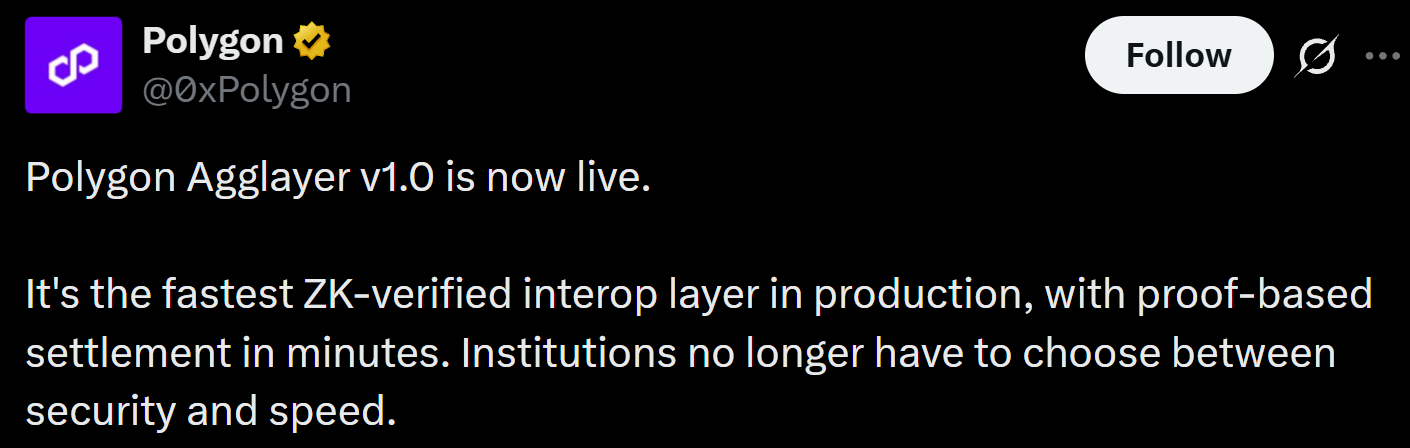
Source: Polygon Post
What Is New: Settlement Times Cut Sharply
The official post, published on November 23, 2026, says moving value from Ethereum to a connected chain now takes under 2 minutes.
Transfers from a connected chain back to Ethereum settle in under 15 minutes, down from about 90.
Every settlement to Ethereum is backed by a ZK proof and unified accounting. The post also says the layer has run in production since 2024 and has settled nearly $10 billion in cross-chain volume.
| Route (measured on Katana mainnet, Nov 2026) | Time | Status |
| Ethereum to Katana | 1m 19s | Claimed automatically |
| Katana to Ethereum | 14m 20s | Settled on Ethereum |
| Katana to Ethereum, before v1.0 | About 90 min | Previous speed |
In the same comparison, Polygon lists another ZK rollup bridge at about 14 minutes in and 3 to 6 hours back, with a manual claim needed.
How Proof-Based Settlement Became Faster
Polygon says proving was never the only delay. The team reviewed the whole settlement pipeline and cut waiting at each stage:
-
Optional finality wait: on eligible routes, the Ethereum finality wait is now optional, saving roughly 15 minutes per transfer. Operators who want the most conservative setting can keep it on.
-
Faster certificates: they go out as soon as there is something to settle, rather than on a fixed interval.
-
Real-time proofs: proofs are generated in real time on an external prover network.
-
Instant-finality chains: these do not wait at all.
The proofs are as strict as before. Next, Polygon plans to integrate Ethereum's Fast Confirmation Rule, now in testing, to shorten the trip back to Ethereum further.
Security Built for Institutions
Polygon notes that moving money between chains has long been one of crypto's weakest points, citing $3.69 billion lost to bridge hacks.
Its answer is the pessimistic proof. A chain can never withdraw more than was deposited into it, and no group of signers can approve a transfer that does not balance.
That is why Polygon Agglayer v1.0 can cap an institution's exposure to any connected chain. Polygon answers the questions a risk review would ask as follows:
-
Compromised chain: damage stops on that chain, because withdrawals are limited to what was deposited.
-
Auditability: settlement is backed by proof verified on Ethereum, and the proof system is documented in the open.
-
Scale: the unified bridge covers public chains and private, permissioned Besu networks. Infrastructure partners include Conduit, Gateway and Succinct, with high-availability upgrades planned for early 2027.
-
Cost and control: there is no fee to connect, and chain owners keep full control. The software is open source under MIT and Apache licenses, and no share of a chain's revenue goes to another project's token.
Where the Interop Layer Is Already Running
According to the announcement, these networks are already connected:
-
Katana: built with Polygon CDK on the OP Stack and the first chain on the fast settlement path.
-
X Layer: OKX's chain, connected to the layer.
-
Miden: a ZK chain built outside the EVM, and the first non-EVM chain connected.
-
CDK Besu: lets banks launch a private Hyperledger Besu chain connected from its first block, as covered in the CDK Besu announcement.
Chains built with Polygon CDK connect by default, so Polygon Agglayer v1.0 is available to them out of the box. The full list is on the supported chains page.
Why It Matters for the Wider Industry
Native withdrawals from optimistic rollups still wait out a seven-day challenge window, which is why so much cross-chain volume runs through third-party bridges.
Polygon expects the number of chains to climb into the hundreds and then the thousands.
In its view, proofs hold up at that scale, while bridges that rely on signers or servers get weaker with every new connection.
It says it has invested more than $1 billion in ZK teams and technology since 2021.
It also says other native ZK interop connects only chains built on one vendor's stack, while this one is open to chains on any stack.
Conclusion
Polygon Agglayer v1.0 removes the old trade-off between proof-based security and usable speed. Transfers into a chain take about 1 to 2 minutes, and returns to Ethereum take under 15.
With a proof-backed cap on losses, no connection fee and open-source code, it is aimed squarely at institutions. Watch for the planned Fast Confirmation Rule integration and the early 2027 upgrades.
Disclaimer
This article is for educational and informational purposes only and is not financial or investment advice. Crypto assets are high risk, their prices can be very volatile, and you can lose some or all of your money. Always do your own research and consider speaking with a licensed financial advisor before making investment decisions.
0
0


 Manage all your crypto, NFT and DeFi from one place
Securely connect the portfolio you’re using to start.
 Where will Ethereum trade next?
Live Polymarket and Kalshi odds on Ethereum price targets, compared side by side.
See Ethereum price odds


