
Bitcoin for a gift card: what paying with crypto means for your holding period

0
0
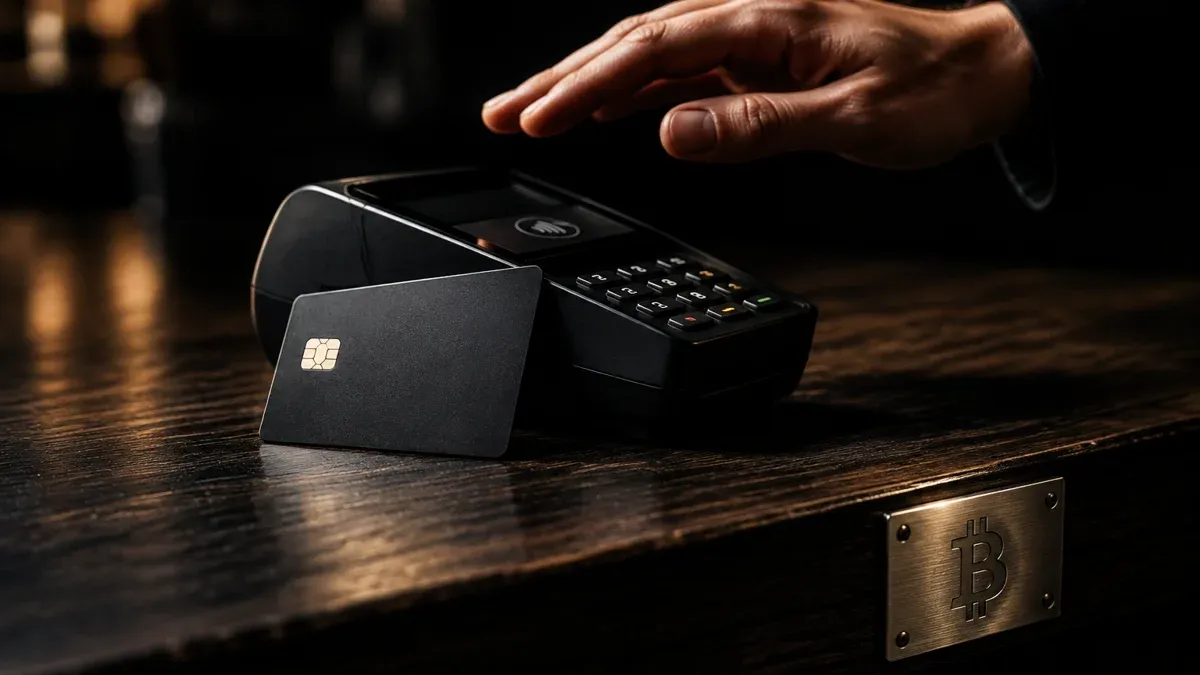
Swapping Bitcoin for a gift card is not a purchase for tax purposes, it is a sale. The moment you pay for a gift card, a good or a service with crypto assets, you hand over the coins and receive something else in return. The tax office treats that transaction exactly like a sale on an exchange: as a private disposal under section 23 of the German Income Tax Act, the EStG.
Whether tax actually falls due hangs on two numbers. If more than twelve months lie between the purchase and the gift card payment, the gain stays tax free. Below that it counts, and it counts together with every other private disposal of the year against the threshold of 1,000 euros. So if you buy Bitcoin in January and pay for a gift card with it in March, you have a tax relevant transaction on the books, even though not a single euro has landed in your account.
The gift card purchase is a disposal, not an exchange
A disposal within the meaning of section 23 EStG is any transfer of an asset for consideration. The fact that what you receive in return is a gift card rather than euros changes nothing: for consideration simply means that something flows the other way. On February 14, 2023, the Federal Fiscal Court confirmed that crypto assets are other assets in this sense and fall under the provision.
That is what sets the gift card purchase apart from a gratuitous transfer. Anyone who gives coins away or hands them to a charitable organisation is not disposing of them, because nothing flows the other way; different rules apply there, which we have written up under claiming Bitcoin donations against tax. A gift card is consideration with a quantifiable value, and the whole calculation hangs on that.
In practice that means there is no free pass for spending coins by way of a gift card in order to sidestep the tax. The opposite is true, because unlike with a sale on an exchange you are afterwards left without the exchange statement as evidence.
What counts as the disposal proceeds: the market value of the gift card
The disposal proceeds are the value of what you received for the coins. With a gift card that is its face value in euros, meaning the sum printed on the card that you can redeem with it. From that you deduct the acquisition cost, meaning the euro amount the coins you handed over cost you when you bought them, plus the incidental purchase costs at the time.
An example with round figures: you bought coins for 400 euros and eight months later pay for a gift card worth 700 euros with them. The taxable gain is 300 euros. Had you instead sold the same coins on an exchange for 700 euros, the result would be identical. The gift card merely stands in for the euro as consideration.
You need to pay attention when the provider takes a premium and you hand over coins with a market value of 730 euros for a gift card worth 700 euros. What then governs is what you actually received. The premium reduces your result, and you should be able to document it, because otherwise the higher market value of the coins can be used as the basis.
The one-year holding period decides the tax
The holding period begins on the day after the purchase and ends after twelve months. Redeem the gift card after that and the gain stays tax free, however large it is. Within the period it is taxable at your personal income tax rate.
What is decisive is the date of the payment, not the date on which you later use the gift card in a shop. The swap of coins for a gift card is the moment that counts for tax. Anyone who wants to see the mechanics of the period in context will find them in our comparison of the loss sale and buyback within the holding period.
The 1,000 euro threshold: why a gain of 1,001 euros is taxable in full
Private disposals are subject to a threshold of 1,000 euros per calendar year. A threshold is not an allowance: once it is reached or exceeded, the entire gain becomes taxable, not just the part above it. On a gain of 999 euros you pay nothing; on 1,001 euros you are taxed on 1,001 euros.
The limit applies to all private disposals of a year taken together, not per transaction and not per coin. Two gift card purchases with a gain of 600 euros each breach the limit jointly. Gains from other private disposals in the same year count towards it as well. Losses from such transactions reduce the total and therefore need documenting just as carefully as gains.

FIFO or specific identification: which coins the gift card purchase uses up
Anyone who has been adding over months holds coins with different acquisition dates. On the question of which of them the gift card purchase uses up, there are two routes. Under specific identification you demonstrate which particular coins were handed over, for instance because they sat in a wallet of their own. Where that cannot be allocated, the FIFO method comes into play: first in, first out, with the oldest holdings treated as handed over first.
FIFO often works against you when prices are rising, because the oldest holdings carry the lowest acquisition cost and therefore show the highest gain. In exchange, those holdings are also the most likely to be older than a year and therefore tax free. Which variant comes out cheaper depends on the individual case and belongs with a tax adviser, not in a rule of thumb.
Wallet separation matters here: anyone who keeps coins for everyday spending in a wallet of their own and the long term holdings separately from it can substantiate the allocation in the first place. That separation costs nothing and cannot be created after the fact.
The BMF circular of 6 March 2025 replaces the 2022 version
The tax authorities' position on the taxation of crypto assets is set out in a circular from the Federal Ministry of Finance dated March 6, 2025. It replaces the earlier circular of May 10, 2022, and classifies, among other things, airdrops, forks, transactions on decentralised platforms and the boundary between private asset management and commercial activity.
Two things about it matter for the gift card purchase. First, the classification of the payment as a disposal remains in place. Second, the circular expressly stressed the requirements for records and cooperation, and that bites precisely on transactions for which no exchange issues a statement. An administrative circular binds the tax offices, incidentally, not the courts.
Part of the legal position is also what does not currently apply: a bill to abolish the one-year tax exemption was rejected in the Bundestag. The discussion continues, but nothing has been decided. Until then the twelve-month period stands.
VAT stays out of it: the swap counts as a payment
Alongside income tax, the question of VAT comes up regularly. For private holders the answer is short: anyone using coins as a private individual to pay with is not supplying anything subject to VAT. The tax authorities treat crypto assets as equivalent to conventional means of payment for VAT purposes, in so far as they are purely means of payment.
The VAT on the good or service is still owed by the merchant, and it is already baked into the gift card value. You pay it along with everything else, just as with any other method of payment. The position is different for businesses holding crypto assets as operating assets; separate rules apply there, and this page deals with the private case.

Evidence for the tax office: price, date and gift card value
With a sale on an exchange the platform supplies a statement. With a gift card purchase nobody supplies one, and the burden of proof sits with you. So secure four details for every transaction: the date of the payment, the face value of the gift card in euros, the quantity of coins handed over, and the acquisition date together with the purchase price of those coins.
Add to that the records you do receive: the provider's confirmation, the transaction in your wallet or in the block explorer and, where there is one, the invoice for the premium. Evidence of the price on the day of the transaction belongs there too, because the market value of the coins handed over is the cross-check against the gift card value. Programs that keep track of these transactions and produce a report for the tax return are listed in our comparison of crypto tax software and portfolio trackers.
You should keep these records for as long as the tax office can examine the transaction. For private individuals that means, in practice, until the tax assessment for the year in question is final, and longer if in doubt.
Where you can pay for gift cards with Bitcoin, and what the premium costs
Gift cards against crypto assets are brokered by specialised providers, and in some cases by individual merchants directly. The process is similar everywhere: you choose the gift card, the provider quotes an amount in coins, you transfer, and the code arrives by email or in your customer account. Three items determine the price.
First, the premium on the face value, with which the provider covers its price risk and its margin. Second, the network fee for the transfer, which weighs heavily on small amounts. Third, the price the provider calculates with, and the window for which it guarantees that price. So always work the gift card out as a total price in euros and compare it with the route through a sale on an exchange and an ordinary card payment. What that detour costs on an exchange is set out in our comparison of the best crypto exchanges.
Check as well whether the provider offers returns or refunds at all. A redeemed gift card code is as a rule not revocable, and in a dispute you have no payment service provider chargeback available of the kind you know from a credit card.
The gift card itself triggers no further crypto tax later
After the swap you no longer hold a crypto asset, you hold a claim denominated in euros. When you redeem the gift card in a shop weeks later, that is not a private disposal, because no asset within the meaning of the provision is being disposed of any more. The transaction that mattered for tax was complete when the coins changed hands.
That has a practical consequence: if the price keeps rising after the gift card purchase, you have no share in it any more, and a later slide in the price does not shrink the tax that has already arisen. The gain is fixed as at the moment of the swap. Anyone planning the transaction shortly before the turn of the year should keep that in view, because the gain falls into the year of the payment.
If a gift card expires unused, the transaction still stands for tax purposes. The loss of the gift card value is a private financial loss and not a reduction of the disposal gain that arose back then.
Bitcoin for a gift card: How to proceed now
- Check the holding period before you pay. Look up when the coins you intend to hand over were bought. If the purchase is more than twelve months ago, the gain is tax free; below that you count it against the threshold of 1,000 euros. A tool from our comparison of crypto tax software carries those periods parcel by parcel.
- Work the total price out against the exchange route. Add up the premium, the network fee and the price gap and compare the sum with the route through a sale and an ordinary payment. What a sale on an exchange costs is shown by our comparison of the best crypto exchanges.
- Secure the records the same day. The date, the gift card value, the quantity of coins handed over, the price and the provider's confirmation belong together in one folder before the email sinks in your inbox. Anyone paying with crypto assets regularly will find solutions that document the transaction together with a statement in our comparison of crypto credit cards.
The legal position in this article rests on the circular of the Federal Ministry of Finance dated March 6, 2025, file reference IV C 1 - S 2256/00042/064/043, whose changes against the 2022 version are set out in detail by PwC, and on section 23 of the Income Tax Act. This article is no substitute for tax advice.
(As of October 6, 2026. This article is not investment advice. Prices and fee structures change; check the terms with the provider before you buy.)
0
0


 Manage all your crypto, NFT and DeFi from one place
Securely connect the portfolio you’re using to start.


