
Polkadot five years after its 2021 record: DOT trades 98 percent lower

0
0

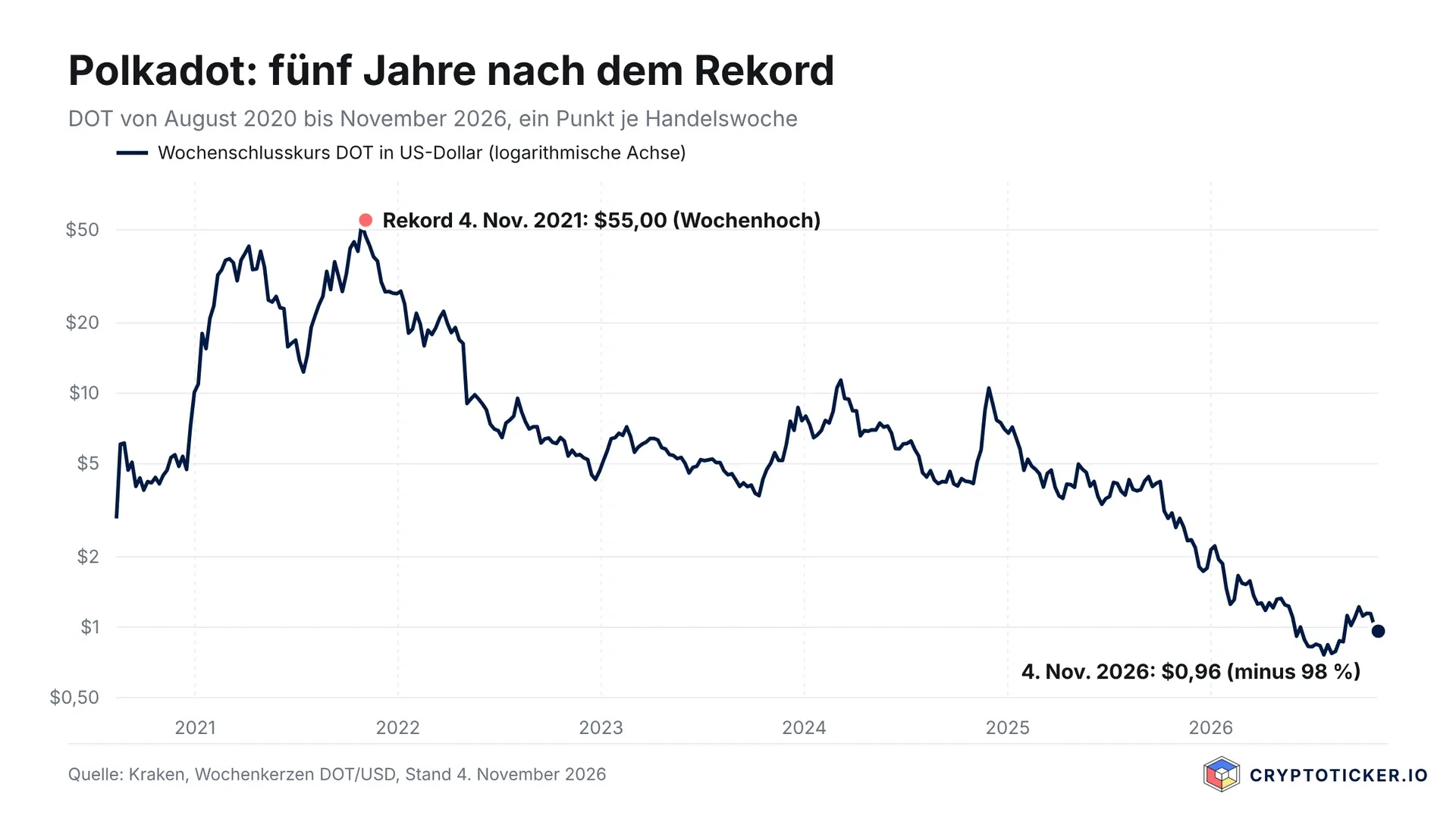
On November 4, 2021, Polkadot peaked at $55.00 on the Kraken exchange. Five years later, at midday on Wednesday, DOT trades there at $0.96, or €0.85. That is 98.3 percent below the record. Anyone who put €1,000 into DOT back then and never sold now holds a little over €17 on paper.
What is documented: the price history comes from Kraken's weekly candles, and the rules on staking and tax come from the Polkadot Forum, the Polkadot Wiki and the German Income Tax Act. Our own assessment follows further down in a separate paragraph and is labelled as such.
The anniversary is no reason for nostalgia, but it is a good moment to take stock. The network of 2026 shares little more than its name and its token with the network of 2021. Parachain auctions are gone, supply now has a hard cap, balances and staking sit on a different blockchain, and since July you can leave staking in about two days instead of 28. For holders in Germany there is also a tax question that many get wrong: a loss from 2021 can no longer be offset today.
DOT price on November 4: $0.96 instead of $55
The record fell on a Thursday. In the week starting November 4, 2021, the Kraken candle ran from $41.89 to $55.00, and the week closed at $46.77. After that, the price fell in steps for five years. Looking at the week around each anniversary shows the pattern:
| Week around November 4 | DOT weekly close (Kraken) | Distance from the $55 record |
|---|---|---|
| 2021 | $46.77 | minus 15 percent |
| 2022 | $5.39 | minus 90 percent |
| 2023 | $5.04 | minus 91 percent |
| 2024 | $4.12 | minus 93 percent |
| 2025 | $2.67 | minus 95 percent |
| 2026 (current week, Wednesday midday) | $0.96 | minus 98 percent |
DOT took most of the loss in the first year after the record. From mid-2022 to the end of 2024 the price swung in a wide band between roughly $4 and $12, with two breakouts above $10 in March and late November 2024. Since early 2025 there has been no such counter-move. In June 2026, DOT dropped below one dollar for the first time, and the lowest weekly low on Kraken came in the week starting August 13 at $0.7235. According to Coinpaprika, the market value of all circulating DOT is currently around $1.64 billion, which puts Polkadot at rank 56 among the largest cryptocurrencies.
What would surprise a reader of the 2021 headlines is the sideways phase itself: the price never came close to the record again. Since the crash in May 2022, the highest weekly high was $11.85, in March 2024.
Parachain auctions in 2021: why DOT was so expensive
The record came in the weeks before the first parachain auctions on Polkadot, which began in November 2021. A parachain is an independent blockchain that connects to Polkadot and shares its security. Projects had to win their slot at auction, paying in DOT that was locked for up to 96 weeks. Many projects gathered these DOT from holders through so-called crowdloans and promised their own tokens in return.
The result was a pull on demand. Locked DOT were off the market, and anyone who wanted to join several crowdloans had to buy DOT. On top of that came the broader crypto market, which was also at a record in November 2021. When the locks expired and the market as a whole collapsed in 2022, both drivers disappeared at once.
The auctions no longer exist. Since September 19, 2024, Polkadot has allocated blockspace through Agile Coretime: projects buy capacity in DOT for 28 days at a time or pay only for individual blocks. The system is more flexible for developers, but it no longer locks DOT for almost two years. The lock-up effect of 2021 has vanished from the model.
DOT supply: 1.71 billion tokens and a cap at 2.1 billion
For a long time Polkadot was inflationary with no upper limit. That changed in 2026. By referendum, the network set a maximum supply of 2.1 billion DOT; the first cut to new issuance, of 53.6 percent, took effect on March 14, 2026, and further cuts follow every two years. According to Coinpaprika, about 1.71 billion DOT have been issued so far, so just under 390 million DOT can still be created before the cap is reached.
For the price, this has two consequences. Dilution pressure eases because fewer new DOT reach the market. It does not go away, though, and the cap does not replace the demand that the auctions generated in 2021. So far the decision has not turned the trend: at the end of October, DOT was already trading around the one-dollar mark despite the cap.
Asset Hub instead of Relay Chain: where your DOT sit today
The second big change concerns where DOT are recorded. In 2021, balances, staking and governance votes lived on the Relay Chain, Polkadot's central blockchain. Today the Asset Hub, a system chain of the network, handles all of that. The Relay Chain now only takes care of security and of connecting the attached blockchains.
If you hold your DOT on an exchange, you do not need to do anything. If you use your own wallet, make sure it supports the Asset Hub and reads your balance there; staking and voting also run through the Asset Hub.
Staking since Referendum 1910: unbonding in two days instead of 28
For investors, the most important change of recent months is one that barely made headlines. With Referendum 1910, Polkadot changed the rules for nominators. A nominator is a DOT holder who backs one or more validators with their coins and receives a share of the staking rewards in return. Unbonding is the waiting period between triggering an exit and the moment the DOT are freely available again.
According to the announcement on the Polkadot Forum of July 6, 2026, two things now apply. First, the unbonding period for nominators is only about two days, or two eras to be precise, instead of 28 days. Second, nominators can no longer be penalised through slashing, the cut to their stake when a validator breaks the rules. Nothing changes for validators themselves: they remain liable, need a minimum self-stake and keep their existing periods.
Nomination pools, which let you stake from as little as 1 DOT, benefit too. The Polkadot Wiki now gives one to two days for leaving a pool on Polkadot. Older guides, including help pages for the staking dashboard, still say 28 days.
There is a catch in the small print. If you triggered your exit before the switch, you are still waiting on the old 28-day schedule; the short period only applies to requests made after the upgrade. According to the forum, an old request can be converted by re-bonding the DOT in a batched transaction and restarting the unbonding. If you stake DOT through an exchange, you are not directly affected. There, the provider sets its own withdrawal period, which may differ from the network rule. A look at the terms and a comparison of staking providers shows who passes the short period on.

Holding period and losses: the tax rules for DOT bought in 2021
For holders in Germany, the anniversary is above all a tax question. Crypto assets held privately fall under Section 23 of the German Income Tax Act (EStG). If you sell them within twelve months of buying, a gain is taxable, provided all private disposal gains of the year together reach €1,000. After twelve months, the sale is tax-free.
The flip side is less well known: what is tax-free after the holding period does not count as a loss either. If you bought DOT in autumn 2021 and sell now at a 98 percent loss, you cannot offset that loss against other gains. A loss can only be offset if the DOT you sold were held for less than twelve months. On November 4, 2025, DOT stood at about $2.67 on Kraken in the week around the anniversary, so anyone who has bought since then is in the red on almost every entry and still within the period.
Staking follows its own rule. Rewards count as other income under Section 22 No. 3 EStG when received, tax-free up to an exemption limit of €256 a year. Each reward credited also starts its own twelve-month holding period. Staking does not extend the holding period of the staked DOT themselves, as the German Federal Ministry of Finance confirmed in its guidance on crypto assets. If you collect many small reward entries, you will struggle to produce a clean statement without crypto tax software.
Holding period reform: what the draft would mean for DOT bought from 2027
Over all of this hangs a draft that is not yet law. On September 30, 2026, the German Federal Ministry of Finance presented a draft bill under which crypto assets would be treated as capital assets and taxed at the 25 percent flat withholding tax, with no tax-free holding period. Only coins acquired or received after December 31, 2026 would be covered; older holdings would stay under the old rules. Nothing has been decided: the cabinet passed no resolution on October 14 or October 28. We track the latest status on our page on the crypto holding period reform.
For DOT holders, this means only one thing for now: whatever you buy or receive as staking rewards by the end of 2026 falls under the one-year rule as things stand. Buying solely because of the draft would be premature, since it is open whether and in what form it will pass.
Funding and long ratio: what has moved in the futures market since Monday
On Monday evening DOT was at $0.94. In our report of November 2, almost 70 percent of accounts on OKX were on the long side at the time, yet the funding rate was negative. The funding rate is the payment that buyers and sellers of perpetual contracts make to each other every few hours; when it is negative, the shorts pay.
Since then the picture has calmed. According to Binance data analysed by Blockchain.News on Wednesday morning, the eight-hour rate is back at the neutral 0.0100 percent, the share of long accounts has fallen to 61.4 percent, and open interest has shrunk by 1.5 percent within 24 hours. Over the same period, the price rose two cents to $0.96. That points more to one-sided bets being unwound than to new buyers.
DOT levels: $0.92 below, $1.04 at the 20-day average above
On Kraken, the range of the past 24 hours ran from $0.9068 to $0.9722. Based on Binance daily prices, Blockchain.News puts the next support at $0.92, then $0.89 and the lower Bollinger Band at $0.87. On the upside, the first resistance levels are $0.96 and $0.98. The moving averages matter more: the 20-day average is at $1.04, the 200-day at $1.03 and the 50-day at $1.12. DOT trades below all three.
That suggests a simple reading. As long as the price stays below about $1.03 to $1.04, any recovery is technically a counter-move within a downtrend. A drop below $0.87 would open the way to the summer low at $0.72. If you need levels for your own planning, you will find the longer-term scenarios in the Polkadot prediction box below this article.
Polkadot after five years: our assessment
Our assessment: the 2021 record was largely an effect of the auctions and the overall market, not of the network. Both drivers are gone. What Polkadot offers today is technically more mature: capped supply, cheaper blockspace, and staking with no slashing risk for nominators and a two-day exit. None of this has shown up in the price so far, and the evidence is clear: DOT is below all three moving averages and has not set a higher high since early 2025. The only counterpoints are that long bets have recently been unwound and that the summer low at $0.72 has held so far. We do not derive a buy recommendation from this; cryptocurrencies can fall all the way to a total loss.
Polkadot in year five: below $1.03 the trend stays down
- Check your staking period. If you still have an unbonding running from before July 2026, the Polkadot Forum says you can switch it to the two-day period by re-bonding and restarting. If you stake with a provider, compare its withdrawal period in the staking comparison.
- Sort by purchase date. Separate DOT you bought before November 4, 2025 from more recent purchases. Only for the recent ones can a loss be offset for tax purposes. Crypto tax software handles the allocation on a FIFO basis.
- Choose a route to buy under MiCA. If you want to buy more or rebalance, use an exchange with MiCA authorisation and compare DOT fees in the crypto exchange overview.
(As of November 4, 2026. This article is not investment advice. Prices and fee structures change; check the terms with the provider before you buy.)
0
0

 Manage all your crypto, NFT and DeFi from one place
Securely connect the portfolio you’re using to start.


