
DEX swaps and arbitrage drive Ethereum fees above $56M on the day after Binance hack

0
0

Ethereum fees spiked to the highest levels since April, showing a sudden burst of activity in the ecosystem in the aftermath of the Binance hack. Decentralized trading and MEV bot fees were the main drivers of the performance spike on the chain.
Ethereum block builders had a field day after the $6.3B Binance hack, the biggest theft event in the history of crypto. The event showed decentralized platforms were extremely resilient and even benefited from the increased activity.
The initial movement of funds from the Binance wallet was one source of fees, but the hack also opened new trading opportunities, decentralized liquidations, and other on-chain transfers.
Most of the block builder fees came from activities in stablecoins, as well as Ethereum’s leading apps and protocols. The hacker also had to swap some of the stolen assets for ETH, demanding the services of block builders to forge priority transactions.
MEV bots moved in, pushing those transactions with high fees to block builders. Block builders then pay validators a share of the fee, keeping the rest as revenue, explained X analyst @0xnairoff.
Ethereum breaks above $56M in daily fees
The recent inflow of activity led to over $44.25M in daily fees on the day of the hack, and $56.4M in the next 24 hours. As of October 30, activity was still elevated, with over $10M in fees as of this report.
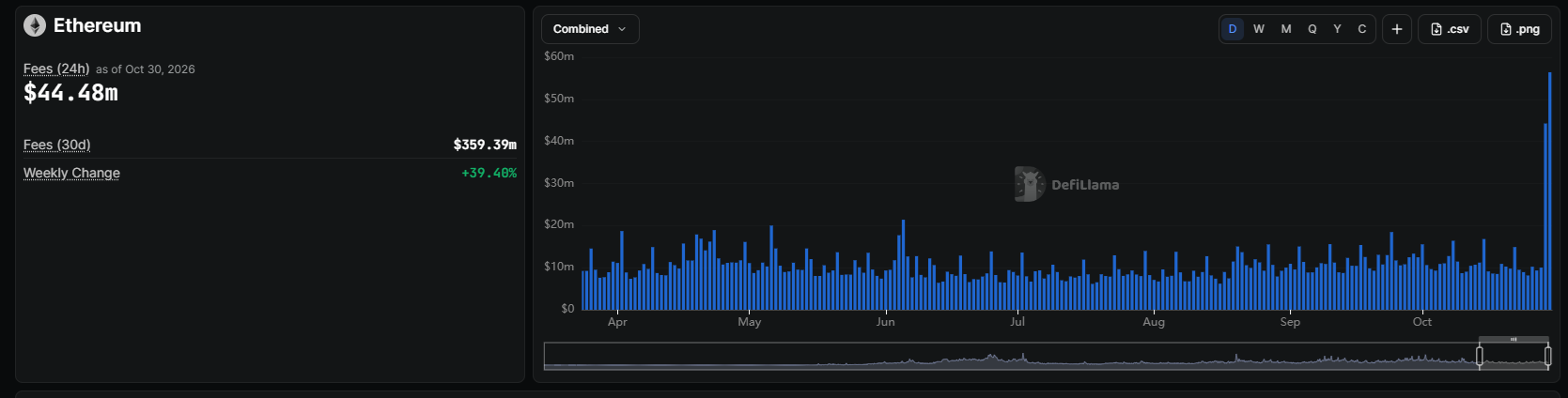
The biggest effect of the recent fees affected Titan Builder, the leading block builder in the past months. In the past 24 hours, the block builder absorbed $24.65M in fees, meaning validators would also receive a large portion of the additional income.
The Ethereum chain alone had over $10M in daily fees, while Uniswap turned into the main trading venue, also logging over $10M in fees, based on DeFi Llama data.
As of October 30, the mix of smart contracts and apps on Ethereum also shifted. KyberSwap emerged as a leading aggregation router, burning 92.58 ETH in fees. Several unknown smart contracts also displaced USDT and USDC as the leading gas burners. ETH transfers alone burned 72.8 ETH in the past day.
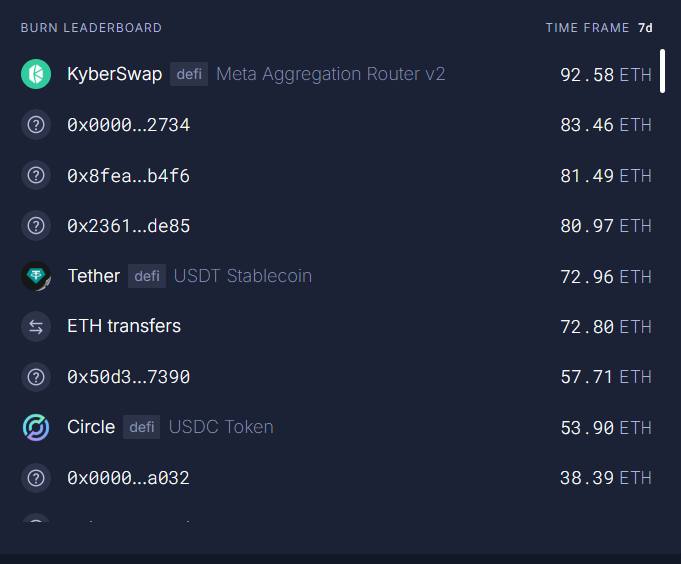
At the same time, ETH gas fees are still under $0.01, as only specialized traders and whales rushed to perform transactions and swaps.
Additionally, the increased activity led to a one-month peak in blob fees, after weeks of almost zero demand for blob space. The usage of L2 chains, especially Arbitrum, was linked to some of the stolen assets and attempts to bridge them to Ethereum.
Binance hack led to ETH arbitrage
Following the Binance hack, ETH was used as an exit asset, similar to other large-scale exploits. As a result, ETH prices showed significant disparity. On decentralized markets like Uniswap, ETH traded as high as $2,700. Other data points to anomalous on-chain pricing as high as $3,300, though not offered at all on centralized markets.
On other markets, the price settled at around $2,223.25, causing additional pressure on derivative markets. The ETH decentralized price was mostly driven by attempts to swap tokens. At the same time, the ETH crash is causing liquidation risk for whales that positioned themselves while ETH was still more bullish.
ETH is down by 17.2% in October to date following its recent crash, and on track to close the worst October since its inception in 2016.
The ETH crash brought down the fear and greed index to 28 points, solidly in fear territory. ETH is closely watched for preserving $2,200 as a support level. Losing that level is seen as a signal for sinking below $2,000.
If you're reading this, you’re already ahead. Stay there with our newsletter.
0
0

 Manage all your crypto, NFT and DeFi from one place
Securely connect the portfolio you’re using to start.
 Where will Ethereum trade next?
Live Polymarket and Kalshi odds on Ethereum price targets, compared side by side.
See Ethereum price odds


