
Dogecoin: four in five leveraged accounts are long, more one-sided than Bitcoin, Ethereum and Solana

0
0
On the OKX derivatives market on Friday morning, 4.17 long accounts face a single short account in Dogecoin. That is 81 percent of all accounts with an open position, and no other large coin comes close. For Bitcoin the ratio is 1.61, for Ethereum 1.78. We measured this ourselves at 10:00 UTC using the exchange's public market data.
If you hold Dogecoin, this is no footnote. A long side this lopsided changes what happens in a setback: the more accounts sit on the same side, the more forced closures pile up once the price slips below a level where many positions get tight at the same time. Which levels those are today, how reliable the metric is and what an investor in Germany can make of it follows below.
4.17 long accounts per short account: the Friday morning measurement
The figure comes from the long/short account ratio that OKX publishes for every tradable currency. The metric divides the number of accounts with an open long position by the number with an open short position, across all of the exchange's futures contracts on that coin. A value of 1.00 would mean equal numbers on both sides. 4.17 means that for every account betting on falling prices there are a good four betting on rising ones.
The price itself offers little support for that. Dogecoin trades at $0.082375 at midday on Friday, 2.9 percent above the previous day and 3.5 percent below the level of a week ago (CoinGecko, as of October 16). The low of the day was $0.077935, the high $0.082513. Those two points are 5.9 percent apart, and the price sits at the upper edge of that range.
Why we collect the figure ourselves
Position data from individual exchanges is often quoted in market reports, rarely put in context and almost never placed side by side. We therefore pulled the same metric for nine coins in a single pass on October 16 at 10:00 UTC, so the values come from the same moment and the same source. You can follow the running values at Coinglass, among others, which aggregates the same metric across several exchanges.
What the ratio counts and what it does not
The metric counts accounts, not money. An account with $200 at stake weighs exactly as much as one with $2 million. A high value therefore says that many individual traders sit on the same side, not that most of the capital is there too. That is precisely why the metric counts as a sentiment gauge for retail traders: large accounts tend to work with few, big positions and barely register in a head count.
A second limitation applies. The figure describes a single exchange. OKX is large enough to be representative, but it is not the whole market. Reading the metric as a statement about all derivatives markets overstretches it. As a statement about the behaviour of accounts on this exchange it holds, and as a comparison between coins on the same exchange at the same moment all the more so.
Dogecoin is the outlier among nine coins
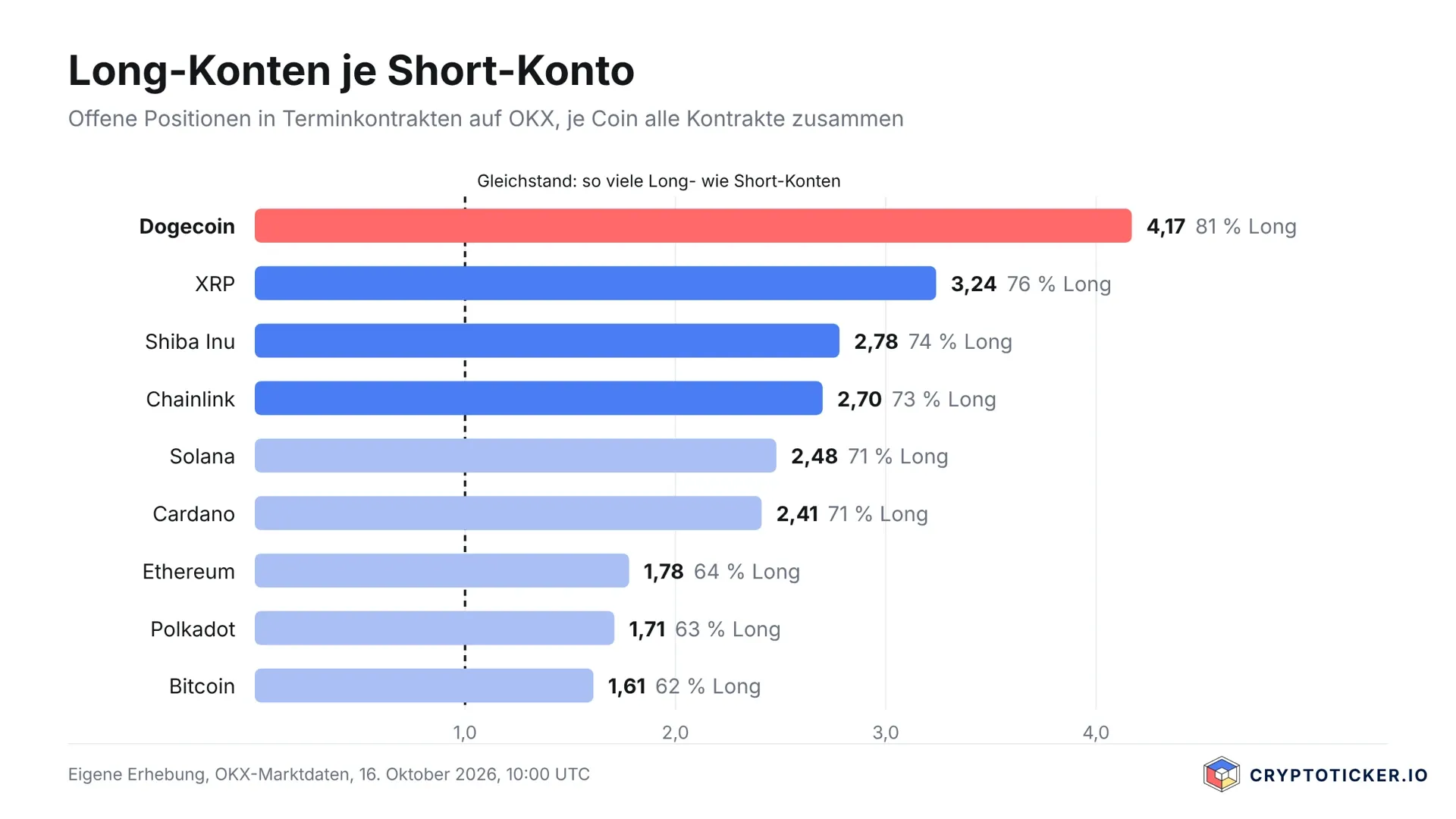
The comparison is what turns the reading into a finding. Behind Dogecoin at 4.17 comes XRP at 3.24, then Shiba Inu at 2.78 and Chainlink at 2.70. Solana stands at 2.48, Cardano at 2.41. At the other end sit the two largest assets in the market: Ethereum at 1.78 and Bitcoin at 1.61. Polkadot comes in at 1.71.
In shares, 81 percent of Dogecoin accounts are on the long side, against 62 percent for Bitcoin. The gap of 19 percentage points is the widest in this field, and it has held steady through the day. That meme coins are carried more by retail traders than Bitcoin is no surprise. The scale is: Dogecoin sits almost a full step above XRP, which is itself strikingly one-sided.
Long positions were cut overnight even as the price rose
The second part of the measurement is the more interesting one. At 23:00 German time the ratio still stood at 4.43. By midday it had fallen to 4.17, hour by hour, without a jump. Over the same period the price gained 2.9 percent. Accounts therefore closed their long positions into the recovery rather than letting them run.
That fits a market in which many positions from last week's weak phase are still under water and get squared on the first countermove. Open interest tells the same story: across all Dogecoin contracts on OKX it stood at $117.7 million early on Friday morning and $119.7 million at midday, so effectively unchanged. The day before it had jumped from $109.3 million to $121.6 million, a rise of 11.2 percent on a day of falling prices.
The spot market points the same way
On Thursday, Dogecoin worth $462.3 million was sold and $403.3 million bought on the same exchange's spot market, measured by the side that actively hit the market. The excess on the sell side came to $59 million or 14.6 percent, on turnover that almost doubled against Wednesday. Selling happened on the spot market, building happened on the derivatives market.
Funding rate at 0.01 percent: the imbalance sits in the number of accounts
Anyone expecting longs to pay dearly for this one-sidedness is wrong. The funding rate on the DOGE-USDT perpetual stood at 0.01 percent per eight-hour period on Friday morning, the exchange's usual base value. Annualised over a day that is 0.03 percent. The premium of the contract over the spot price was even slightly negative at minus 0.06 percent, so the contract traded a shade below spot.
Together the two give a clear picture: the one-sidedness sits in the number of accounts, not in the volume. Were the capital equally lopsided, the funding rate would have to sit well above the base value, because longs would then pay shorts continuously. It does not. This is many small long positions against few, larger short positions.

How a chain of forced closures builds
The mechanism behind it is plain. A leveraged position is closed automatically once the collateral falls below the required minimum. That closure is a market sale, which pushes the price down further. When many positions sit close together, the first wave triggers the next, without any new piece of news being needed.
Small accounts amplify this because they typically work with higher leverage and thinner collateral than large ones. An account at ten times leverage is stopped out on a ten percent countermove, one at two times only at fifty. In Dogecoin, 81 percent of accounts sit on the same side, and the span between the low and the high of the day is 5.9 percent. Those two figures belong together.
Levels where it gets tight: $0.0779 and $0.0825
On the downside, the low of the day at $0.077935 is the first solid level. The price turned there overnight and has recovered 5.7 percent from it. If it falls below, there is no traded support left until the zone from which the recovery of recent days started.
On the upside the high of the day sits at $0.082513, less than two tenths of a percent above the current price. The next level above comes from our own measurement of October 11, when Dogecoin traded at $0.0868 and $57.2 million was withdrawn from exchanges. Between $0.0825 and $0.0868 lie 5.2 percent, and within that span the coin has turned lower twice in recent days.
Where things stand since our article of October 15
On Thursday we measured here that Dogecoin lost 8.6 percent in seven days while Bitcoin gave up only 2 percent. That gap has narrowed sharply since: over the week Dogecoin now stands at minus 3.5 percent, Bitcoin at minus 0.8 percent. The reason is the countermove of the past 24 hours, in which almost every large asset gained.
Dogecoin only came along in the middle of the field. Chainlink gained 5.5 percent, Polkadot 5.1 percent, Solana 4.3 percent, Ethereum 4.1 percent. Dogecoin managed 2.9 percent, ahead of XRP at 2.7 percent and Bitcoin at 1.6 percent, but behind every other altcoin in the comparison. The relative weakness of the previous week has not disappeared, it is simply less visible when prices rise.
The blockchain itself stays quiet
Little has changed on the Dogecoin blockchain in these days. Over 24 hours, 22,754 transactions were confirmed, 46 transactions were waiting in the mempool at the time of measurement, and hash rate stood at 3.44 petahash per second (Blockchair, October 16). The largest single transfer of the day was worth $46.9 million. The price move therefore comes from trading, not from a change in usage.
Leverage in Germany, 2 to 1 on contracts for difference
The figures above come from an international derivatives exchange whose leverage is not available to you as a retail investor in Germany. The European securities regulator ESMA has capped leverage at 2:1 for retail clients on contracts for difference on cryptocurrencies, the strictest tier of its scale. For comparison: the most liquid currency pairs allow 30:1, single equities 5:1.
In practice, a provider under European supervision lets you move at most twice your stake in Dogecoin. With €1,000 of collateral the position is €2,000, and a 50 percent setback wipes out the stake. Offers with twenty or fifty times leverage are aimed at clients outside that framework; anyone trading there has no European supervisor behind them in a dispute. Which providers work under which licence is set out in our broker comparison.
Three things that can be checked concretely
First, your own liquidation price: every trading interface shows it per position, and it belongs next to the low of the day at $0.077935. Second, the funding rate of the contract traded, because 0.01 percent per eight hours does add up to around eleven percent a year over time. Third, the holding period: anyone holding Dogecoin in spot and selling after a year sells tax-free as things stand, while every gain from a contract for difference falls under capital gains tax regardless of how long it was held.
Our assessment of the positioning
From the newsroom's point of view, the finding is a warning signal of medium strength, not an alarm. In favour: 81 percent long accounts is the highest value in the comparison field, the spot market sold with a 14.6 percent excess on Thursday, and open interest rose 11.2 percent on a falling day. Against it, just as clearly: the funding rate sits at the base value of 0.01 percent, the premium is negative at minus 0.06 percent, and the ratio has been unwinding since the night rather than climbing further. An imbalance that resolves in an orderly way is a different thing from one that keeps stacking up.
What follows can be said without a price target: the probability of a fast move down is currently higher in Dogecoin than in Bitcoin or Ethereum, because more leveraged positions on the same side meet the same levels. That is expressly not a statement about whether the price rises or falls. Anyone holding spot without leverage is affected by all of this only through the price, not through a forced closure.
Dogecoin: $0.0779 is where the long side is decided
Three steps that make sense today:
- Match position against liquidation price. Note the liquidation price of every open Dogecoin position and hold it against $0.077935. If it sits above or just below, the position is in the zone where a break of that level closes many others at the same time. Which providers offer which collateral requirements and leverage is shown in the broker comparison.
- Weigh cost against holding time. 0.01 percent per eight hours is around eleven percent a year. A position meant to stay open for weeks carries that cost; a spot position does not. Where buying without leverage runs at which fees is in the exchange comparison.
- Track the metric instead of checking it once. A ratio of 4.17 is a snapshot. It only becomes meaningful over time: if it keeps unwinding as it has since Thursday night, the situation eases. If it climbs back above 4.4 while prices fall, the material for a chain of forced closures is thickening.
(As of October 16, 2026. This article is not investment advice. Prices and fee structures change; check the terms with the provider before you buy.)
0
0


 Manage all your crypto, NFT and DeFi from one place
Securely connect the portfolio you’re using to start.
 Where will Bitcoin trade next?
Live Polymarket and Kalshi odds on Bitcoin price targets, compared side by side.
See Bitcoin price odds


