
Litecoin price crash: LTC falls to $42.63, its lowest level since July

0
0
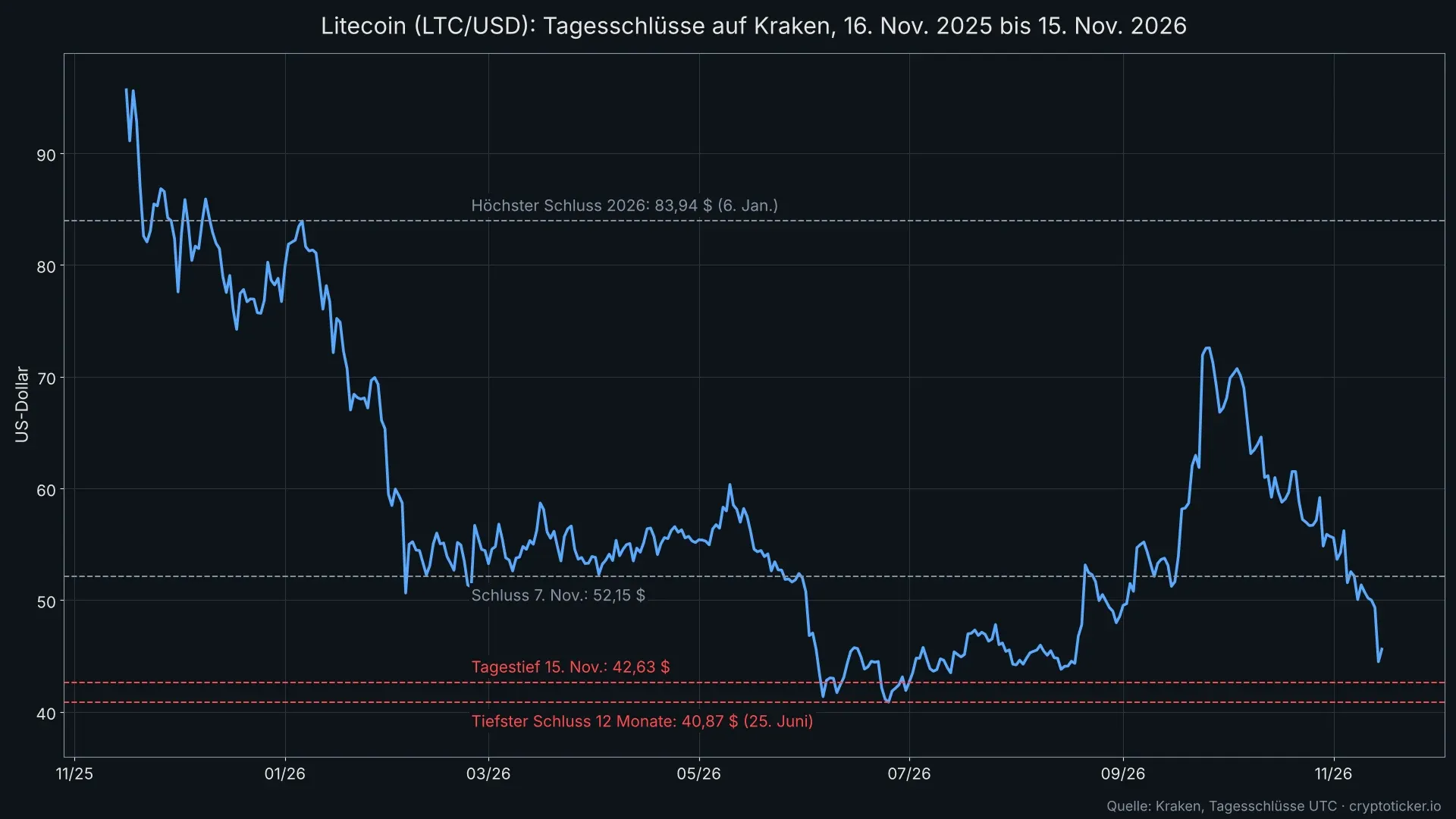
The Litecoin price has fallen to its lowest level since early July in this weekend's market slump. On Sunday, November 15, 2026, LTC slid overnight to $42.63 on Kraken. The last time the price stood lower was on July 2. In late morning trading Litecoin changed hands at $45.66, or €41.42 (CoinGecko). That is 5.4 percent less than 24 hours earlier and 11.9 percent less than a week ago.
Saturday was already weak. Litecoin closed on November 14 at $44.49 on Kraken, its lowest close since August 18. We covered that first leg down on Saturday evening in our report on the Litecoin three-month low. Overnight into Sunday the price dropped by a good four percent more before buyers pushed it back above $45. With a market capitalisation of $3.55 billion, Litecoin ranks 24th among the largest cryptocurrencies on CoinGecko.
Litecoin price crash on November 15: price, daily range and volume
The key figures of the weekend, each with its source:
- Price on Sunday morning: $45.66, down 5.4 percent in 24 hours and 11.9 percent in seven days (CoinGecko, November 15).
- Range over the past 24 hours: $42.73 to $48.44 on trading volume of $370 million (CoinGecko).
- Intraday low on November 15 on Kraken: $42.63, the lowest since July 2, 2026 (intraday low then: $42.37).
- Close on November 14: $44.49, with an intraday high of $49.58 (Kraken). High and low on that single day were around 14 percent apart.
- Close one week earlier, on November 7: $52.15 (Kraken).
- Distance from the all-time high of $410.26 set on May 9, 2021: minus 88.9 percent (CoinGecko).
The monthly comparison is starker still. According to CoinGecko, Litecoin trades 25.2 percent below its mid-October level and 55.4 percent below its price a year ago. Our Litecoin price page shows the live price with chart and volume.
Why is Litecoin falling? Rate fears and the crypto sell-off
There is no Litecoin-specific bad news this weekend. LTC is falling with the market as a whole. Bitcoin stood at $65,512 on Sunday morning, down 13.9 percent in seven days, while ether traded at $1,829 after losing 18.6 percent over the same period (CoinGecko). The Fear and Greed Index for the crypto market reads 10, which is extreme fear (alternative.me, as of November 15).
The main driver is the outlook for US interest rates. According to the CME FedWatch tool, futures traders on Friday put the probability of a 0.25 percentage point rate hike at the Federal Reserve meeting on December 8 and 9 at 88.5 percent, Bitcoin.com News reported on November 14. Higher rates make safe assets more attractive and credit more expensive. Risk assets such as altcoins usually lose ground first in such phases. Our article on why bitcoin is falling sets out the reasons in more detail, and our page on the crypto crash provides the daily overview.
The ranking is telling. Over the past 24 hours Litecoin lost 5.4 percent, more than twice as much as bitcoin (minus 2.5 percent). On a weekly basis, however, LTC fell slightly less than bitcoin and much less than ether. Litecoin therefore made up most of its decline only at the weekend, when the sell-off spread from the large caps to the smaller altcoins.
Litecoin price since January: from the $83.94 high to the June low
The price action of the past twelve months shows where LTC stands today. On January 6, 2026, Litecoin closed at $83.94 on Kraken, its highest daily close of the year. From there it fell almost without interruption into the summer. On June 25 the price hit $40.87, the lowest daily close of the past twelve months, with an intraday low of $39.25 that day.
A strong recovery followed in the autumn. In late September and early October LTC rose above $70 at times. That rally has now been fully reversed. The price is 45.6 percent below January's high for the year and only around twelve percent above the June low. The weekend slump has thus pushed Litecoin back into the range in which it traded continuously from mid-June to mid-August: between $41 and $48.
What is Litecoin? Block time, Scrypt and the 84 million LTC cap
Litecoin is one of the oldest cryptocurrencies. Charlie Lee launched the network in October 2011 as a faster variant of bitcoin. The basic idea is the same: a public blockchain on which miners confirm transactions and receive new coins in return. According to the Litecoin project, the network produces a new block roughly every two and a half minutes, against around ten minutes for bitcoin.
For mining, Litecoin uses the Scrypt algorithm. Scrypt is a proof-of-work method that requires more memory than the SHA-256 algorithm used by bitcoin. Supply is strictly capped: there will never be more than 84 million LTC, four times as many as bitcoin. According to CoinGecko, around 77.8 million LTC are currently in circulation, a little over 92 percent of the maximum supply.
In the short term, none of this matters much for the price in a crash. Like most older cryptocurrencies, Litecoin is used mainly as a means of payment and as a trading asset; it lacks a sizeable DeFi ecosystem like Ethereum's. That also means it lacks its own source of demand that could support the price in a broad sell-off.
Leverage on Litecoin: what 10x and 100x mean at a price around $45
Anyone looking to trade LTC in this market quickly comes across leveraged products. Leverage multiplies the price move on the capital deployed, in both directions. A long position bets on rising prices, a short position on falling ones. Our guide to long and short in crypto explains the basics.
A worked example using Sunday's price: with tenfold leverage and an entry at $45.66, a 10 percent drop to $41.09 wipes out the entire stake. If the price instead rises 10 percent to $50.23, the stake doubles. At a hundredfold leverage a move of around one percent, roughly 46 cents, is enough to liquidate the position. For comparison, on Saturday alone Litecoin swung by a good six dollars between its intraday high and low. Fees and the funding rate come on top, so in practice liquidation kicks in somewhat earlier.
A liquidation means the exchange forcibly closes the position because the collateral posted has been used up. Traders using leverage usually limit their risk with a small position size and a stop-loss, an order that closes the position automatically at a set price. In this weekend's slump, around $2 billion of positions were forcibly closed across the crypto market, mostly longs, according to our report of November 15. Details are in our article on crypto liquidations.
Litecoin open interest: fewer open contracts, fewer long accounts
Open interest measures the total value of all open futures contracts on a coin. If it rises while prices fall, new bets are being added. If it falls, traders are closing their positions or being liquidated. Our explainer on open interest goes into more detail.
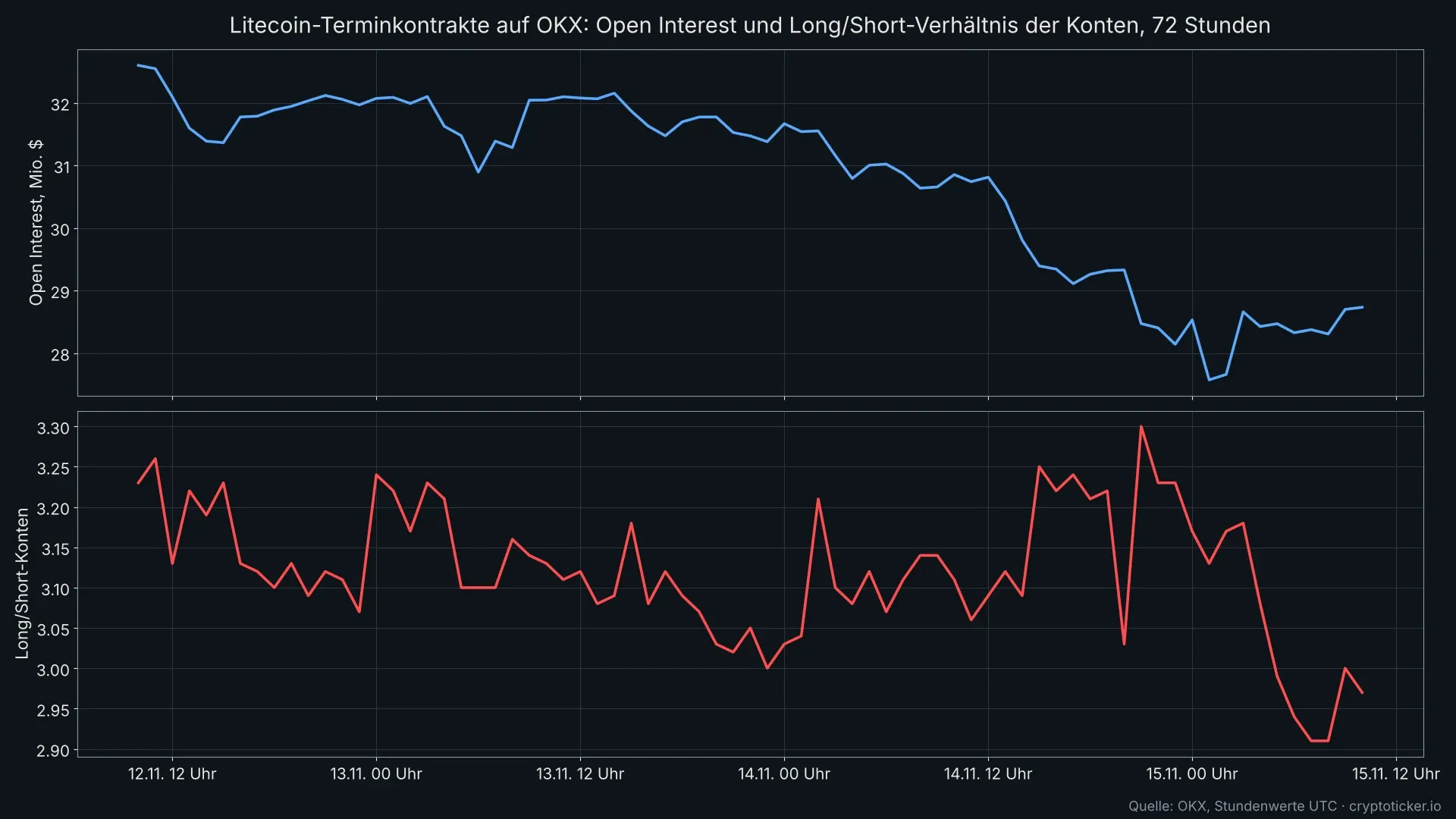
For Litecoin futures on OKX, open interest fell from $32.6 million on Thursday morning, November 12, to $28.7 million on Sunday morning. That is a decline of just under 12 percent. It hit its lowest level of around $27.6 million overnight into Sunday, precisely during the hours of the price low.
The long/short ratio of accounts has moved too. It shows how many accounts hold a long position for every account holding a short. For Litecoin it was stable between 3.0 and 3.3 for days, dropped to 2.91 on Sunday morning and last stood at 2.97 (OKX). The funding rate, through which the long and short sides offset each other, was slightly negative at minus 0.0015 percent per settlement period. In that case the short accounts pay a small fee to the long accounts.
Taken together, this means some traders gave up or lost their long positions in the slump. The large majority of accounts, however, is still betting on rising prices. If the price falls again, that could trigger further forced selling.
Will Litecoin fall below $40? Key levels from the price history
Nobody can give a reliable price forecast. The price history does, however, supply levels that many traders watch. On the downside, the first zone lies between $42.63, Sunday's intraday low, and $42.37, the intraday low of July 2. Below that sits the lowest daily close of the past twelve months at $40.87 from June 25. The round $40 mark and the low for the year of $39.25 lie just beneath. A close below this zone would be the lowest level in more than a year.
On the upside, LTC would first have to reclaim the 24-hour high of $48.44 and Saturday's intraday high of $49.58. Next comes the weekly close of November 7 at $52.15. A recovery to that level would fully offset this week's slump. How far the overall market fell in earlier cycles is shown in our analysis of how low bitcoin can fall. What the situation means for the market as a whole is described in our article on the bitcoin bear market.
Trading Litecoin in Europe: MiCA exchanges, perpetuals and CFDs
Investors in Europe have three ways to trade LTC. The obvious one is buying directly on a crypto exchange licensed under the EU's Markets in Crypto-Assets regulation, MiCA. MiCA sets out across the EU which providers may trade and hold crypto assets for clients; our overview of the MiCA licence explains what obligations this brings for providers. Which platforms list Litecoin and what fees they charge is shown in our comparison of the best crypto exchanges. Providers with a European licence are listed in the comparison of regulated crypto exchanges.
The second route is perpetuals, futures contracts with no expiry date such as the OKX contracts described above. They allow you to trade long and short with leverage. Such contracts are offered by centralised exchanges and by decentralised venues, which our perp DEX comparison lists. The third route is CFDs, contracts for difference on the price, as offered by the brokers in our comparison of the best crypto brokers. A CFD only tracks the price; you do not own any coins. Whether a given provider offers a Litecoin contract is something you should check there before opening an account.
CFDs are complex instruments and come with a high risk of losing money rapidly due to leverage. A high percentage of retail investor accounts lose money when trading CFDs. You should consider whether you understand how CFDs work and whether you can afford to take the high risk of losing your money.
Sell or hold Litecoin? Two scenarios after the crash
This article makes no recommendation. The situation can, however, be framed in conditions you can check for yourself.
In the first scenario the broader market calms down. Bitcoin holds above its weekend low, rate expectations ahead of the Fed meeting on December 8 and 9 rise no further, and Litecoin holds the zone of $42.37 to $42.63 on a daily closing basis. In that case the June low would have held for a second time, and a recovery towards $48 to $50 would be the first hurdle.
In the second scenario the sell-off continues. If LTC closes below $40.87, the most important support from the summer gives way. The still clear majority of long accounts in the futures market suggests that further forced selling is possible if the price gives way. How investors in the bitcoin market approach the same question is described in our article on whether to buy or sell bitcoin now.
November crypto crash: where Litecoin stands among the altcoins
Litecoin is not the only older altcoin to have fallen to a multi-month low this weekend. Among the 25 largest cryptocurrencies on CoinGecko, LTC was one of the biggest losers on Sunday morning at minus 5.3 percent in 24 hours, behind Avalanche at minus 8.8 percent, Dogecoin and Cardano. We have covered Avalanche, Cardano and Uniswap in separate articles. Our bitcoin price page shows where bitcoin stands now. An overview of the reasons behind the decline is on our page why is crypto down.
Litecoin price: below $40.87, a new low for the year looms
Litecoin has lost just under twelve percent in a week and given back the entire autumn rally. The cause lies in the broader market; the severity of the weekend drop reflects smaller altcoins catching up with the decline. Three points help put it in context:
- Watch the daily close: what matters is whether LTC holds the zone between $40.87 and $42.63. You can compare Litecoin prices and fees at the best crypto exchanges.
- Run the numbers on leverage before you trade: at 10x, a 10 percent move is enough for a total loss. The perp DEX comparison shows which venues offer perpetuals and at what fees.
- Look at the licence: for accounts in the EU, MiCA authorisation is what counts. Which providers hold it is listed in the comparison of regulated crypto exchanges.
(As of November 15, 2026. This article is not investment advice. Prices and fee structures change; check the terms with the provider before you buy.)
0
0

 Manage all your crypto, NFT and DeFi from one place
Securely connect the portfolio you’re using to start.


