
Ethereum 2027 Upgrade Delay: Could Solana Benefit From ETH's Setback

0
0
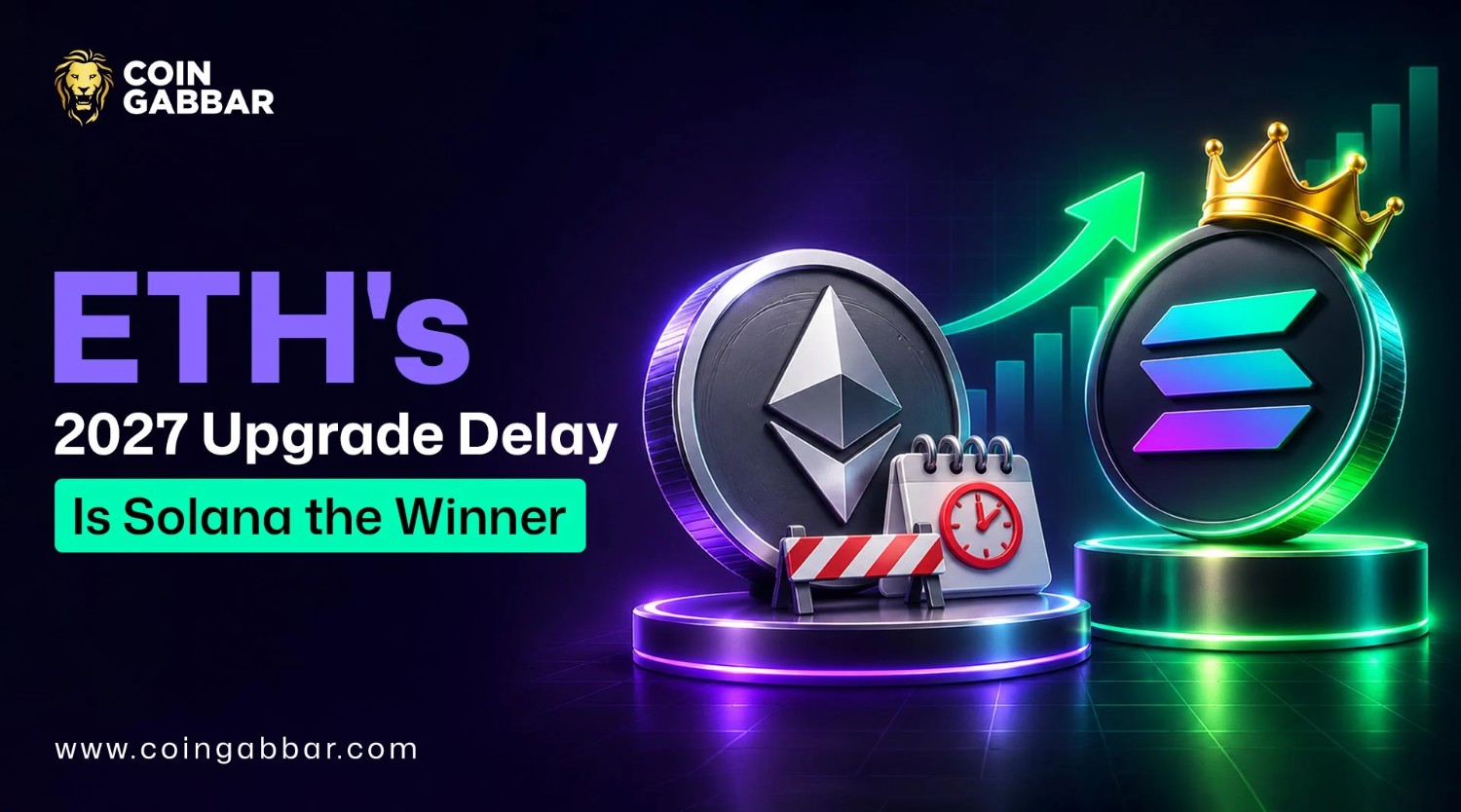
Ethereum Missed Another Date. Is Solana Ready to Step In?
Ethereum's next big upgrade isn't landing on schedule. The Ethereum 2027 upgrade delay has become a major talking point across crypto, and rival networks are paying attention.
Glamsterdam is the planned hard fork, a network-wide software change that every node must adopt. Developers say mainnet activation can't happen before mid-January 2027.
That raises a fair question. Could Solana, a faster competitor, pick up builders and users while ETH waits? This guide explains what slipped, why it slipped, and where Solana's real gains may come from. The risks get equal attention. All details are current as of Nov. 24, 2026.
Why Is Ethereum Delaying Glamsterdam?
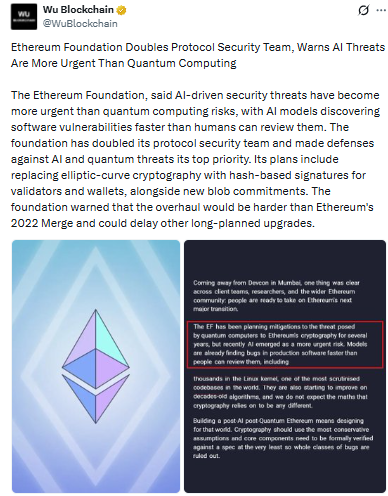
Ethereum is delaying Glamsterdam because proposed gas pricing changes could affect existing smart contracts. Developers are reviewing those risks before choosing a mainnet date.
Can Solana benefit? Possibly, through attention and a timing edge. No verified data shows developers or capital moving because of the delay.
What Exactly Caused the Ethereum 2027 Upgrade Delay?
Ethereum developers pushed back again. Mainnet can't go live before mid-January 2027. No final date exists.
Developers first expected Glamsterdam in the first half of 2026. They later moved it to the fourth quarter. Then came a bigger problem. Security reviews flagged two gas pricing proposals, and developers put the Hoodi testnet launch on hold.
The Ethereum Foundation's security review explains the risk in detail. The Foundation and two independent security firms contacted at least 50 affected projects.
High-impact projects have finished or expect to finish fixes by mid-December. Medium-impact projects have until Jan. 10, 2027. Developers said most contracts stayed unaffected in transaction replays. Many flagged cases can be fixed by raising gas limits. The mainnet itself runs normally. ETH holders need no action.
What Is the Difference Between EIP-8037 and EIP-8038?
Gas is the fee paid for computing work on Ethereum. State is the stored data, like balances and contract storage.
EIP-8037 raises the cost of creating new state, such as accounts, storage slots, and contract codes. It also meters that cost separately through a state gas reservoir.
EIP-8038 provides access to the existing state, including storage reads and writes. Both aim to stop state access from holding back scaling. Prices should track the real work each operation takes.
Why Could Ethereum Smart Contracts Break After Glamsterdam?
Some contracts assume an operation always costs a fixed amount of gas. Hardcoded gas amounts are the usual example. If prices change, those assumptions can fail. Even unchanged code can behave differently.
Reviewers also flagged contracts that keep running after an external call fails. Under the new rules, some failure handlers could succeed where they used to revert. The Foundation published a repository describing eight such assumptions for auditors. Not a live failure. Not an attack. Just a risk caught before launch.
How Late Could Glamsterdam Go? Three Possible Timelines
At the Nov. 19 developer meeting, no final decision came. Developers discussed three paths.
-
Mid-January 2027: earliest window, if current specifications stay unchanged
-
Late February to early March 2027: if the decision waits until January
-
April to May 2027: if modified specifications get adopted
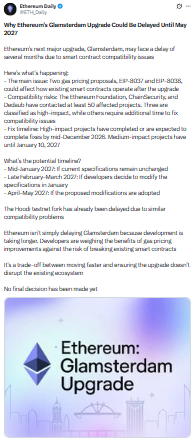
Late January or early February was discussed as the more realistic launch window. These are discussion scenarios, not confirmed dates.
A Nov. 26 call is expected to set the next testnet date. A mid-December Hoodi run remains tentative. Basically, it's a trade-off. Moving fast risks breaking live apps, and moving slowly delays scaling work.
What Does Glamsterdam Change, and Why Does It Matter?
Glamsterdam's headline feature is ePBS, short for enshrined proposer-builder separation. It aims to build fairer block production into the protocol itself.
Validators and block builders get clearer roles. That's meant to cut MEV, the extra profit made by ordering transactions.
Hegotá is the next upgrade on the Ethereum roadmap, also aimed at 2027. The Ethereum Foundation says that work continues in parallel and isn't affected by this delay.
How Is Solana Positioned While Ethereum Waits?
Solana's answer arrived first. Alpenglow, its major consensus upgrade, went live on mainnet on Oct. 21, 2026, according to the Alpenglow documentation.
Consensus is how validators agree on the next block. Alpenglow targets about 150 milliseconds to finality, down from 12.8 seconds. That figure is a target, not a guarantee for every transaction.
Slot times also fell from 400ms to 200ms in four steps between Aug. 21 and Oct. 9, 2026. Each step waited on block skip rates, according to the slot time rollout page.
What Does Solana's 150ms Finality Mean for Users?
Three terms get mixed up. A slot, now 200ms, is the window in which a validator can produce a block. Confirmation means the network has accepted a transaction. Finality means it can't be reversed.
Alpenglow is designed to make those last two the same state. That could matter most for trading and payment apps. Real-world timing still needs measuring over weeks of live use. A target isn't a track record.
Can Firedancer Improve Solana's Network Resilience?
Firedancer is an independent validator client built by Jump Crypto. It has been live on the mainnet since December 2025. A second client matters. A bug in one codebase doesn't automatically hit the other.
The Alpenglow migration, though, didn't support Firedancer or its hybrid version, Frankendancer. Operators on either side switched to Agave before the one-slot handoff. Firedancer releases have continued since launch. Current Alpenglow support is worth verifying in the client's own release notes.
Solana vs Ethereum: Where Does Each Network Stand?
| Factor | Ethereum | Solana |
| Latest major upgrade | Glamsterdam, mainnet earliest mid-January 2027 | Alpenglow has been living since October. |
| Upgrade approach | Compatibility first, slower rollout. | Performance first, live network handoff |
| Slot time today | About 12 seconds | 200ms |
| Main goal | Block building changes, gas repricing | Faster consensus and finality |
| Key risk | Smart contract compatibility | Early results versus target, client diversity |
| Mainnet status | Running normally | Running normally |
Ethereum treats compatibility as the first rule. Existing apps hold user funds, so breaking even a small group is costly.
Solana's recent upgrades favor performance first. Alpenglow swapped the consensus engine on a live network after months of rehearsals. Neither approach is better by default. One accepts slower delivery. The other accepts migration risk.
In editorial terms, Solana holds the stronger near-term narrative. That's a judgment about timing, not a measured result. Technical performance also isn't token performance. SOL and ETH prices depend on far more than upgrade schedules.
What Did Solana Actually Gain From Ethereum's Delay?
No verified data yet shows developers or money moving to Solana because of the delay. Solana's clearest benefit is timing. It's showing speed gains while Ethereum fixes safety issues.
Anza's 2027 roadmap, announced by Solana, aims to double compute capacity. Compute units measure the work a transaction needs. It also targets an 80% cut in compute use for token-account transactions. Account limits per transaction would rise from 64 to 96.
Faster block propagation and a feature called Constellation, aimed at clearer ordering rules, are planned too. These are engineering targets, not delivered results.
Ethereum's process adds context. One Foundation researcher noted that Glamsterdam needed 12 test networks in 160 days. Pectra, the previous upgrade, needed seven in 285.
Will Ethereum's Upgrade Delay Affect Developer Activity?
Builders pick networks for liquidity, meaning how easily assets trade, plus tools, security history, and users.
A few late months don't erase Ethereum's deep base of apps and money. So why would a team rebuild on a new chain over a short upgrade wait? Some might. New projects choosing a first home are the likeliest group. But moving live contracts is costly and risky. Speed and fees were Solana's pitch long before this delay.
Ethereum's Layer 2 networks , separate chains that bundle transactions, already carry part of the scalability load. The Ethereum 2027 upgrade delay slows Ethereum's pace, but its position stays intact.
What Risks Could Limit Solana's Upside From This Delay?
Ethereum's delay doesn't erase Solana's own risks. The network has a record of past outages, and shorter slots demand more from validator hardware and networking.
Sentiment swings fast. A delay headline may lift SOL for days, then fade once real usage data arrives. Price moves carry no promise.
What Does the Data Say About Ethereum and Solana?
The stronger signal is the delay's cause. Developers chose a safety review over a rushed launch.
Unlike a security failure, the Ethereum 2027 upgrade delay shows a team choosing caution. The main concern is the open timeline. A January decision could still move activation by months.
Here's the thing: the biggest unknown is Solana's real finality after weeks of live use. Early numbers and long-run numbers rarely match. Ethereum carries timing risk. Solana carries execution risk. Neither path is free of problems. A mass developer shift seems unlikely from here.
What Should Readers Watch Before Drawing Conclusions?
Anyone tracking the Ethereum 2027 upgrade delay should follow four markers.
-
Whether the next testnet date holds
-
Whether developers keep or change the gas rules in January
-
Whether Solana's finality moves toward its 150 millisecond target
-
Whether Solana delivers its 2027 roadmap items on time
Final Take: Does Ethereum's Setback Really Help Solana?
Ethereum is delaying Glamsterdam to fix smart contract risks. Solana, meanwhile, already shipped Alpenglow. Ethereum still holds the deeper base of apps and liquidity. Solana holds the fresher upgrade.
Put plainly, Solana gains attention and a timing edge, not automatic market share. The Ethereum 2027 upgrade delay gives Solana a story, not a switch. What stays unclear is the final mainnet date and how Solana's speed holds under real demand.
Disclaimer
This article is for general informational purposes only and isn't financial advice. Crypto assets are volatile and high risk, and the outcome of any upgrade remains uncertain. Readers should research independently and consult a licensed advisor before making any financial decision.
0
0


 Manage all your crypto, NFT and DeFi from one place
Securely connect the portfolio you’re using to start.
 Where will Ethereum trade next?
Live Polymarket and Kalshi odds on Ethereum price targets, compared side by side.
See Ethereum price odds


