
White House nominates four to SEC and CFTC as CLARITY Act stalls

0
0
On November 12, the White House nominated four candidates to fill vacancies at the Securities and Exchange Commission (SEC) and Commodity Futures Trading Commission (CFTC).
As of Friday, the SEC only had two commissioners and the CFTC had one commissioner. The nominees are introduced at a time when the CLARITY Act is still stuck in Congress.
All four nominees must get Senate approval before they can take office. The announcement itself does not change anything in crypto regulations that are already in place, and there is no reported market activity due to the nomination announcements.
A bipartisan slate, with three seats still open
The White House slate includes Nathan Anonick and Matthew Rowland for the CFTC, alongside Kristin N. Johnson and Steven Levine for the SEC. Reports note a bipartisan split: Anonick and Levine are Republicans; Rowland and Johnson are Democrats.
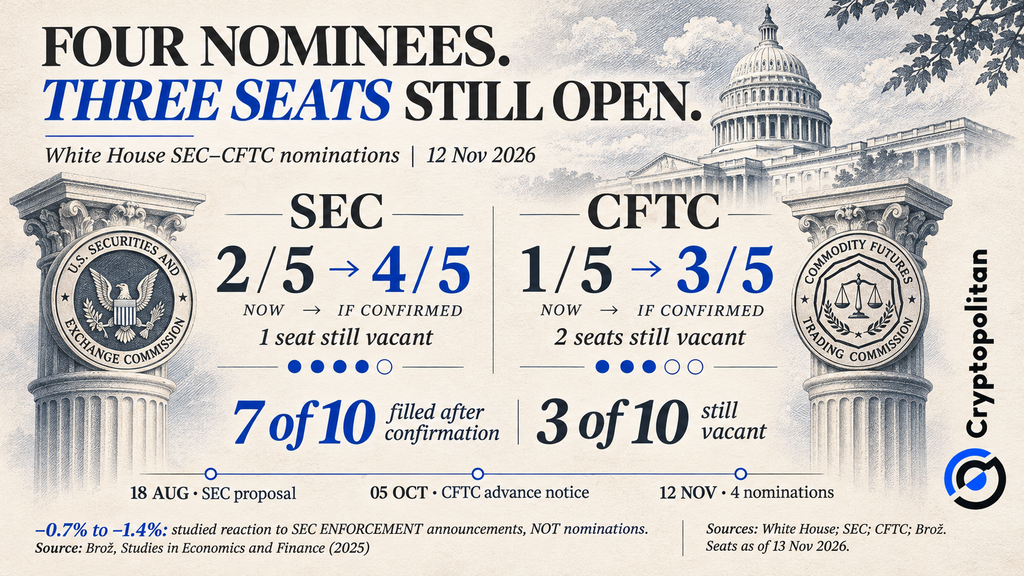
Official rosters list two SEC commissioners and one at the CFTC. Confirming all four would fill seven of ten combined seats and reduce vacancies from 70% to 30%. One SEC and two CFTC seats would stay vacant.
What the nominees bring to the table
Two of the nominees worked on the stalled CLARITY Act, namely: Nathan Anonick and Matthew Rowland.
Anonick, who is counsel to Senate Agriculture Committee Chairman John Boozman, helped negotiate the committee’s provisions. Rowland, a CFTC lawyer assigned to the same committee, worked on CLARITY and an earlier crypto bill in 2024.
Kristin N. Johnson, a former CFTC commissioner, dealt with the issues of crypto custody, decentralized finance, and AI. Steven Levine previously served as advisor to SEC Commissioner Mark Uyeda and served as part of the White House Council of Economic Advisers.
Why a fuller bench matters after CLARITY stalled
Although the CLARITY Act successfully passed in the House in July 2025, it did not succeed in the Senate. The Senate failed to pass the bill when a procedural vote on September 15 resulted in a 49 to 50 outcome, falling short of the required 60 votes.
Without new laws, the CFTC has proceeded to develop cryptocurrency regulations in accordance with its powers, even if there was only one commissioner seated at the time.
As reported by Cryptopolitan, some lawmakers warned that rules issued by one commissioner can result in more legal challenges. Appointing additional commissioners would make it possible for proposed regulations to go through several people’s discussions and approvals.
This way, it would be harder for legislation to fall apart because collective judgment of appointed commissioners will ensure that all decisions are taken by several people, rather than just one. This is important in case Congress has to reintroduce CLARITY in 2027.
Rules are already moving without Congress
The SEC and CFTC have both begun working on rules regulating cryptocurrencies.
On August 18, the SEC released its proposal for Regulation Crypto Assets. The proposal includes a one-time exemption for offerings of up to $5 million in four years and another allowing up to $75 million each year. The proposals are not yet finalized.
The CFTC, on the other hand, has requested comments on retail cryptocurrency transactions in an advance notice published on October 5. This notice solicits input from the public but does not place any obligation. If they are confirmed, the new commissioners will join in the efforts already underway.
What research suggests about investor reaction
Regulatory decisions can affect crypto prices, but past enforcement cases cannot predict how investors will react to these nominations. A Boston College Law Review study found stronger negative market reactions to SEC enforcement than to CFTC actions. Antifraud cases drew relatively better responses.
Separately, Václav Brož estimated price declines of 0.7%–1.4% around SEC enforcement announcements between 2019 and 2023. Neither study examined nominations. Bitcoin traded at $68,408 at 12:10 a.m. Eastern on November 13, down 7% over 24 hours. The decline was not linked to the nomination.
The global backdrop raises the stakes
US crypto policy is unfolding as other countries develop their own regulatory frameworks. Chainalysis estimated $9.4 trillion in on-chain activity despite a roughly 50% decline in crypto market capitalization. Brazil topped its adoption rankings.
Meanwhile, the Financial Stability Board warned that inconsistent regulations allow firms to exploit differences between jurisdictions. Europe has already reached another milestone. Its MiCA transition ended July 1, 2026, requiring unauthorized providers to wind down EU operations. For crypto firms, the US regulatory debate now runs alongside rules already taking effect overseas.
The smartest crypto minds already read our newsletter. Want in? Join them.
0
0

 Manage all your crypto, NFT and DeFi from one place
Securely connect the portfolio you’re using to start.


