
Ethereum price prediction: 986,847 ETH queue to stake while only 4,320 ETH wait to exit

0
0

Close to one million ether was waiting on Friday evening to enter staking, while only 4,320 ETH had requested to exit. That is the picture from the queue tracker validatorqueue.com on November 6. Ether itself cost $2,229 on Friday evening according to CoinGecko, 13.4 percent below its level 30 days earlier. What the data show: despite the price decline, hardly anyone is leaving staking, and inflows are still large enough to produce a wait of just over 17 days. Our assessment follows further down: the queue supports supply, but it does not replace new buyers in the market.
Where the price could head over a horizon of months is covered in our Ethereum price prediction. This piece looks at the short term until the end of November and at a metric missing from most price reports: the ratio of ether pushing into staking to ether trying to get out.
Ethereum staking queue: 986,847 ETH and a wait of just over 17 days
The entry queue is the list of validators that have already deposited their stake but are not yet allowed to take part in consensus. On November 6 it holds 986,847 ETH. validatorqueue.com puts the estimated wait at 17 days and 15 hours. Anyone registering a validator today will therefore earn a first reward on November 24 at the earliest.
On the other side, 4,320 ETH are waiting to exit, with a wait of just over a day. Then comes the so-called sweep: after the exit it currently takes around 7.1 days for the balance to arrive at the registered withdrawal address. A third queue covers the merging of validators, known as consolidation. It holds 15,424 ETH and does not change the amount of staked ether.
In total, 44.4 million ETH are staked. That is 36.36 percent of supply, spread across 812,866 active validators. The average annual yield is 2.44 percent. For comparison, on September 22 the figure was 35.74 percent of supply. How the share has built up since the switch to proof of stake is shown in our article on Ethereum mining after the Merge.
Ethereum price since November 5: from $2,416 to $2,229
Our last Ethereum price prediction on November 5 focused on the options market: 77,441 puts for the November 13 expiry against 24,464 calls. Ether was trading at around $2,416 in the late morning at the time. Since then the price has lost 7.8 percent. On Thursday evening the drop coincided with the sell-off in chip stocks on the Nasdaq, which, as we reported on November 5, also pulled bitcoin lower.
Anyone who had hedged with puts was proved right through Friday. What is new is that on Friday the price fell clearly below the 100-day moving average at $2,360. The daily range, according to CoinGecko, ran from $2,209 to $2,266. The 200-day moving average, which was still around $260 away on November 5, is now only about $70 below.
Churn limit: how Ethereum rations access to staking
Ethereum does not let validators in and out at any speed they like. Per epoch the network processes only a fixed amount of ether, the so-called churn. An epoch comprises 32 slots of 12 seconds each, or 6.4 minutes. According to validatorqueue.com, the churn currently stands at 256 ETH per epoch, for entries and exits alike. With 225 epochs a day, that means 57,600 ETH can move into staking each day.
The mechanism protects consensus: a sudden mass exit could otherwise weaken the security of the network, and a sudden mass entry could shift the weights between validators. For investors this has a practical consequence. Anyone who wants to stake ether through their own validator first ties up the capital without earning a yield on it. With a 17-day wait and an annual yield of 2.44 percent, about 0.04 ETH of rewards on 32 ETH is forgone before the validator even starts.
Staking exits: the October 1 wave has been cleared
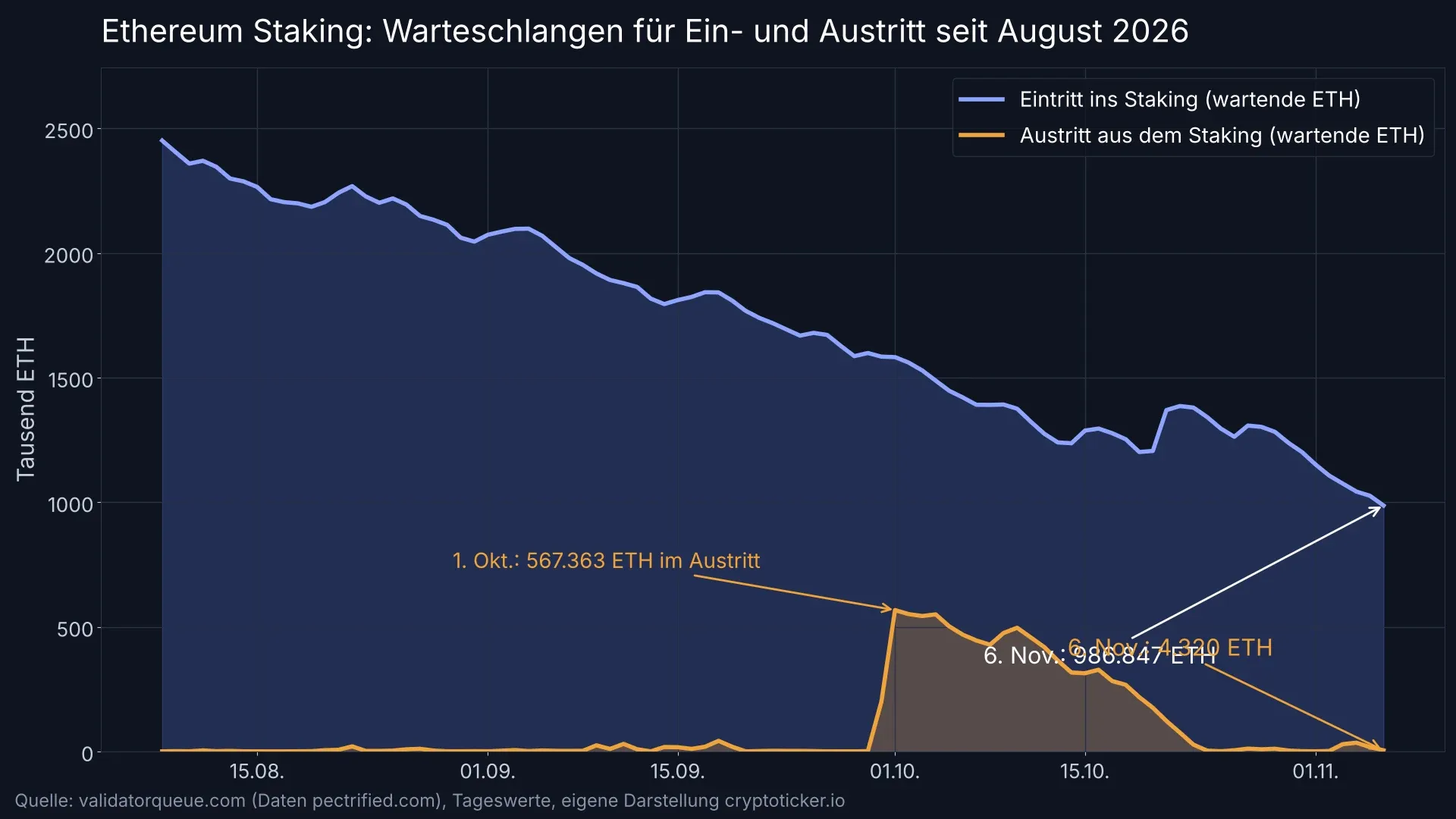
A look at the trend since August shows why today's figure of 4,320 ETH stands out. On October 1 the exit queue held 567,363 ETH, with a wait of almost eleven days. By October 24 that wave had been fully worked off, and since then exits have ranged from a few hundred to just over 35,000 ETH. The record dates from September 12, 2025, with 2.68 million ETH and a wait of 46.6 days.
Ether leaving staking is potential supply for sale. Those who shut down a validator usually want to redeploy or sell the capital. The fact that this flow has not swelled again during the decline of the past 30 days shows that stakers themselves did not respond to the price drop by heading for the exit. The selling pressure of recent weeks must therefore have come mostly from ether that was not staked.
Ethereum staking entries: inflows are getting smaller
The entry queue tells the second half of the story, and it is less friendly. On August 8 it still held 2.45 million ETH, on September 22 1.72 million and on October 22 1.39 million. The year's peak came on February 12, 2026, at 4.10 million ETH and a 71-day wait. Since October 22 it has been shrinking again day after day.
That allows a rough estimate of new inflows. From November 5 to November 6 the queue fell from 1,025,855 to 986,847 ETH, a drop of around 39,000 ETH. Up to 57,600 ETH were processed over the same period. That implies around 18,600 ETH of new arrivals in one day. This is our own calculation from the daily figures on validatorqueue.com, not an official metric, but it shows the direction: less is coming in than the network can absorb.
Ethereum price prediction: the 200-day moving average at $2,157 is the next support
For the levels we use the moving averages of daily closing prices from CoinGecko, as of November 6. A moving average is the mean of closing prices over a fixed number of days and serves as a gauge of the trend over that period.
- $2,157: the 200-day moving average and therefore the most important support. The price sits about 3 percent above it.
- $2,209: Friday's daily low. If it holds, the day's range stays intact.
- $2,360: the 100-day moving average, broken on Friday and now the first resistance on the way up.
- $2,503: the 50-day moving average. Only above it would the decline since late September be called into question.
- $1,774: the July 14 low and the lowest close of the past 120 days. It only becomes relevant if the 200-day moving average gives way.
The 120-day high was $2,775 on September 22. Ether is about 55 percent below its record high of $4,946 from August 24, 2025.
Ethereum staking in Germany: tax on rewards, holding period on sales
Anyone joining the queue now or staking through a provider should know the tax side. In Germany, staking rewards count as other income under Section 22 No. 3 of the Income Tax Act. What matters is the market value in euros at the moment of receipt. If all other income of this kind stays below 256 euros a year, it is tax-free; the threshold is an exemption limit, so anyone above it pays tax on the full amount.
For selling the staked ether itself, the one-year holding period applies. The Federal Ministry of Finance has clarified that staking does not extend this period to ten years. With a holding period under one year, gains of up to 1,000 euros a year remain tax-free, again as an exemption limit. Whether the tax-free holding period will survive is an open question: the current state of the reform plans is summarised on our page on the crypto holding period.
Because every single reward has its own value at receipt, the bookkeeping quickly becomes messy. An overview of suitable programs is in our comparison of crypto tax software.

Ethereum staking through exchanges: who bears the wait
Very few retail investors run their own validator with 32 ETH. The usual route is staking through an exchange or a staking provider. There the queue is often invisible, because the provider pools deposits and serves them from a stock of validators that are already active. As a result, rewards flow sooner than with your own validator, but the cost is built into a commission on the rewards. Which providers offer ether staking on what terms is shown in our comparison of staking platforms.
Two points are worth checking in the small print. First, withdrawals: some providers only release ether once the exit queue and the sweep have run their course, currently after just over eight days. Second, custody: staked ether sits with the provider, not in your own wallet. Check whether the provider holds a licence as a crypto-asset service provider under the EU's MiCA regulation. An alternative is liquid staking tokens, which make staked ether tradable; they carry their own risk, however, because their price can deviate from the ether price.
Ethereum price prediction to the end of November: bear case, sideways range, recovery
The staking data and the levels point to three paths. This is not a forecast but a map of where the picture would change.
Bear case: a close below $2,157
If ether closes a day below the 200-day moving average, the most important support on the chart would be broken. The next notable point is the round $2,000 mark, and below that the July low at $1,774. A warning sign would be the exit queue climbing back to several hundred thousand ETH at the same time, as in early October.
Sideways range: $2,157 to $2,360
If the 200-day moving average holds without the 100-day moving average being reclaimed, the price oscillates between the two. In that case the November 13 expiry, which we reported on on November 5, would decide the next direction.
Recovery: back above $2,360
A close above the 100-day moving average would neutralise the downward pressure of the past few days. The next target would then be the 50-day moving average at $2,503. That requires new demand in the spot market; the staking queue alone will not supply it.
Our view of the Ethereum staking data
In the editorial team's view, the ratio of 986,847 to 4,320 ETH suggests that the price decline of the past 30 days is not being driven by long-term holders. Those who stake tie up capital for weeks and, according to data from validatorqueue.com, stay put even at a 13 percent loss. Against that, the entry queue has shrunk by almost 400,000 ETH since October 22, and daily inflows of around 18,600 ETH are well below the absorption capacity of 57,600 ETH. The queue keeps supply tight, but it does not bring fresh demand to the exchanges. For the price, the 200-day moving average at $2,157 therefore matters more than any staking metric. A total loss of the capital invested can never be ruled out with crypto assets.
Ethereum staking data: without new buyers the queue cannot carry the price
- Choose how to buy: If you want to buy and stake ether, start by comparing providers that offer staking and hold a MiCA licence. The overview is in our list of regulated crypto exchanges.
- Sort out custody: If you do not want to stake, ether is better kept in your own wallet than on an exchange. Our hardware wallet comparison covers devices and prices.
- Record your rewards: Log every staking reward with its date and euro value so the 256-euro exemption limit can be checked properly. Crypto tax software helps with this.
(As of November 6, 2026. This article is not investment advice. Prices and fee structures change; check the terms with the provider before you buy.)
0
0

 Manage all your crypto, NFT and DeFi from one place
Securely connect the portfolio you’re using to start.
 Where will Ethereum trade next?
Live Polymarket and Kalshi odds on Ethereum price targets, compared side by side.
See Ethereum price odds


