
South Korea Moves to Lift Its ICO Ban. Parliament Has Not Voted Yet

0
0

South Korea’s Financial Services Commission put a digital asset bill on the legislative track on Nov. 24, and the provision that matters most sits in the market section: domestic token sales would be legal again, provided the issuer files a white paper with the regulator before it asks anyone for money.
The bill was tabled at a meeting of the FSC’s Virtual Asset Committee chaired by FSC chairman Lee Eok-won at the Government Complex in Seoul, according to the commission’s 11-page release. It would replace the current two-law arrangement, VASP reporting and anti-money-laundering duties under the Specific Financial Information Act plus user-asset and unfair-trading rules under the Virtual Asset User Protection Act, with a single statute covering industry, market and users.
None of it is law. The release says the FSC will support the legislative process so that the bill can be enacted “after sufficient discussion in the National Assembly.” Until that happens the initial coin offering route stays shut and the new licence categories do not exist.
What the committee did, and what it did not do
The Virtual Asset Committee is an advisory body created by Article 5 of the user-protection act. Its Nov. 24 session at 15:00 Seoul time was the venue, not the author of the decision. The FSC chairman had already met DAXA, the domestic exchange association, major exchanges and outside academics on Nov. 23 to hear objections before the bill went public, and the release records what he told that room: “innovation, above all, has to be built on trust.”
On the bill itself, Lee said it “will raise the trust and transparency of our digital asset market and lift the industry’s competitiveness by a step,” and that it should contribute to “new industrial growth and job creation through new capital inflows.” Those are the commission’s projections, not results. The same release commits the government to supporting passage rather than promising a date.
Three separate files are in play here, and the Korean coverage has blurred them. The release sets out an industry-and-market statute. It does not establish a test for when a token is a security, it does not change how gains are taxed, and it does not touch the travel rule. Those questions live in the capital markets code, the tax code and the amended Specific Financial Information Act respectively, and the Sept. 5 roadmap for tokenised securities is a separate track entirely.
One licence becomes four
The current regime has a single gate: register as a virtual asset service provider, meet AML obligations, and operate. The bill splits that into four businesses, trading, brokerage, custody and management, each regulated according to function under a stated “same risk, same regulation” principle, plus a designation for the venue itself.
Trading, brokerage and custody would require a licence, with own capital of at least KRW 2 billion where the business handles all digital assets or KRW 1 billion where it handles only stablecoins, along with personnel, premises, a viable business plan and fit-and-proper tests for major shareholders and officers. Management, which never touches client assets, would be a registration with KRW 500 million of capital and professional staff. An exchange becomes a platform operator only after holding all three licences and being designated by the FSC.
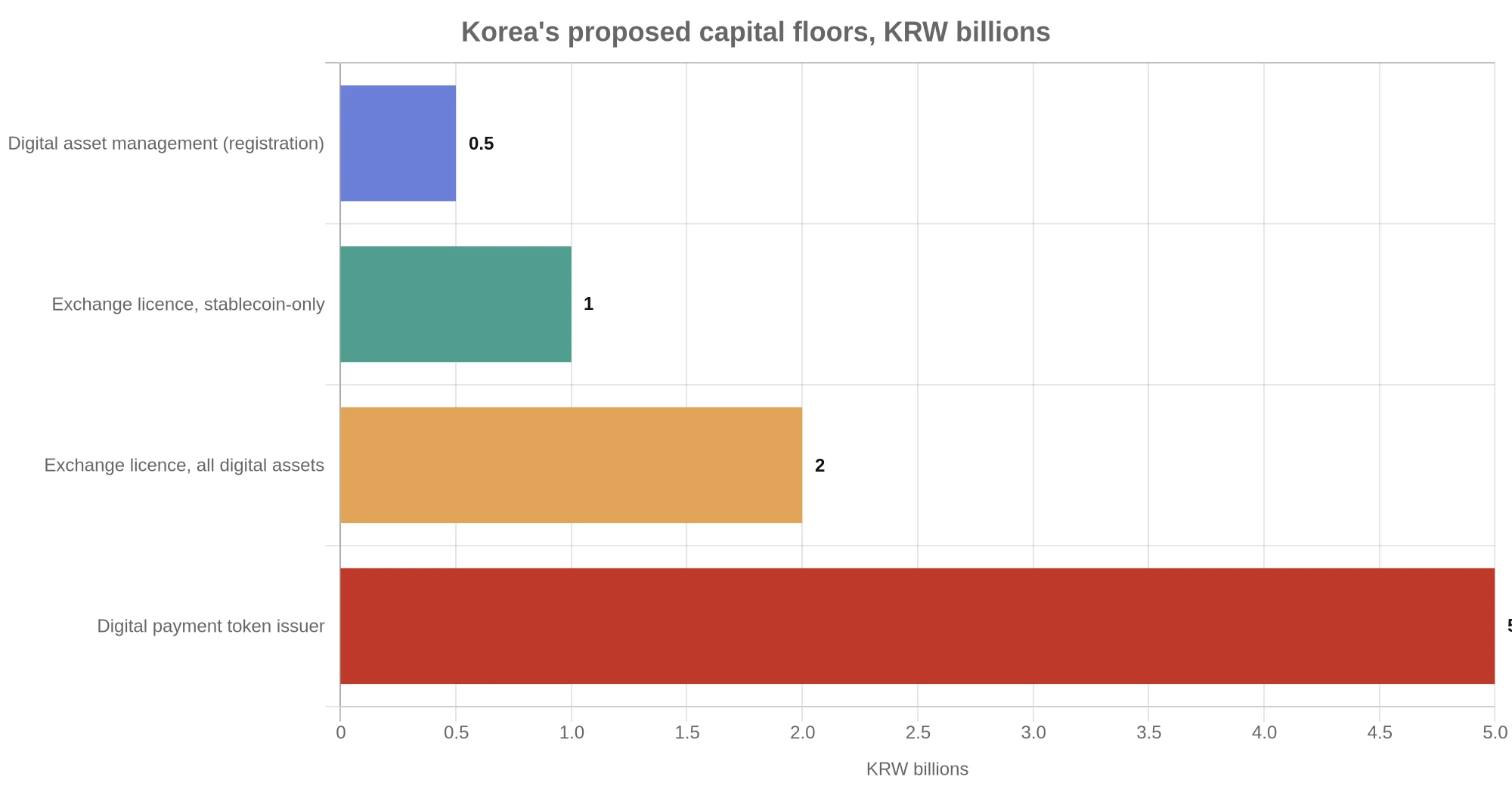
The ladder is the part worth memorising, because it tells you which businesses the government expects to be small. A management registration needs a tenth of the capital of a digital payment token issuer, and a stablecoin-only exchange licence needs a fifth. The issuer floor, at KRW 5 billion, is 2.5 times the full exchange licence. Read as a ranking of who must carry balance sheet risk, the bill puts stablecoin issuance at the top, above the exchanges that distribute it.
The licensing split also settles an argument the industry has made for two years: that a custody business and a derivatives-style trading desk should not answer to the same rulebook. South Korea blocked 27 unregistered exchanges in October under the old single-gate framework, a reminder of how blunt that gate was.
The ICO rule: white paper, filing, then a waiting period
Token sales return under conditions. An issuer, or the broker arranging the sale, must draft a digital asset white paper and file it with the FSC before soliciting unspecified buyers. The document mirrors a securities registration statement: who is soliciting, what the money is for, how much is being issued, what the project is, and what can go wrong. The FSC can demand corrections for material omissions, and solicitation is allowed only after the filing is accepted, published, and a deliberation period has passed.
The release does not state how long that deliberation period runs. That number, like the shareholder-composition test for stablecoin issuers, is left to the enforcement decree, which means the practical difficulty of raising money in Seoul will be decided by regulation rather than by the statute.
Listing gets its own disclosure layer. A platform operator must file and publish a listing report covering the issuer, supply, project and risks before supporting a token, and must disclose hacks, outages and supply changes immediately. False or missing material facts expose the disclosing entity and its executives to damages liability, with FSC investigation powers, fines and criminal penalties behind that.
This is a utility-and-asset-token framework. Security tokens remain on the other track, the FSC’s September proposal to tokenise securities issuance and circulation under capital markets law, which the commission has been drafting separately.
Stablecoins: banks first, and a KRW 1 trillion tripwire
The bill gives stablecoins a legal name, digital payment token, defined as a digital asset designed to hold a stable value against one currency and used mainly for payments. An issuer would need an FSC licence, own capital of at least KRW 5 billion, a viable plan, staff and premises, and a conflict-of-interest framework.
Shareholder composition is where the politics sits. The decree will set the test, and the government has already said how it intends to use it: at first, only consortiums in which banks hold a majority stake will be allowed to issue, with fintech and technology firms permitted to be the largest single shareholder. Foreign issuers with adequate home supervision can establish a Korean branch, meet working-fund requirements, register, and notify the FSC of the specific token.
Issuance runs through an approved plan covering volume, limits, reserve management and redemption. Tokens are issued against money of equal value, holders cannot be paid interest, and any token without an approved or notified plan cannot be listed or handled by a licensed firm. Reserves must be deposited or trusted at a bank-type custodian at 100% or more of the amount outstanding, ring-fenced from the issuer’s estate, and paid to holders first if the issuer loses its licence, goes bankrupt, or cannot redeem after a hack.
The bill also creates a category above the rest. A token with more than KRW 1 trillion outstanding can be designated a significant digital payment token, triggering additional capital, stricter reserve-liquidity rules and the right of the Bank of Korea to request a joint inspection. The release puts the comparable thresholds at EUR 5 billion in the European Union and USD 10 billion in the United States, which is a reminder that Korea is writing its rule for a won-denominated market that starts far smaller.
Exchanges: 20%, 34%, and up to six years
Platform operators face an ownership cap borrowed from the alternative trading systems regime: no shareholder may hold more than 20%, and the FSC can approve up to 34% through the enforcement decree. Votes attached to shares above the limit cannot be exercised.
The cap applies three years after an exchange is designated a platform operator, and small exchanges can ask for up to three more years on investment-attraction grounds. Run the arithmetic and the timing is generous. If the bill passes in 2027 and designations follow in 2028, the cap becomes binding in 2031 at the earliest and 2034 at the latest. That is a calculation from the stated timetable, not a forecast of passage.
The stated reason is publicness and neutrality: an exchange sets listing standards and runs surveillance, and the bill converts those functions from self-regulation into public regulation. A venue that is also controlled by a conglomerate with tokens of its own has an obvious conflict, and the ownership cap is the government’s answer to it.
No-fault compensation and a 10% punitive fine
User protection is where the bill departs most sharply from what Korea has now. Licensed firms would inherit the disclosure duty, the ban on unfair solicitation and the advertising and terms rules from the consumer-protection act, and add continuous checks of client assets, periodic audits by an outside accounting firm, a client register, segregated management, and bankruptcy remoteness for segregated assets.
Two provisions will drive compliance budgets. A firm would be liable for losses from hacks and system failures without proof of fault, and the FSC could impose a punitive fine of up to 10% of revenue where an IT-safety obligation was breached and an incident followed. The release also creates criminal liability for attacking digital asset facilities.
Unfair-trading rules widen in four directions: coverage extends to tokens still under listing review, the ban on using undisclosed material information follows employees for a year after they leave, manipulation now includes exchange transactions as well as purchases and sales, which reaches non-won venues, and the FSC gains grounds to freeze accounts and bar trading on substantial suspicion. Self-reporting leniency and whistleblower bounties come with it. A firm that wants to close must give 30 days’ notice and submit a plan for returning client assets.
Why the market impact is deferred
Nothing in the Nov. 24 package changes a price, a listing or a licence on Nov. 25. Exchanges continue under the current registration regime, the ICO ban continues to bind, and the new categories take effect only after passage and the decrees that follow it. The near-term read for traders is that the legal risk of holding won stablecoins on a domestic venue does not change this quarter.
What the release does document is why the government moved. It cites a platform company that set up a foundation in a third country in May 2025 to issue a token and route it back onto domestic exchanges, a workaround of the ICO ban that left Korean buyers with no filing to read. It cites a won stablecoin that traded at 4.2 times its reference price immediately after listing in September 2026 before settling within eight hours. Both are the FSC’s own examples, chosen to argue that the absence of rules did not produce safety.
The distributional effect is clearer than the price effect. Issuers get a filing route and a white-paper standard that global venture investors can diligence. Exchanges get a defined licence and an ownership clock. Custodians and managers, which had no bespoke category before, get one with a low capital floor, which is where new entrants are most likely to appear. Bank-led stablecoin consortiums get first refusal on issuance, and technology firms get the largest-shareholder seat rather than the controlling one.
What to watch in the National Assembly
Four parameters decide how much of this survives contact with the market. The first is the bill number and committee referral, which will show whether the government pushes it as a priority or parks it behind the budget. The second is the deliberation period for token sales: weeks make the ICO route usable, months make it decorative. The third is whether the 34% ownership route is a general standard or a case-by-case favour, since the difference determines whether a conglomerate can buy a stake in an exchange at all. The fourth is the grace period, which is the only part of the bill with a fixed deadline attached.
The commission’s English press index had not carried the Nov. 24 item at the time of writing, so the Korean release and its attached bill summary remain the authoritative record.
Frequently Asked Questions
Does South Korea allow ICOs now?
No. The ban stands until the National Assembly passes the enactment bill the FSC presented on Nov. 24, 2026, and the enforcement decree sets the filing and deliberation procedures. The bill would allow domestic token sales with a white paper filed before solicitation, but it is not law.
How much capital would a Korean crypto exchange need under the bill?
A licence for trading, brokerage or custody requires at least KRW 2 billion where all digital assets are handled, or KRW 1 billion for stablecoins only. A management business registers with KRW 500 million. An exchange must hold all three licences and be designated a platform operator by the FSC.
What is a digital payment token in the bill?
It is the legal term for a stablecoin: a digital asset designed to hold a stable value against one currency and used mainly for payments. Issuers need an FSC licence and KRW 5 billion of capital, and the government intends to allow only consortiums where banks hold a majority stake in the early phase, with technology firms able to be the largest shareholder.
When would the 20% exchange ownership cap apply?
Three years after an exchange is designated a platform operator, with up to three more years for small exchanges. On the stated timetable a bill passed in 2027 with designations in 2028 would make the cap binding between 2031 and 2034. Shares above the limit lose their voting rights.
This article is based on the Financial Services Commission’s Nov. 24, 2026 release and its attached bill summary, read in the original Korean. No part of the bill is in force.
Disclosure: This article does not represent investment advice. The content and materials featured on this page are for educational purposes only.
The post South Korea Moves to Lift Its ICO Ban. Parliament Has Not Voted Yet appeared first on BlockchainReporter.
0
0

 Manage all your crypto, NFT and DeFi from one place
Securely connect the portfolio you’re using to start.


