
Solana news: why the price crashed to $67 as Breakpoint opened in London

0
0
Solana briefly dropped as low as $67.37 overnight into Sunday, November 15, 2026. According to CoinGecko, SOL traded at $71.01 (€64.42) at 6:47 a.m. Central European Time, 6.2 percent lower than 24 hours earlier and 20.2 percent lower than a week ago. The slide hits Solana on the first day of Breakpoint, the Solana Foundation's annual conference, which is being held in London for the first time from November 15 to 17. Our Solana price page shows the live rate.
The short answer to why Solana is falling: the coin is falling with the entire crypto market, and it is falling harder than Bitcoin. At the same time, Bitcoin stood at $64,780, down 3.2 percent, and Ethereum at $1,805, down 4.8 percent. There was no bad news specific to the Solana network overnight. The pressure came from rate fears ahead of the Fed's December meeting, outflows from the spot ETFs and a wave of forced selling of leveraged long positions.
Solana crash on November 14: daily close, overnight low and volume
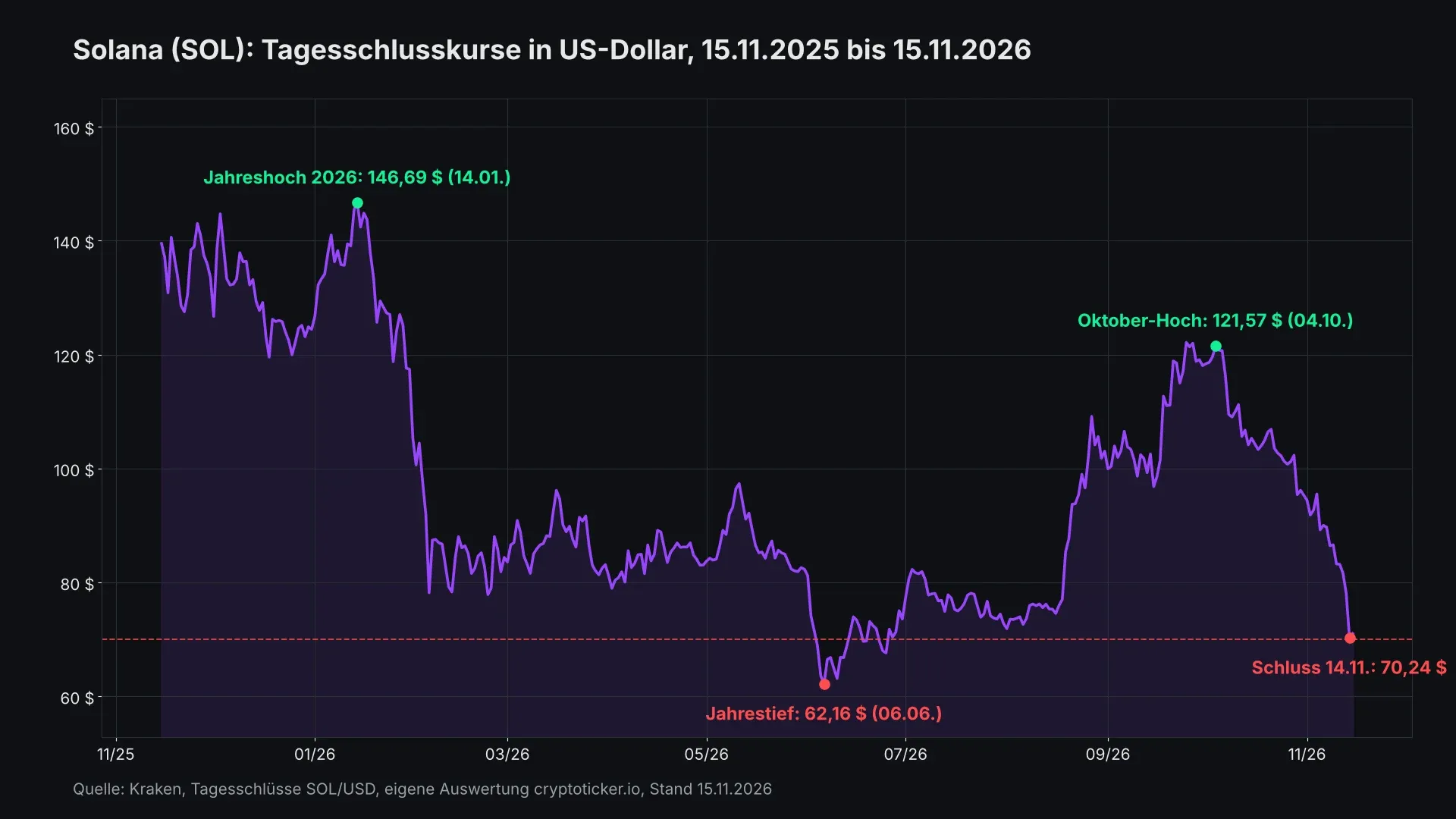
Saturday was Solana's weakest day in weeks. On Kraken, SOL closed November 14 at $70.24, after $78.09 the day before. That is a daily loss of a little over 10 percent and the lowest daily close since June 25, 2026, when the price ended at $67.61. The intraday low was $68.53. Around 667,000 SOL changed hands on Kraken that day, more than on any other day of the past ten days.
The decline continued overnight. At around 2 a.m. Central European Time, the price fell to $67.37. Solana last traded lower on June 26, 2026, when the daily low was $65.80. By the morning the price had recovered to around $71. According to CoinGecko, the gap to the all-time high of $293.31 from January 19, 2025, is 75.8 percent. With a market capitalisation of $42 billion, Solana ranks seventh among the largest cryptocurrencies.
cryptoticker.io compiled this analysis of the daily data itself on November 15, 2026. It is based on 721 daily closes and the hourly candles of the SOL/USD pair on Kraken.
Why is Solana falling? Rate fears, ETF outflows and liquidations
Three burdens are hitting the whole crypto market at once. The first is rate expectations. According to the CME FedWatch tool, cited by Bitcoin.com, the futures market is pricing a 25 basis point rate hike at the Fed's December meeting with a probability of 88.5 percent. Higher rates make risky assets less attractive, and cryptocurrencies are among them.
The second burden is outflows from exchange-traded funds. Net outflows from the US spot Bitcoin ETFs came to around $1.07 billion between November 9 and 13, Coinpaper reports, citing data from Farside Investors. The Solana funds are losing money too. According to SoSoValue, the US spot Solana ETFs reported a net outflow of $3.09 million for November 13, all of it from Fidelity's fund (FSOL), as KuCoin News summarises. Assets under management across all Solana ETFs then stood at $1.137 billion.
The third burden is leverage. A spot ETF is an exchange-traded fund that holds the coin itself; a liquidation, by contrast, is the forced sale of a leveraged position whose collateral has been used up. According to TokenPost, positions worth $691 million were liquidated in the hour in which Bitcoin fell below $64,000, $671 million of them on the long side. Over 24 hours, the sources give a range from around $1 billion (Bitcoin.com) to $1.47 billion (Coinpaper, citing CoinGlass). The Fear and Greed Index from alternative.me, a sentiment gauge running from 0 to 100, stands at 10 on Sunday, in the zone of extreme fear. How the individual causes interact is explained in our piece why is crypto down.
Breakpoint London 2026: what the Solana conference brings from today
Breakpoint runs from November 15 to 17 at the Olympia exhibition hall in west London. It is the first edition held in the United Kingdom; the Solana Foundation says it expects more than 8,000 attendees. The motto is "Token Supercycle". According to the programme overview from Coin Gabbar, the first day is devoted to stablecoins, payments and tokenised real-world assets, the second to AI agents and consumer applications. Tokenised real-world assets are securities, bonds or other assets represented as tokens on a blockchain.
The speaker list includes Solana co-founder Anatoly Yakovenko and Foundation president Lily Liu, as well as former British prime minister Boris Johnson, former chancellor Sajid Javid, Revolut chairman Martin Gilbert and Bitwise chief executive Matt Hougan, as announced by the Solana Foundation. The Foundation has not named any specific product announcements in advance. For investors, it is therefore an open question whether the conference will deliver news that moves the price.
Even before the start, Solana was trading well below key moving averages. Our Solana outlook from November 14 noted that the price stood around 15 percent below the 200-day line ahead of the conference. It has since lost a further 10 percent or so. On Friday evening we covered the break of the $72 level in our report Solana falls below $72.
Solana since the October high: from $121 to $71
The decline did not begin this week. On October 4, Solana still closed at $121.57 on Kraken, its highest daily close since February. Since then the price has lost around 42 percent. The 2026 high stands at $146.69 from January 14 and the low for the year at $62.16 from June 6, both based on daily closes. Intraday, the price had even fallen as low as $60.12 on June 6.
The chart shows how close Solana has come to that June low again. A little over 11 percent separates Saturday's close from the low for the year. Over the summer, the price moved in a range between roughly $70 and $80 before climbing above $100 in September.
If you want to buy or sell Solana through a regulated provider, you can find the terms in our comparison of the best crypto exchanges. For investors who prefer to invest through a fund, our overview shows how to buy crypto ETFs.
Solana open interest: fewer bets, but the longs stay
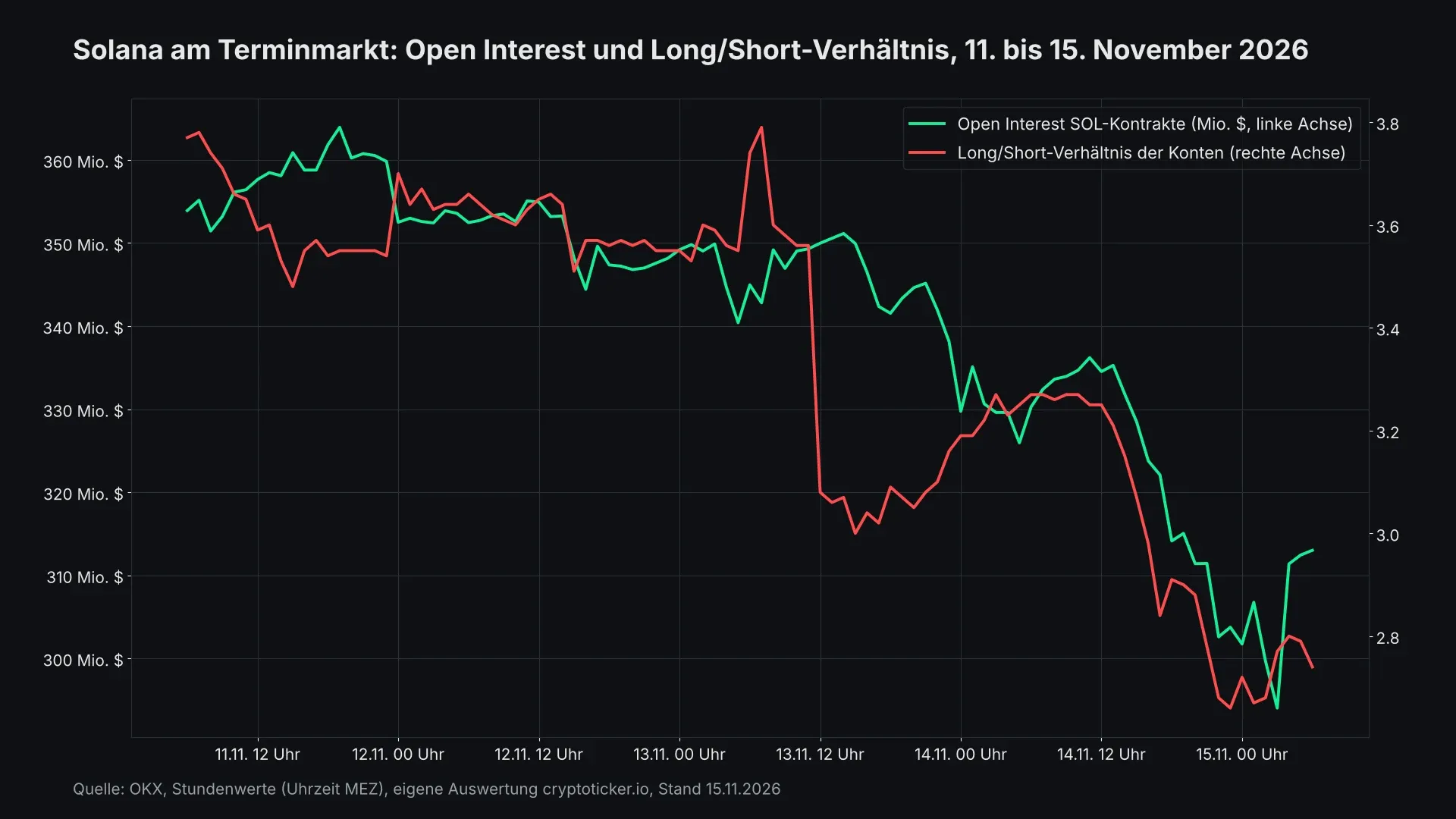
Open interest is the value of all open futures contracts on a coin. When it rises, new bets are being added; when it falls, positions are being closed or forcibly unwound. On the OKX exchange, open interest in Solana contracts stood at around $354 million at 6 a.m. Central European Time on November 11, and at $330 million at the same time on November 14. Overnight into Sunday it dropped to $294 million at around 3 a.m. and was back at $313 million by the morning.
The ratio of accounts stands out. The long/short ratio counts how many accounts are betting on rising prices compared with those betting on falling ones. On OKX it was 3.77 on November 11, 3.27 on Saturday morning and 2.74 on Sunday morning. For every account holding a short position, there are still almost three accounts holding a long. The crash has pushed some of the optimists out of the market, but the majority is still betting on a recovery.
At the same time, the funding rate, the balancing payment between the long and short sides of perpetual contracts, has turned negative. On OKX it most recently stood at minus 0.012 percent per eight-hour period for SOL-USDT. A negative value means the short side pays the long side, a sign that demand for short positions in the futures market has risen.
cryptoticker.io compiled this analysis of the derivatives data itself on November 15, 2026. It is based on 97 hourly readings from OKX for open interest and the long/short ratio, and on the funding history of the SOL-USDT contract.
Leverage on Solana: how long, short and the liquidation price work
When you trade Solana with leverage, you put up only part of the position's value as collateral, known as margin. A long position gains when the price rises, a short position gains when it falls. Leverage multiplies both, the profit and the loss. At ten times leverage, a 10 percent price move shifts the position by 100 percent, in either direction.
A worked example with the price on Sunday morning: a long position with 10x leverage, opened at $71, would be liquidated at around $63.90, ignoring fees and maintenance margin. That is only a little over 5 percent below the overnight low of $67.37. At 100x leverage, a decline of around 1 percent is enough, to roughly $70.30. In practice, the liquidation price sits slightly closer to the entry price because of the maintenance margin. Conversely, a short with 10x leverage opened at $78 on Friday would have returned around 136 percent on the stake at the overnight low.
Two tools limit the risk. A stop-loss closes the position automatically at a price set in advance, before the liquidation kicks in. Position size determines how much of your own capital is at risk in the first place. What long and short mean in detail is explained in our article long and short in crypto.
Will Solana fall below $60? The levels from the price history
The daily data from Kraken point to three levels on the downside. The first is the overnight low at $67.37. Below that is the area around $65.80, the low from June 26. The third level is the low for the year: $62.16 on a closing basis and $60.12 intraday, both from June 6, 2026. If Solana fell below that, the price would be at its lowest since early 2024.
On the upside, the $72 level, which the price broke on Friday evening, is the first hurdle. Above it lies the area around $78, the close from November 13. These levels are not a forecast. They show the prices at which traders have bought or sold over the past months and the points at which liquidations could cluster.
Trading Solana in Europe: MiCA exchanges, futures and CFDs
If you want to buy or sell Solana, or bet on a move, there are three routes in Europe. The simplest is to buy through a crypto exchange or a broker licensed under the EU's crypto regulation, MiCA. MiCA stands for Markets in Crypto-Assets and has governed across the EU since the end of 2024 which providers may trade and hold crypto assets for clients. Kraken and OKX, for example, list SOL. Which providers hold such a licence is shown in our overview of MiCA-regulated exchanges.
The second route is futures and perpetuals, derivatives contracts that let you go long and short with leverage. Perpetuals are futures contracts without an expiry date whose price stays tied to the spot price through the funding rate. They are offered by centralised exchanges and by decentralised trading venues, which are listed in our comparison of perp DEXs. The third route is CFDs, contracts for difference on the price, as offered on cryptocurrencies by CFD brokers such as XTB. A CFD only tracks the price movement; you do not own any coins.
CFDs are complex instruments and come with a high risk of losing money rapidly due to leverage. A high percentage of retail investor accounts lose money when trading CFDs. You should consider whether you understand how CFDs work and whether you can afford to take the high risk of losing your money.
Sell or hold Solana? Two scenarios after the crash
This article cannot and will not make a recommendation. It does help, though, to frame the situation in conditions that can be checked.
In the first scenario, the broader market calms down. Bitcoin stabilises, the wave of liquidations runs its course and Solana holds the zone between $66 and $68 on a daily closing basis. If Breakpoint also delivers announcements that convince investors, a recovery towards $78 would be possible. The high long/short ratio shows that many traders are betting on exactly that.
In the second scenario, the sell-off continues, driven by further ETF outflows or sharper rate expectations ahead of the Fed's December meeting. If Solana closes below $65.80, the low for the year at $62 comes within reach, and below that the $60 level. The many open long positions would accelerate such a break through forced selling. How investors in the Bitcoin market deal with the same question is covered in our article should you buy or sell bitcoin. What earlier downturns show is set out in our piece on the bitcoin bear market, and the conditions under which analysts expect a recovery are described in our article on the question will bitcoin go back up.
Whatever the scenario, anyone holding Solana with leverage should check their own liquidation price against the levels above. If you hold without leverage, you lose money if prices keep falling, but you will not be forced out of the position.
Weekend crypto crash: Bitcoin, Ethereum and the other altcoins
Solana is not alone this weekend. Our crypto news on the Bitcoin slide gives an overview of the day, the piece Why is Bitcoin falling? puts the causes in context, and we keep updating the latest on the crypto crash today. How deep the decline goes for Ethereum is shown in our article on the Ethereum crash, and Avalanche fell to around $7, as our piece on the Avalanche crash describes.
How much further Bitcoin could fall is covered in our article how low can bitcoin fall, and what the break of the 200-week moving average means is the subject of a separate piece. Long-term scenarios for a bitcoin price prediction 2027 are collected on our prediction page. How the decline fits into the picture across the other financial markets is shown in our overview of the stock market crash. How companies with large Bitcoin holdings are coping with the slump is examined in our article on Strategy stock. Whether the planned IPO of AI company Anthropic is drawing capital away from the crypto market is an open question among investors; what is known about the offering is on our page on Anthropic stock.
Solana after the crash: three points for Breakpoint week
- Note the levels. The overnight low of $67.37 and the June low of $62.16 will decide the next move; on the upside, $72 is the first hurdle. Providers that offer Solana are listed in our comparison of crypto exchanges.
- Recalculate your leverage. If you trade with leverage, work out your own liquidation price and set a stop-loss. Platforms for futures and CFDs are listed in our comparison of crypto brokers.
- Follow the conference. Announcements from Breakpoint until November 17 can move the price in either direction. For buying and selling without leverage, providers with a MiCA licence are a good fit; our overview of regulated crypto exchanges lists them.
(As of November 15, 2026. This article is not investment advice. Prices and fee structures change; check the terms with the provider before you buy.)
0
0

 Manage all your crypto, NFT and DeFi from one place
Securely connect the portfolio you’re using to start.


