
Ethereum price falls to $1,830, its lowest since July, as the Foundation sells 7,500 ETH

0
0

Ethereum fell to around $1,830 on Saturday evening, or roughly €1,660. According to CoinGecko, Ether lost 5.7 percent in 24 hours, with a daily low of $1,813 (as of November 14, 2026, 7:48 pm CET). On a daily closing basis, the price is now as low as it was last in mid-July. Two burdens are combining: the Ethereum Foundation has been selling ETH from its holdings for days, and US spot ETFs had lost money for six trading days in a row up to Thursday. These funds do not trade at the weekend, so new inflows or outflows will show up on Monday at the earliest.
Ether holders now have three questions to answer: how their purchase dates line up for tax purposes, whether a leveraged or loan position hangs on a liquidation level, and which price levels below $1,800 still hold. The answers follow further down; the numbers come first.
Ethereum price on Saturday: down 5.7 percent in 24 hours
The decline is part of a move that began on November 4. After the US midterm elections, Ether rose as high as $2,450, according to CryptoPotato. On November 9 the price fell below $2,100, and on Thursday the $2,000 mark gave way. Since November 4, the loss adds up to just over 25 percent.
CoinGecko data show the scale over longer periods: down 18.1 percent in seven days and 25.1 percent in 30 days. The price is now 63 percent below its record high of $4,946, reached on August 24, 2025. Ether's market capitalisation stands at around $224bn.
Bitcoin gave up 4.7 percent to about $65,600 over the same period. Ether thus fell harder than the largest cryptocurrency, a pattern often seen in downturns: the smaller and more volatile a market, the more strongly it reacts to selling pressure.
Ethereum Foundation sells 7,500 ETH in four days
The Ethereum Foundation is the Swiss non-profit organisation that funds development, research and grant programmes around the Ethereum blockchain. To do so, it holds a stock of ETH and regularly sells parts of it to cover expenses in dollars or stablecoins.
According to analytics service Onchain Lens, as picked up by CryptoPotato on Saturday, the Foundation sold 7,500 ETH worth around $14.5m in four days. The latest tranche comprised 2,500 ETH for about $4.7m, swapped for 4.597 million USDS via the CoWSwap trading platform. According to the report, the proceeds went to a Safe multisig wallet, a wallet whose transactions have to be approved jointly by several key holders.
Measured against daily trading volume, 7,500 ETH is a small amount. The effect lies more in the signal: when the organisation that develops the network sells into falling prices, many market participants read it as a lack of buying appetite at the source. What is documented, however, is only the sale itself, not any motive beyond covering expenses.
Spot Ether ETFs: six days of outflows, then a small gain
A spot Ether ETF is an exchange-traded fund that buys and holds real ETH. When money flows out, the issuer usually has to sell Ether; when money flows in, it buys more. That is why daily fund flows are considered one of the most direct gauges of institutional demand.
According to TokenPost, citing SoSoValue, US spot Ether ETFs lost a net $70.57m on November 12. On Friday, November 13, the picture narrowly turned: net inflows were $2.36m after six consecutive trading days of outflows. Fidelity's FETH took in $11.64m, while Grayscale's ETH lost $9.28m. Assets under management across all US spot Ether ETFs stood at $10.85bn, equal to 4.56 percent of Ether's market capitalisation.
Friday's small inflow did not support the price on Saturday. Because the US funds are closed at the weekend, a large buyer that could absorb selling pressure from the futures market is missing during these hours. The figures for Monday, November 16, will show whether the outflow streak has really ended. If you would rather invest through an exchange-traded product than in individual coins, our overview of crypto ETFs and ETPs in Germany lists the tradable variants.
Liquidations and leverage: why Ether falls harder than Bitcoin
A liquidation is the forced closure of a leveraged position once the posted collateral no longer covers the losses. Anyone betting on rising prices with fivefold leverage, for example, loses their collateral after a price drop of just under 20 percent, or slightly earlier depending on the exchange and fees.
Such forced sales amplify a downturn. Every closed long position is sold on the market, pushes the price down further and so triggers the next liquidation level. With Ether, this mechanism is particularly strong because a large share of trading runs through perpetual futures. These are futures contracts without an expiry date whose price stays tied to the spot price through a regular payment between buyers and sellers, the funding rate.
On top of that, Ether serves as collateral in the DeFi lending market. Anyone borrowing stablecoins against deposited ETH on platforms such as Aave has to add collateral when the price falls or is automatically partially liquidated. For holders of such a position, the health factor in the lending protocol is now the most important number: it shows how much further the price can fall before forced liquidation begins. If you trade Ether with leverage, it is best to compare collateral rules and fees at the decentralised perp exchanges first, because liquidation logic differs markedly between platforms.
Fear and Greed Index at 13: extreme fear in the crypto market
The Fear and Greed Index combines volatility, trading volume, sentiment and market dominance into a value between 0 and 100. According to alternative.me, it stands at 13 on Saturday, in the extreme fear zone, after 20 the day before.
Such a low reading describes the mood, not a direction. It can stay low for days while the price keeps falling. For investors, that means the index is a sign that panic selling is shaping the market, not a buy signal with a date attached.
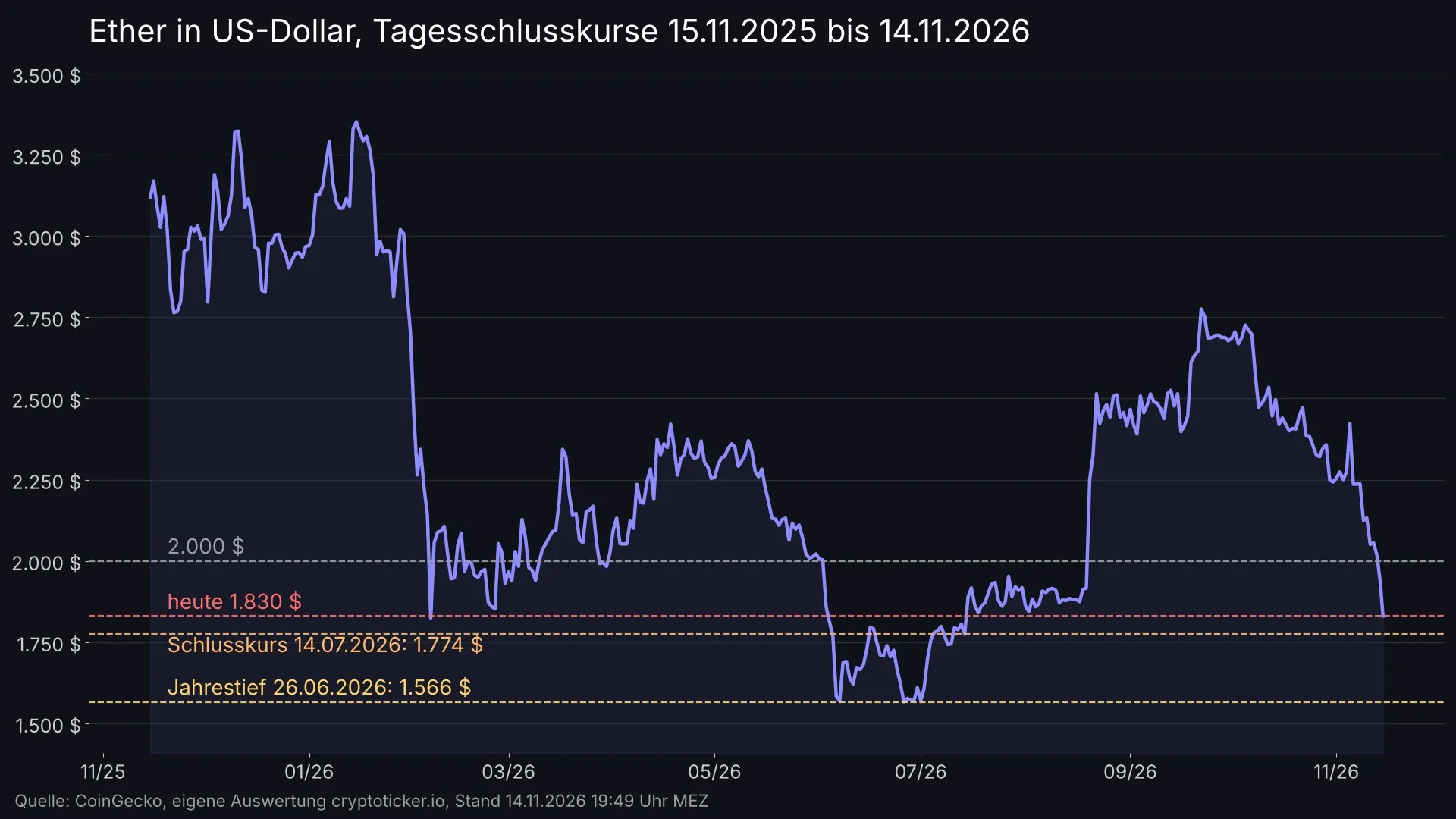
Ethereum chart over one year: the $1,774 and $1,566 levels
For the chart above, cryptoticker.io analysed CoinGecko daily closing prices for the period from November 15, 2025 to November 14, 2026. cryptoticker.io compiled this analysis itself on November 14, 2026. Three levels emerge from it:
- $1,774: the close of July 14, 2026, the last day Ether closed lower than today.
- $1,566: the yearly low of June 26, 2026. From there, Ether rose to around $2,775 by September 22.
- $2,000: the round number lost on Thursday. To the upside, it would be the first hurdle if the price recovers.
Investor and well-known crypto critic Peter Schiff sees the next stop only at around $1,600, where in his view an uptrend runs, according to CryptoPotato. If that breaks, he says, the next support is the 2022 low just below $1,000. That assessment is an opinion, not a forecast with a probability. The counter-evidence is in the same chart: in June the zone around $1,566 held, followed by a rise of just over 75 percent within three months.

Ether staking in a price slide: rewards in ETH, price risk in euros
Staking means depositing Ether to secure the network and receiving ongoing rewards in ETH in return. The yield is paid in Ether, not in euros. If the price falls 25 percent, an annual staking yield in the low single digits does not offset that loss.
If you stake Ether directly on the network, you also need to plan for an exit queue: the more validators leave at the same time, the longer it takes for the coins to become available again. Liquid staking tokens avoid the waiting time but sometimes trade at a discount to the Ether price in stress phases. Provider terms vary widely; our comparison of staking platforms sets out yields, lock-up periods and custody models side by side.
Buying Ether after the slump: MiCA licence and savings plan
If you want to use the decline as an entry point, check how you buy first. Since the European crypto regulation MiCA came into force, providers that trade or hold crypto assets for customers in the EU need a licence as a crypto-asset service provider. Whether an exchange holds this licence can be checked in the register of the European Securities and Markets Authority, ESMA. Which platforms are licensed and what they charge for ETH is listed in the crypto exchange comparison.
A savings plan spreads the entry over many dates and takes the question of the right day out of the decision. With a price that has lost a quarter in ten days, that is the calmer route for many retail investors than a single large purchase. Leveraged buying at the weekend, by contrast, is risky: liquidity is thinner, and price jumps in both directions are larger.
Custody is part of the decision too. Coins on an exchange sit in the provider's custody, while coins in a wallet of your own are under your control alone, including responsibility for the recovery phrase. How gains and losses on Ether are taxed depends on your country of residence; a crypto tax tool keeps a record of every tranche with its purchase date.
Ethereum price slide: three steps before ETF Monday
Until the next US trading day there will be no fund data, and the market trades without this anchor. Three steps can be taken beforehand:
- Check cost basis and purchase dates: Know when each of your Ether purchases was made and at what price. A crypto tax tool assigns every tranche.
- Secure leverage and loans: For open futures and DeFi loans, check the liquidation price and add collateral or reduce the position if needed. Platform terms are in the perp DEX comparison.
- Choose a licensed route to buy: If you want to buy more, use an exchange with a MiCA licence and compare fees and withdrawal rules first in the exchange comparison.
The levels for the coming days: to the downside, $1,774 as the last lower close and $1,566 as the yearly low; to the upside, $2,000 as the first hurdle. Monday's ETF figures and further sales by the Ethereum Foundation are the two data points that will help decide the direction.
(As of November 14, 2026. This article is not investment advice. Prices and fee structures change; check the terms with the provider before you buy.)
0
0

 Manage all your crypto, NFT and DeFi from one place
Securely connect the portfolio you’re using to start.
 Where will Ethereum trade next?
Live Polymarket and Kalshi odds on Ethereum price targets, compared side by side.
See Ethereum price odds


